 Petrochemical Insight
From PTA and MEG to Finished Yarn: The Polyester Fiber Value Chain Explained
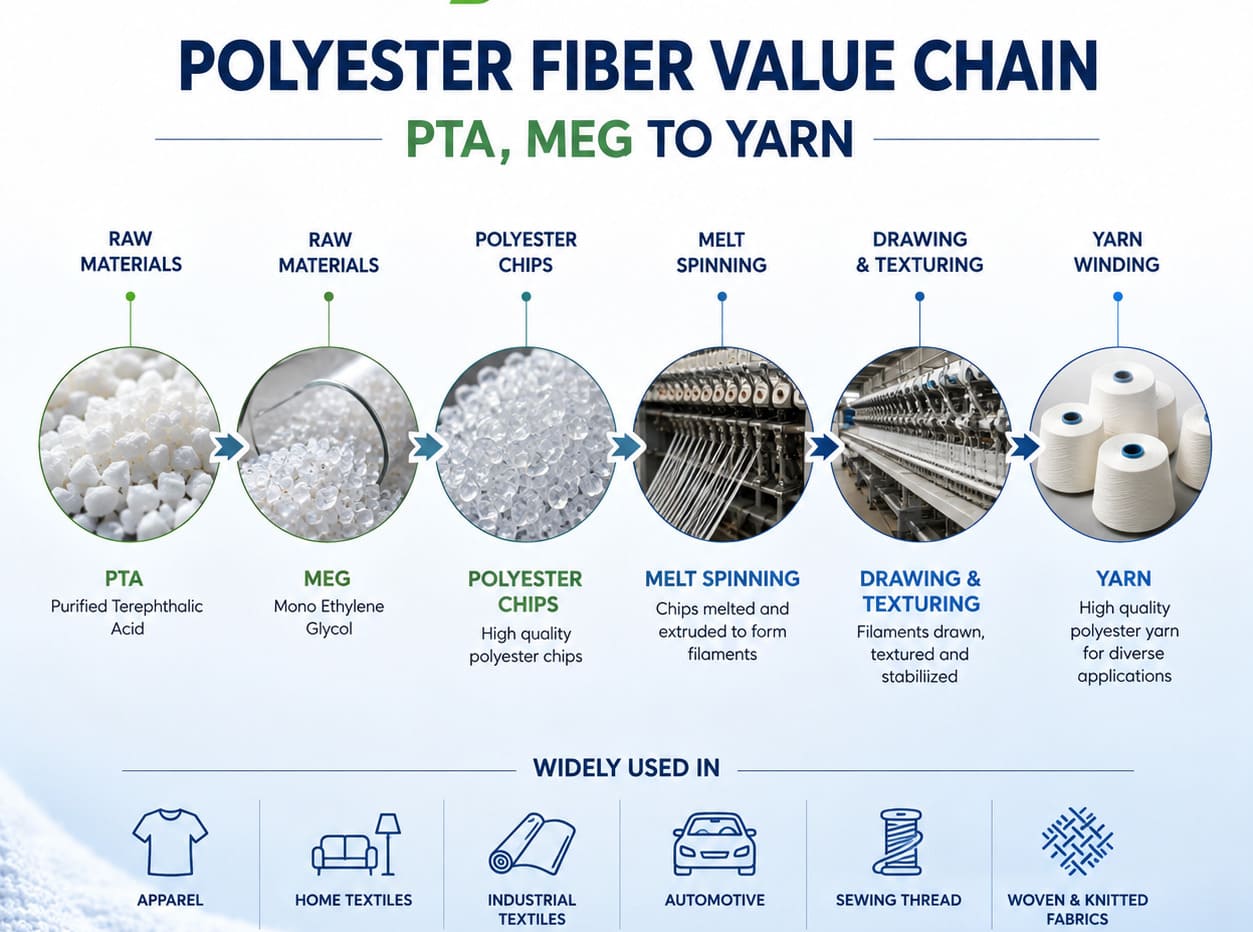
Polyester is the most widely produced synthetic fiber in the world, yet the yarn woven into fabrics, tire cord and nonwovens begins far upstream — in the refineries and petrochemical plants that supply the industry's raw building blocks. This article traces the polyester fiber value chain from petrochemical feedstock to finished yarn, and shows where base oils and specialty chemicals fit into the picture.
For companies that operate at different points along this chain — feedstock traders, chip producers, spinners and yarn exporters — knowing how each stage connects is not academic. It determines which grade to buy, which specification to quote, and where quality is won or lost. Below we walk through the four core stages, then explain the often-overlooked role of spin finish oils and base stocks.
Stage 1 — The petrochemical feedstocks: PTA and MEG
Every polyester molecule — chemically, polyethylene terephthalate (PET) — is built from just two petrochemical intermediates. The first is purified terephthalic acid (PTA), produced by oxidising paraxylene (PX), an aromatic hydrocarbon recovered from naphtha or refinery reformate. The second is monoethylene glycol (MEG), derived from ethylene, an olefin obtained by cracking naphtha or ethane.
These two intermediates sit at the heart of the polyester industry: roughly, it takes about 0.86 kg of PTA and 0.34 kg of MEG to make one kilogram of PET, though exact ratios depend on the process and are defined by each producer's specification. As a petrochemical trader, Sinolook handles feedstocks and intermediates in this family — including PTA, ethylene glycol and related glycol and glycol-ether products — supplying buyers who convert them further downstream.
Stage 2 — Polymerisation: from intermediates to PET chip
PTA and MEG react through esterification followed by polycondensation, building long PET polymer chains and driving off water. The molten polymer is then either cast and cut into PET chips or fed directly into a continuous spinning line.
The key property that emerges here is intrinsic viscosity (IV) — a measure of average molecular weight that dictates what the polymer can become. Lower-IV chip suits textile filament; higher-IV chip is reserved for bottle-grade and industrial applications. Because IV, moisture and additive content vary by producer, buyers should always work to the supplier's technical data sheet rather than a generic range.
Stage 3 — Melt spinning: POY and FDY
Molten polymer is forced through fine spinnerets, quenched in air, and drawn into continuous filaments. Two of the most traded outputs come from this stage:
- POY (Pre-Oriented Yarn) — partially drawn filament, most often used as feedstock for texturing into DTY.
- FDY (Fully Drawn Yarn) — fully drawn in one continuous process, producing a smooth, high-strength yarn ready for weaving and knitting.
Both are specified by denier (linear density), filament count, lustre (raw white, semi-dull, dope-dyed) and tenacity — parameters that a buyer must match precisely to the target fabric.
Stage 4 — Texturing: turning POY into DTY
To give flat POY the bulk, stretch and softness that garments demand, it is run through a false-twist texturing process to become DTY (Draw Textured Yarn). Alongside DTY, FDY and POY, the wider chemical fiber family also includes polyester staple fiber (PSF) for spinning and nonwovens, and poly-cotton (TC/CVC) blended yarns that pair polyester's durability with cotton's comfort.
This is the point where petrochemical feedstock finally becomes a shippable textile product. Specialist exporters bridge the gap between Chinese fiber mills and global weavers and knitters — for example, polyester yarn exporter Yaakan Chemical Fiber, a Xiamen-based supplier of DTY, FDY, POY, staple fiber and poly-cotton blends to buyers across more than fifty countries. It is the natural downstream counterpart to the feedstock and base-oil trade described here.
The base-oil connection: spin finish oils
There is one input that runs quietly through Stages 3 and 4 but rarely reaches the headlines: spin finish oils, also called textile fiber lubricants. As filaments are spun, drawn and texturised at high speed, they are coated with a thin finish that controls friction, dissipates static and binds filaments into a coherent yarn. Without it, modern high-speed spinning simply would not run.
These finishes are formulated systems — typically a lubricant base combined with emulsifiers, antistatic agents and other functional additives. It is precisely the domain where the lubricant industry meets the fiber industry, and where Sinolook's core expertise sits. As the exclusive China distributor of ADNOC Group III base oil and a supplier of Group I, II and III base stocks, naphthenic oils and a full range of lubricant additives, Sinolook supplies the building blocks that blenders draw on across many specialty-oil applications.
Why the whole chain matters to buyers
Reading the polyester fiber value chain end to end gives a procurement team three practical advantages:
- Cost intelligence. Yarn prices ultimately move with PX, PTA, ethylene and MEG. Watching the feedstock lets buyers anticipate rather than react.
- Specification discipline. IV at the chip stage, denier and filament count at the yarn stage, and finish chemistry at the spinning stage all cascade into final fabric performance.
- Sourcing clarity. No single company spans every link. Knowing who does what — feedstock trader, chip maker, spinner, yarn exporter — makes for cleaner, more traceable supply.
Where Sinolook sits
To be clear about our own position: Sinolook is a petrochemical trader and distributor, not a fiber manufacturer. Our focus is the upstream end of this chain — base oils (including exclusive ADNOC Group III / ADbase distribution in China since 2020, plus Group I, II and naphthenic grades), lubricant additives, and petrochemical intermediates such as PTA and ethylene glycol. For the downstream fiber and yarn end — DTY, FDY, POY, staple fiber and blended yarns — we're glad to point readers toward dedicated chemical fiber and polyester yarn specialists who serve that market directly.
Frequently asked questions
What is the difference between POY, FDY and DTY yarn?
POY (Pre-Oriented Yarn) is a partially drawn filament used mainly as feedstock for texturing. FDY (Fully Drawn Yarn) is drawn in one continuous step into a smooth, high-strength yarn ready for weaving and knitting. DTY (Draw Textured Yarn) is POY that has been false-twist texturised to add bulk, stretch and softness. Each is specified by denier, filament count and lustre.
Which petrochemical feedstocks are used to make polyester fiber?
Polyester (PET) is polymerised from two intermediates: purified terephthalic acid (PTA), made from paraxylene, and monoethylene glycol (MEG), made from ethylene. Both trace back to naphtha and other refinery streams, which is why polyester fiber pricing is closely linked to the wider petrochemical market.
What are spin finish oils and why do they matter?
Spin finish oils, or textile fiber lubricants, are thin coatings applied to filaments during spinning and texturing. They control friction, dissipate static electricity and give the yarn cohesion, allowing high-speed processing without breaks. They are typically formulated from a lubricant base combined with emulsifiers, antistatic agents and other additives.
Does Sinolook manufacture or sell polyester yarn?
No. Sinolook is a petrochemical trader and distributor focused on base oils, lubricant additives and petrochemical intermediates — the upstream end of the value chain. For finished polyester yarn such as DTY, FDY and POY, we recommend dedicated polyester yarn and chemical fiber exporters who specialise in that segment.
What is intrinsic viscosity (IV) in PET chip?
Intrinsic viscosity is a measure of a polymer's average molecular weight. In PET, it indicates whether the chip is suited to textile filament (lower IV) or to bottle-grade and industrial uses (higher IV). Because IV and other properties vary by producer, buyers should always confirm against the supplier's technical data sheet.
Talk to Sinolook about base oil & petrochemicals
Exclusive ADNOC Group III distribution in China, plus Group I/II, naphthenic base oils, additives and petrochemical intermediates — exported to 60+ countries.
Email info@sinolook.com WhatsApp us