 Safety & Storage
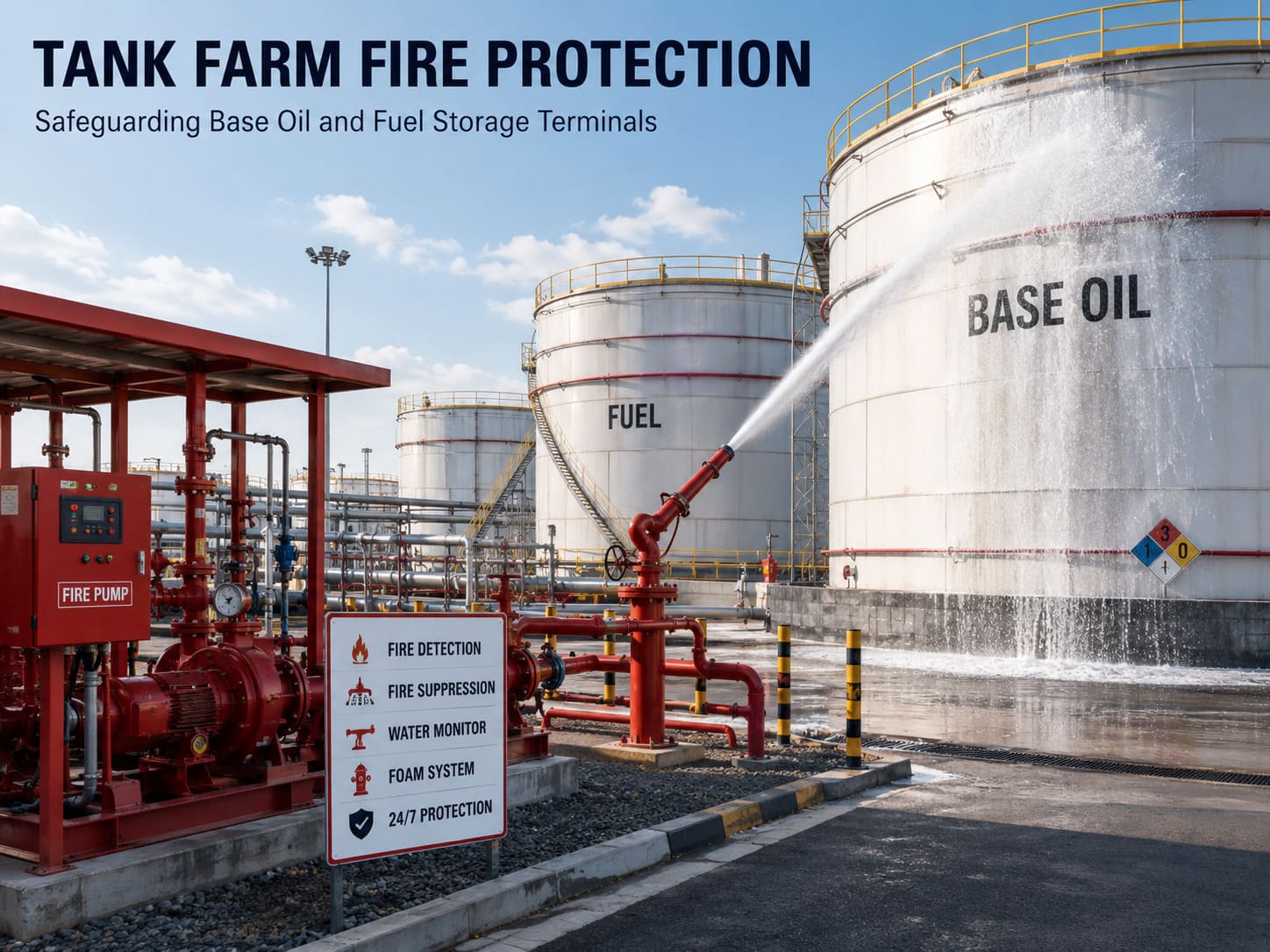
Tank Farm Fire Protection: Safeguarding Base Oil and Fuel Storage Terminals
A base oil or fuel storage terminal spends most of its life doing nothing dramatic — but the one event it must never fail to handle is fire. Because the products stored are flammable hydrocarbons, tank farm fire protection is not an optional extra; it is the discipline that lets a terminal exist at all. This article explains how petrochemical storage terminals are defended, from containment to foam-water suppression.
For any company that stores, blends or exports petroleum products, the stakes are unusually clear: a single ignited tank can threaten an entire facility, its neighbours and its people. Understanding how the layers of protection work together helps operators, buyers and partners judge whether a terminal is genuinely safe to work with.
Why hydrocarbon storage is a fire hazard
Base oils, fuels and solvents are Class B flammable liquids — the fire class defined by burning liquids rather than solids. What actually burns is not the liquid itself but the vapour it gives off above its surface. Once a liquid is warmer than its flash point, enough vapour is present to ignite from a spark, a hot surface or static discharge.
In a tank farm, that risk takes several forms:
- Full-surface tank fires — the entire exposed liquid surface of an open or damaged tank alight.
- Rim-seal fires — a fire around the seal of a floating-roof tank, the most common tank fire.
- Bund (dike) fires — a spill ignited inside the containment area around the tanks.
- Radiant heat exposure — a fire in one tank heating adjacent tanks toward their own ignition point.
Defence in depth: layered tank farm fire protection
No single device makes a terminal safe. Modern terminal fire defence is built as overlapping layers, so that if one fails the next still holds:
- 1. Containment — bunds, dikes and impervious paving keep any spill inside a defined area, away from other tanks and drains.
- 2. Detection — flame, heat and gas detectors linked to an alarm system raise the alert before a small event becomes a large one.
- 3. Cooling — fixed water-spray and deluge systems keep exposed tank shells below the temperature at which they weaken or ignite.
- 4. Suppression — foam systems and fire monitors deliver foam onto the burning surface to cut off the vapour and extinguish the fire.
Foam: the medium that stops a Class B fire
Because flammable-liquid fires are fought by cutting off vapour, firefighting foam is the primary extinguishing medium at a tank farm. Foam is a stable blanket of air-filled bubbles that floats on the fuel surface, sealing in vapour, blocking oxygen and cooling as its water content drains. Delivered correctly, it suppresses the fire and — just as importantly — prevents re-ignition.
Foam is generated by mixing a measured dose of Class B foam concentrate into the water stream through a proportioner, then aspirating air at the nozzle. The concentrate type and application rate are set by the hazard and the governing standard, so this part of the system is engineered rather than improvised.
Fire monitors: the workhorse of tank farm suppression
The device that actually projects that foam onto a burning tank is the fire monitor — a high-flow, long-range nozzle mounted on a fixed base, a riser or a mobile carriage. Positioned around the tank bund, monitors let responders attack a fire from a safe distance, with a throw long enough to reach across a large-diameter tank.
For petrochemical storage, foam-water fire monitors are specified over water-only types, because they can switch between a foam blanket for the burning surface and a water stream for cooling. Typical industrial units deliver flows in the range of 1,200–4,800 LPM with a reach of up to around 85 metres — enough to protect sizeable tanks from outside the hazard zone.
Where personnel should never be present during a fire — the interior of a tank bund, an LNG berth, a hazardous unmanned zone — operators turn to explosion-proof remote-control fire monitors. These are aimed and discharged from a safe control point or wirelessly, removing the operator from the line of radiant heat entirely. Detection-linked automatic monitors extend the same idea to fully unattended suppression of large spaces.
The standards that govern it
Protection on this scale is not designed by intuition; it follows established codes. Foam systems and application rates are set out in NFPA 11, water-spray cooling in NFPA 15, and the storage and handling of flammable liquids in NFPA 30. Industry guidance from the American Petroleum Institute — notably API 2021 on fighting fires in and around storage tanks — and national codes such as GB 50151 in China round out the framework. A credible terminal can point to the standards its systems are built to, and to the inspection records that prove they are maintained.
How Sinolook handles storage
Sinolook operates as a petrochemical trader and distributor, moving base oils, fuels and intermediates through storage terminals in Nantong, Yingkou and Guangdong, as well as a network of overseas storage partners. Product integrity and safe handling sit at the centre of that operation:
- High-quality oil storage tanks under customs control, dedicated to keeping products free of contamination.
- Independent SGS inspection of shore tanks before loading and after discharge, with the tanks sealed after passing.
- Dedicated, cleaned pipelines used for loading and discharge so that no cross-contamination occurs.
- Traceable records at every step, and terminal support available around the clock.
To be clear on scope: Sinolook trades and stores petroleum products — it does not manufacture fire-fighting equipment. The fixed and mobile systems described above are supplied and installed by dedicated fire protection specialists, working to the standards above.
Frequently asked questions
Why do petrochemical tank farms use foam instead of just water?
Base oils, fuels and solvents are Class B flammable liquids. Plain water can sink beneath a burning hydrocarbon or spread it, whereas firefighting foam floats on the surface, seals in flammable vapour and smothers the fire. Water is still used at a tank farm — but for cooling adjacent tanks and structures, not for extinguishing the flammable-liquid surface itself.
What is a fire monitor and where is it used in a tank farm?
A fire monitor is a high-flow, long-range nozzle that projects water or foam onto a fire from a distance, mounted on a fixed base, riser or mobile carriage. In a tank farm it is positioned around the bund so responders can attack a tank fire from a safe distance. Foam-water and explosion-proof remote-control models are used so that flammable surfaces can be foamed and, where needed, operators kept out of the hazard zone.
What standards govern fire protection at a tank farm?
Foam systems follow NFPA 11, water-spray cooling follows NFPA 15, and flammable-liquid storage follows NFPA 30. API guidance such as API 2021 covers fighting fires in and around storage tanks, and national codes such as GB 50151 apply in China. Application rates, foam types and equipment are all specified by these documents rather than chosen ad hoc.
Does Sinolook supply fire-fighting equipment?
No. Sinolook is a petrochemical trader and distributor of base oils and intermediates, and operates storage terminals for those products. Fire monitors, foam systems and other fire protection equipment are supplied by dedicated manufacturers — for example, specialist fire monitor and foam system suppliers who build to NFPA and API standards.
How are base oils stored safely before export?
Base oils are held in dedicated, customs-controlled tanks and moved through cleaned pipelines to prevent contamination. Shore tanks are inspected by an independent surveyor such as SGS before loading and after discharge, and sealed once they pass. Every step is recorded so the product's quality and history remain traceable from tank to shipment.
Source base oil & petrochemicals from a disciplined supplier
Exclusive ADNOC Group III distribution in China, plus Group I/II, naphthenic base oils and petrochemical intermediates — stored, inspected and shipped to 60+ countries.
Email info@sinolook.com WhatsApp us