 Materials & Chemistry
The Petrochemistry of High Pressure Laminate: What Goes Into the Surface
The worktops, cabinet doors and wall panels around us are often finished in high pressure laminate — a surface prized for being tough, hygienic and endlessly decorative. What is far less visible is that this everyday material is, at heart, a product of the petrochemical industry. This article looks at how HPL is made, and at the petrochemical inputs that a laminate line quietly depends on.
For a petrochemical supplier, laminate is a useful example of how far downstream our industry reaches: the same broad chemistry that yields base oils, waxes and solvents also underpins the thermoset resins and processing aids behind a decorative panel. Understanding that connection helps buyers on both sides see where their supply chains overlap.
What is high pressure laminate?
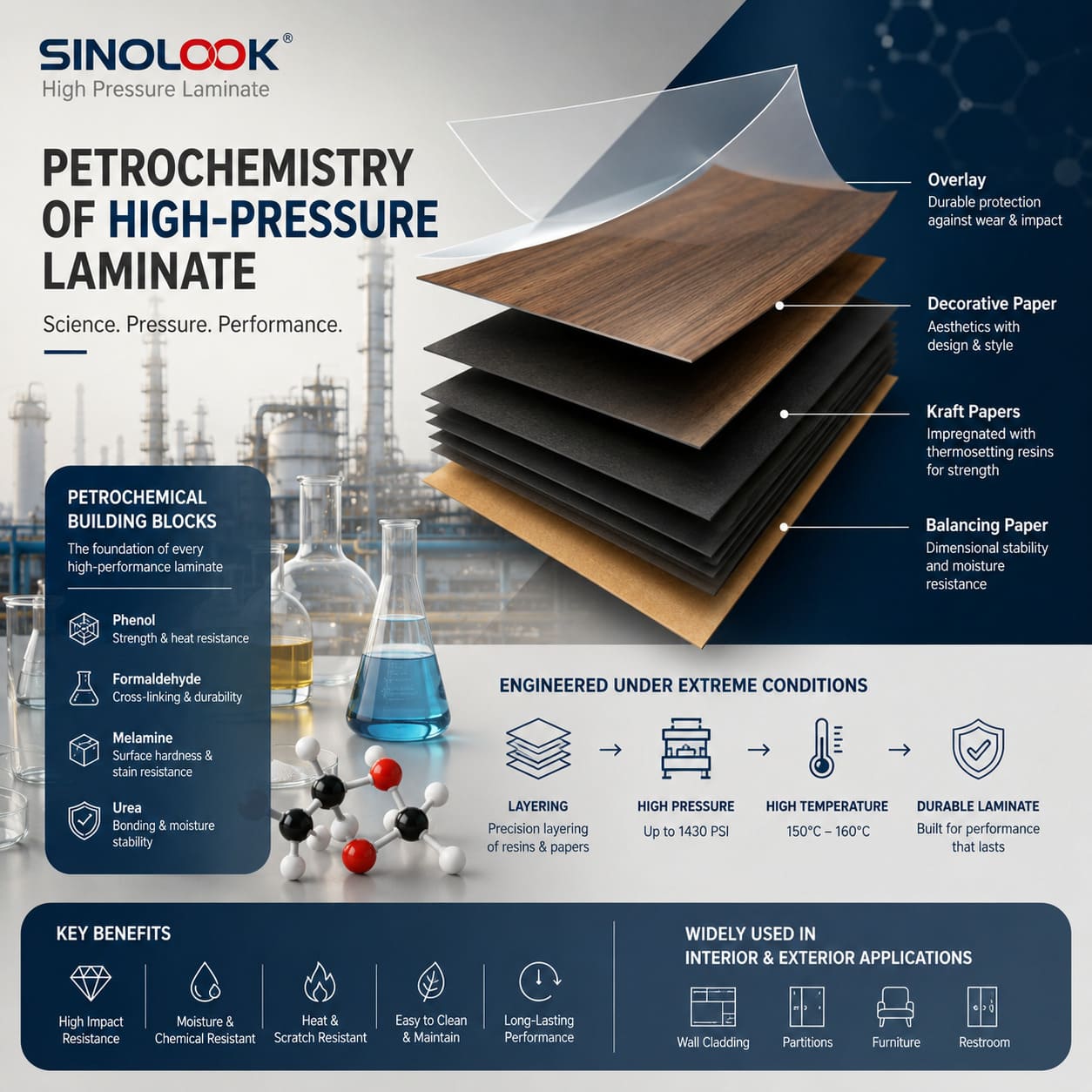
High-pressure laminate — usually shortened to HPL — is a dense decorative surface built from several layers of resin-saturated kraft paper, a printed décor sheet and a clear protective overlay. These layers are fused together at around 150 °C under more than 1,400 psi (roughly 7 MPa) of pressure, which is exactly where the material gets its name. The result is a single hard panel that resists scratches, heat, moisture and years of wear, and its properties are defined internationally by standards such as ISO 4586 and EN 438.
Thin HPL sheets, typically 0.6–1.2 mm thick, are bonded onto a substrate such as MDF or plywood; thicker compact boards are self-supporting. The finished product is manufactured by specialists — for instance, Xiamen-based high pressure laminate manufacturer Golden Ricky, which produces decorative, compact, fire-rated and specialist grades in over a thousand surface designs. Our interest here is one step further back: what the laminate and its production line are actually made of.
The petrochemical backbone: thermoset resins
What holds an HPL panel together is not glue but thermoset resin soaked into the paper and cured under heat. The kraft core layers are impregnated with phenolic (phenol-formaldehyde) resin, while the décor sheet and overlay use melamine (melamine-formaldehyde) resin for a clear, hard, stain-resistant surface. Once cured, these resins cross-link irreversibly — they cannot be re-melted, which is why the panel stays rigid and heat-resistant.
Every one of those resins traces back to petrochemistry. Phenol is derived from benzene and propylene; formaldehyde comes from methanol; melamine is built up from urea. In other words, the decorative surface on a kitchen worktop begins its life in the same aromatics-and-olefins streams that feed much of the chemical industry. The laminate itself is a downstream, high-value expression of those building blocks.
The processing aids a laminate line depends on
Beyond the resins, a working laminate plant relies on a range of petrochemical-derived inputs — the parts of the supply chain where a trader like Sinolook is most active. None of these ends up as the visible surface, but without them the line does not run:
- Release waxes. Paraffin and microcrystalline waxes act as release and anti-blocking agents so that cured panels part cleanly from press plates, and paraffin-wax emulsions give the MDF and particleboard substrates their moisture resistance.
- Press and hydraulic lubricants. The high-pressure presses and their hydraulic systems run on lubricants and hydraulic fluids formulated from base oils — the same base stocks used across industrial lubrication.
- Solvents and glycol ethers. Cleaning of plates and equipment, and the adhesives and coatings used to bond and finish panels, draw on industrial solvents, white spirit and glycol ethers.
Seen this way, a laminate factory sits inside the same petrochemical ecosystem as a lubricant blender or a coatings maker — it simply uses those inputs to make a surface rather than an oil.
Why the chemistry delivers performance
The reason HPL resists heat, scratches, moisture and even many chemicals comes straight from that cured thermoset structure. Cross-linked phenolic and melamine networks are dense and chemically stable, so the surface does not soften with heat or dissolve in everyday cleaning agents. Specialist grades push this further: chemical-resistant compact boards are engineered to withstand acids, alkalis and solvents in laboratories, as offered in ranges such as this chemical-resistant compact HPL. Understanding the resin chemistry is what lets a specifier match the right grade to the right environment.
Where Sinolook fits
To be clear about scope: Sinolook is a petrochemical trader and distributor — we do not manufacture laminate, nor the phenolic and melamine resins at its core. What we supply are the adjacent petrochemical products that serve surfacing, coatings and processing industries broadly: paraffin and microcrystalline waxes, base oils and industrial lubricant inputs, and solvents and glycol ethers. As the exclusive China distributor of ADNOC Group III base oil, and a supplier of Group I/II, naphthenic base oils and petrochemical intermediates to more than sixty countries, our role is upstream of the finished panel. For the laminate itself, dedicated HPL manufacturers are the right partners.
Frequently asked questions
What resins are used to make HPL?
The kraft paper core is impregnated with phenolic (phenol-formaldehyde) resin, and the décor sheet and clear overlay use melamine (melamine-formaldehyde) resin. Both are thermosets that cure permanently under heat and pressure, giving the panel its hardness, heat resistance and durability. All of these resins are ultimately derived from petrochemical feedstocks.
Is HPL a petrochemical product?
Indirectly, yes. While the visible layers are paper, the resins that bind and protect them — phenolic and melamine — are made from petrochemical building blocks such as benzene, propylene, methanol and urea. The production line also relies on petrochemical-derived waxes, lubricants and solvents. So HPL is best understood as a downstream product of the petrochemical industry.
What are release waxes used for in laminate production?
Release and anti-blocking waxes — typically paraffin and microcrystalline grades — help cured laminate part cleanly from the press plates and stop panels sticking together. Separately, paraffin-wax emulsions are added to MDF and particleboard substrates to improve their moisture resistance. Both are common petrochemical-derived inputs in panel manufacturing.
Does Sinolook manufacture HPL?
No. Sinolook is a petrochemical trader and distributor of base oils, waxes, solvents and intermediates. We supply inputs used across the wider surfacing and coatings supply chain, but we do not make laminate or laminating resins. For finished HPL, we recommend dedicated HPL manufacturers who specialise in decorative panels.
Why is HPL so resistant to heat and chemicals?
Because its resins are thermosets. When phenolic and melamine resins cure, they form a dense, cross-linked network that cannot be re-melted and is chemically stable. That structure is what lets the surface shrug off hot pans, cleaning agents and daily wear, and it is enhanced further in chemical-resistant compact grades made for laboratories.
Source waxes, base oils & petrochemicals from Sinolook
Paraffin & microcrystalline wax, Group I/II/III base oils, naphthenic oils, solvents and intermediates — exclusive ADNOC Group III distribution in China, exported to 60+ countries.
Email info@sinolook.com WhatsApp us