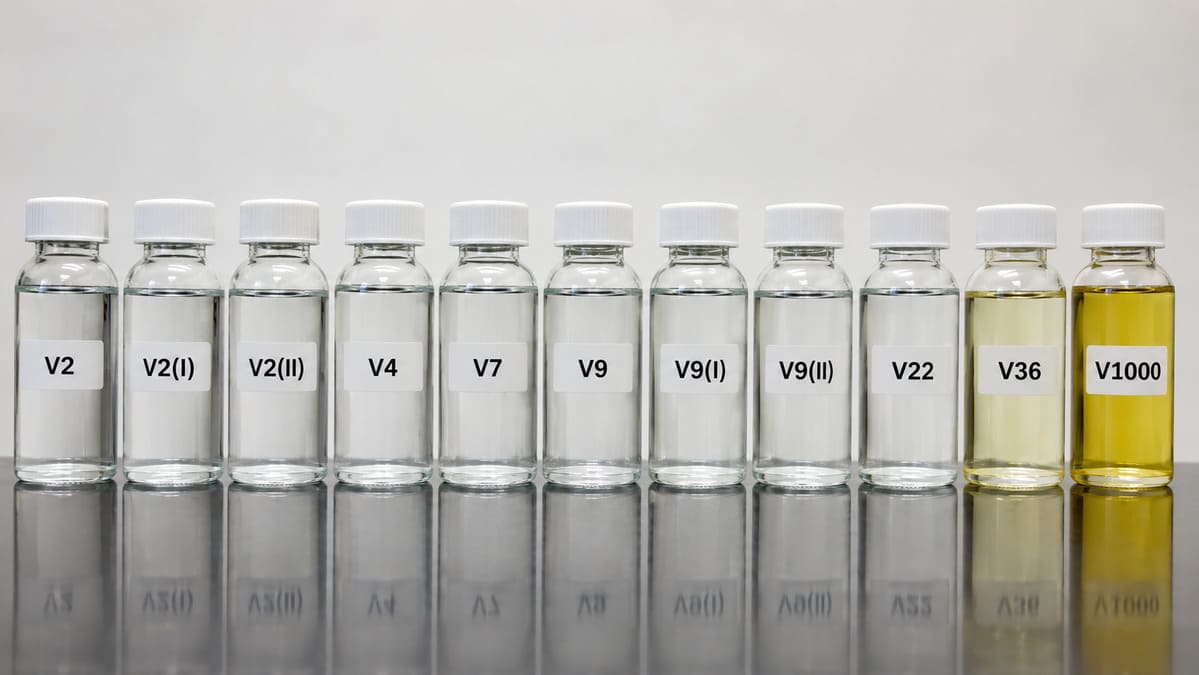
When most people talk about base oil, they mean paraffinic base oil — the Group I, II and III mineral oils that go into engine oils, hydraulic fluids and gear oils. But there's a whole other world of base oil that powers transformer oil, rubber compounding, refrigeration systems, metal-working fluids and many other specialty applications. That world is naphthenic base oil.
If you're new to the topic, you may want to start with our overview of the five API base oil groups. This article goes deep on naphthenic — what makes it chemically different, what grades are available, and which applications need it.
What is naphthenic base oil?
Naphthenic base oil is a specialty mineral base oil refined from crude oils that are naturally rich in cyclic saturated hydrocarbons — called naphthenes — rather than the straight-chain and branched paraffins that dominate ordinary mineral base oils.
Under the API 1509 classification, naphthenic base oil falls under Group V, the catch-all category for base oils that don't fit Groups I to IV.
It's still mineral oil — refined from crude, not synthesized in a chemical plant. But the molecular composition is fundamentally different from Group I, II and III. That difference is what gives naphthenic oil its unique properties.
Naphthenic base oil isn't "better" or "worse" than paraffinic — it's different. It excels at applications where paraffinic oil physically can't compete: very low temperatures, rubber compounding, dissolving polar additives.
Naphthenic vs paraffinic: the core difference
The difference comes down to molecular shape:
- Paraffinic oils (Group I, II, III) — long, straight or branched chains of carbon atoms. Like spaghetti. These chains can align and pack together when cooled, which is why paraffinic oils have moderate pour points (typically −6 to −24°C).
- Naphthenic oils — saturated ring structures (cyclohexane-type). Like donuts. The ring geometry physically cannot pack into ordered crystals, so naphthenic oil stays liquid at extreme cold — some grades flow even below −70°C.
| Property | Paraffinic (Group I–III) | Naphthenic (Group V) |
|---|---|---|
| Molecular structure | Straight/branched chains | Cyclic saturated rings |
| Pour point | −6 to −24 °C typical | −30 to below −70 °C |
| Viscosity Index | High (90 to 150) | Low to moderate (negative to 80) |
| Solvency | Limited | Excellent |
| Aniline point | High (95 to 110 °C) | Low (70 to 95 °C) |
| Density | Lower (0.84 to 0.89) | Higher (0.85 to 0.93) |
| Best for | Engine oils, gear oils, hydraulic | Transformer, rubber, refrigeration, MWF |
Five properties that define naphthenic oil
1. Ultra-low pour point
This is naphthenic oil's signature property. Light grades have pour points below −60°C, with V2(II) flowing below −70°C. No paraffinic base oil can match this — it's why naphthenic oil dominates arctic transformer oil and ammonia refrigeration applications.
2. Excellent solvency
The cyclic structure and slight residual aromatic content make naphthenic oil dissolve polar additives, resins, and elastomers much better than paraffinic oils. This is why naphthenic is the workhorse for rubber process oil — it softens and integrates with the rubber compound during mixing.
3. Low aniline point
Aniline point (ASTM D611) is a measure of solvency — lower aniline point means higher solvent power. Naphthenic oils typically run 70–95°C, vs paraffinic at 95–110°C. This matters for rubber process oil (elastomer swell), printing inks (resin solubility) and additive carriers.
4. Higher density
Cyclic molecules pack tighter than straight chains, giving naphthenic oils density around 0.85–0.93 g/mL, compared to paraffinic 0.84–0.89. This affects how the finished fluid behaves in centrifugal separation, dielectric performance, and rubber swell ratios.
5. Naturally low viscosity index — and why that's OK
Naphthenic oils have low VI by design — for the specialty applications they serve, VI stability across wide temperature ranges isn't the priority. A transformer oil sitting in a substation doesn't see the −30 to +130°C swing that an engine oil sees. Low VI is a feature, not a bug, when low pour point and high solvency matter more.
Viscosity grades: V2 to V1000
Naphthenic base oils are typically labeled by a V grade number that approximates the kinematic viscosity at 40°C in mm²/s. Sinolook supplies all common grades:
| Tier | Grades | KV @ 40°C | Pour point | Typical use |
|---|---|---|---|---|
| Light | V2, V2(I), V2(II), V4 | 1.5 – 4 mm²/s | −50 to <−70 °C | Refrigeration, transformer (V4) |
| Medium-light | V7, V9, V9(I), V9(II) | 7 – 10 mm²/s | −48 to −54 °C | Transformer (V7), MWF, hydraulic |
| Medium-heavy | V22, V36, V100 | 22 – 100 mm²/s | −30 to −50 °C | Rubber process oil, inks, adhesives |
| Heavy | V1000 | ~1014 mm²/s | −4 °C | Heavy RPO, asphalt extender |
Four main applications
Naphthenic base oil dominates four specialty markets where paraffinic alternatives can't match the required performance:
Transformer oil & insulating fluid
Light naphthenic grades meet IEC 60296 specs for electrical insulating oil — very low pour point for cold-climate substations, high dielectric strength, excellent oxidation resistance. Used in distribution and power transformers worldwide.
Rubber process oil (RPO)
The largest naphthenic application globally. Used in tyre treads, EPDM weather seals, NBR oil seals and SBR/CR rubber compounding. Naphthenic RPO outperforms paraffinic for low-temperature flexibility, mixing behaviour and elastomer compatibility — V100 is the global workhorse for tyre compounding.
Refrigeration oil base stock
One of the original refrigeration oil base stocks — especially for ammonia (NH₃) refrigeration in industrial chillers, food processing and cold storage. Light grades V2 and V4 have ultra-low pour point and good miscibility with mineral-compatible refrigerants.
Metal-working fluid, inks & specialty lubes
High solvency makes naphthenic ideal for soluble cutting fluids, neat cutting oils, quenching oils, drawing compounds, printing inks (offset, screen), adhesives, sealants, and as a carrier in specialty industrial chemicals.
How to choose the right grade
Choosing a naphthenic grade comes down to matching viscosity to your application's operating range:
- If you need ultra-low temperature performance (refrigeration, arctic transformer) → V2, V2(II), V4
- If you need transformer-grade dielectric performance → V4, V7
- If you need rubber process oil for tire/EPDM/NBR → V22, V36, V100 (V100 is the most widely used)
- If you need heavy plasticizer or high-Mooney rubber processing → V1000
- If you need general industrial lubricant or MWF base → V9, V22
Always request a typical-value data sheet (TDS) and run formulation testing — different naphthenic sources may have slightly different aromatic content (CA), affecting elastomer swell and additive solubility.
Sinolook supplies all 12 naphthenic base oil grades
From light V2 (KV40 = 1.5) for refrigeration oil to heavy V1000 for rubber compounding — our complete portfolio covers every naphthenic application, with SGS verification on every shipment.
Explore Naphthenic Base OilFrequently asked questions
What is naphthenic base oil?
Naphthenic base oil is a specialty mineral base oil refined from crude oils rich in cyclic saturated hydrocarbons (naphthenes), rather than the straight-chain paraffins that dominate Group I, II and III base oils. This different molecular structure gives naphthenic oil very low pour point, excellent solvency, low aniline point and higher density — making it the preferred base stock for transformer oil, rubber process oil, refrigeration oil and many specialty industrial fluids.
What is the difference between naphthenic and paraffinic base oil?
Paraffinic (Group I, II, III) contains mostly straight-chain and branched paraffin molecules — high VI, moderate pour point, limited solvency.
Naphthenic contains cyclic saturated hydrocarbons — very low pour point (as low as −70°C), excellent solvency, low aniline point, higher density, naturally low VI.
Paraffinic dominates engine oils and general lubricant blending. Naphthenic dominates specialty applications: transformer oil, rubber process oil, refrigeration oil, metal-working fluids.
What is naphthenic base oil used for?
Four main application areas:
1. Transformer oil and electrical insulating fluids (IEC 60296)
2. Rubber process oil for tyre treads, EPDM weather seals, NBR oil seals
3. Refrigeration oil for ammonia and some HFC systems
4. Metal-working fluids, printing inks, adhesives and specialty industrial lubricants
The wide viscosity range from V2 to V1000 covers all these applications.
Which API group is naphthenic base oil?
Naphthenic base oil falls under API Group V, the catch-all category for base oils that don't fit Groups I to IV. The five API groups are: Group I (solvent-refined paraffinic), Group II (hydrocracked), Group III (severely hydrocracked, VHVI), Group IV (polyalphaolefin PAO), Group V (everything else — esters, naphthenic, PAG, silicones).
Why does naphthenic base oil have such a low pour point?
The cyclic ring structures in naphthenic oil resist crystallization at cold temperatures. Straight-chain paraffin molecules can align and pack into ordered crystals when cooled, but ring-shaped naphthenic molecules physically can't. This molecular geometry gives light naphthenic grades pour points below −60°C, with some grades like V2(II) below −70°C — performance no paraffinic base oil can match.
What viscosity grades of naphthenic base oil are available?
The V grade number approximates kinematic viscosity at 40°C. Common grades:
• Light: V2, V2(I), V2(II), V4 — refrigeration, transformer
• Medium-light: V7, V9, V9(I), V9(II) — industrial, transformer
• Medium-heavy: V22, V36, V100 — rubber process oil
• Heavy: V1000 — heavy rubber compounding
Sinolook supplies all 12 grades with full typical-value data sheets.
Naphthenic base oil is the specialty stock for everything paraffinic oil can't do — extreme cold, demanding solvency, rubber compatibility. If your formulation has fought against the limits of paraffinic base oil, the answer might be on the other side of the molecular fence.