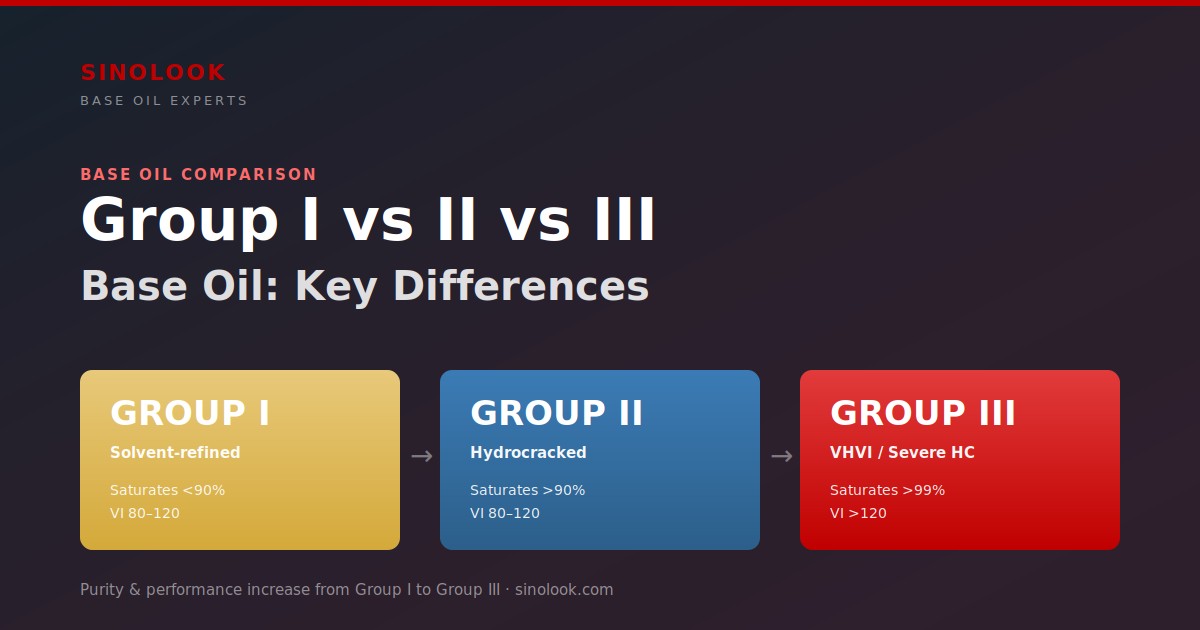
Group I, Group II and Group III are all mineral base oils — refined from the same crude oil. Yet they sit at very different performance and price points. The reason comes down to how intensively each is refined. Understanding that difference is the key to choosing the right base oil for any lubricant.
If you're new to base oil classification, you may want to start with our overview of all five API base oil groups. This article goes deeper on the three mineral groups that matter most in everyday lubricant blending.
The refining difference
All three groups start from vacuum gas oil, but the refining route determines the final quality:
- Group I — Solvent refining. The classic, lower-cost route. Solvent extraction removes aromatics and solvent dewaxing removes wax, but the process leaves more impurities behind. Result: lower saturates, higher sulphur.
- Group II — Hydrocracking. Hydrogen under high pressure and temperature breaks down and saturates impurities far more thoroughly than solvent refining. Result: over 90% saturates, very low sulphur, water-white color.
- Group III — Severe hydrocracking + hydroisomerization. An even more intensive version of the Group II process, with catalytic dewaxing (hydroisomerization) that rearranges molecules for maximum viscosity index. Result: VI above 120, near-synthetic performance.
More hydrogen processing = fewer impurities = better, more stable oil. Group I is the least processed and cheapest; Group III is the most processed and highest-performing of the mineral oils.
Specification comparison
Here's how the three groups compare on the parameters that define them under the API 1509 classification:
| Parameter | Group I | Group II | Group III |
|---|---|---|---|
| Refining process | Solvent refined | Hydrocracked | Severe HC + hydroisom. |
| Saturates | <90% | >90% | >90% (often >99%) |
| Sulphur | >0.03% | <0.03% | <0.03% (often <3 ppm) |
| Viscosity Index | 80–120 | 80–120 | >120 (up to 140+) |
| Color | Yellowish | Water-white | Water-white |
| Oxidation stability | Moderate | Good | Excellent |
| Volatility (Noack) | Higher | Lower | Lowest |
| Relative cost | $ | $$ | $$$ |
Performance differences that matter
On paper the numbers look incremental, but in a finished lubricant they translate into real differences:
- Oxidation stability & service life. Higher saturates (Group II/III) resist oxidation far better, meaning longer drain intervals and less sludge.
- Low-temperature & viscosity control. Group III's high VI keeps viscosity stable across a wider temperature range — essential for multigrade engine oils like 5W-30 and 0W-20.
- Volatility. Group III has the lowest Noack volatility, meaning less oil consumption and lower emissions — critical for meeting modern engine oil specs.
- Additive response & cleanliness. The water-white purity of Group II/III gives more predictable additive performance and cleaner engines.
Which group should you choose?
Use this simple decision guide based on your application and target specification:
In practice:
- Choose Group I for cost-sensitive, undemanding applications — industrial lubricants, marine oils, rubber process oils.
- Choose Group II for conventional and semi-synthetic engine oils, hydraulic fluids and premium industrial lubricants.
- Choose Group III for modern premium engine oils meeting API SP, ILSAC GF-6, ACEA C3 — high performance without full-synthetic cost.
Sinolook supplies all three mineral base oil groups
From Group I solvent-refined oils to ADNOC ADbase Group III, our technical team can help you select and source the right grade for your formulation — with SGS verification on every shipment.
Request a QuoteFrequently asked questions
What is the main difference between Group I, II and III base oil?
The main difference is refining process and resulting purity. Group I is solvent-refined (<90% saturates, >0.03% sulphur). Group II is hydrocracked (>90% saturates, <0.03% sulphur). Group III is severely hydrocracked and hydroisomerized (VI >120). As you move from I to III, oxidation stability, purity and viscosity index improve while volatility decreases.
Is Group II base oil better than Group I?
For most modern applications, yes — Group II has higher saturates, lower sulphur and better oxidation stability, giving longer service life. However, Group I remains preferred for some industrial lubricants and process oils where solvency or cost matters most.
Can I substitute Group III for Group II base oil?
Often yes — Group III can replace Group II to improve VI and lower volatility. But it costs more, and the higher VI may require reformulating the additive package and viscosity modifier. Always validate through formulation testing before production.
Which is cheaper: Group I, II or III base oil?
Group I is generally cheapest (least intensive refining), Group II costs more (hydrocracking), and Group III is the most expensive of the three (severe hydrocracking + hydroisomerization). Pricing also varies by region, supply and crude feedstock costs.
Choosing between Group I, II and III comes down to matching performance needs against budget. For most modern engine oils, Group III delivers the best balance — but Group I and II remain the right choice for many industrial and conventional applications. When in doubt, our technical team can help you decide.