Xiamen Sinolook Oil Co., Ltd

API Group IV & Group V · Project-Based Supply

Synthetic Base Oil — PAO & Ester (Group IV / V)

Polyalphaolefin (PAO) and ester base oils for high-performance lubricants. Sinolook sources synthetic base oils on a project basis for our existing base oil customers — covering the full PAO 2 to 100 cSt range plus polyolester and diester chemistries.

How Sinolook supplies synthetic base oils

We source PAO and ester base oils through trusted China-based suppliers on a project basis — primarily as a complement to our mineral base oil supply contracts. For dedicated continuous PAO-only supply, see the FAQ below.

About Synthetic Base Oil

The premium base stock when mineral oil isn't enough

Synthetic base oils are produced by chemical synthesis rather than crude oil refining — offering superior viscosity index, oxidation stability and temperature performance that mineral base oils (Group I, II, III) cannot match.

Two API categories cover the synthetic space:

Group IV — Polyalphaolefin (PAO): synthesized from ethylene-derived alpha-olefins. The workhorse of full-synthetic engine oils, industrial gear oils and high-performance greases. VI typically 130–145.

Group V — Esters & other non-PAO synthetics: includes polyolesters (POE), diesters, alkylated naphthalenes and silicones. Often blended at 5–30% with PAO to enhance additive solubility, seal compatibility and thermal stability.

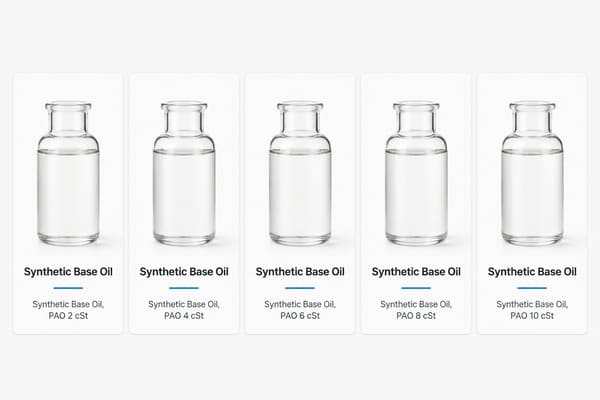
Synthetic base oil — PAO polyalphaolefin sample range from 2 to 100 cSt

Extreme VI

PAO VI 130–145, esters up to 200+ — outperforms Group III in viscosity stability.

Ultra-Low Pour

PAO pour point typically <−60°C — performs in arctic conditions where mineral oil fails.

Thermal Stability

Esters operate to 200°C+, PAO to 175°C — for hot-running engines and compressors.

OEM Premium Tier

Required for full-synthetic positioning, racing oils, aviation and some HFC refrigeration.

Two Synthetic Categories

PAO (Group IV) and Ester (Group V) compared

Most synthetic lubricant formulations use PAO as the primary base stock, with ester added at 5–30% for specific performance benefits. Here's when each chemistry is preferred.

API Group IV

Polyalphaolefin (PAO)

Synthetic hydrocarbon from ethylene-derived alpha-olefins
  • High VI (130–145) with stable viscosity-temperature behavior
  • Very low pour point (typically <−60°C) for arctic performance
  • Excellent oxidation stability and long drain intervals
  • Compatible with mineral oil and all common additives
  • Poor additive solubility — usually blended with 5–30% ester
  • Limited seal swell — may need ester supplement for elastomer compatibility
Common Viscosities PAO 2 PAO 4 PAO 6 PAO 8 PAO 10 PAO 40 PAO 100

API Group V

Ester Base Oils

Polyolesters, diesters, dibasic esters — and other non-PAO synthetics
  • Even higher thermal stability than PAO — operates to 200°C+
  • Excellent additive solubility and elastomer swell
  • Naturally polar — adheres to metal surfaces, reduces wear
  • Many esters are readily biodegradable (OECD 301B)
  • POE polyolesters are the standard for HFC/HFO refrigeration oils
  • Higher cost than PAO — usually used as 5–30% additive, not primary base
Common Types Diester (DOS, DOA) Polyolester TMP POE NPG Biobased ester
Typical Market Specifications

Industry typical values for PAO & ester base oils

The data below represents industry-typical values for common PAO and ester grades available in the global market. Actual specifications depend on the supplier, batch and origin. Specific batch COA will be provided once your project sourcing is confirmed.

Grade KV @ 100°C (mm²/s) KV @ 40°C (mm²/s) VI Pour Point (°C) Flash Point (°C) Density @ 15°C
API Group IV — Polyalphaolefin (PAO)
PAO 21.75.5<−631550.798
PAO 43.917122<−662200.820
PAO 65.830135<−632350.827
PAO 87.948136<−572600.833
PAO 109.866137<−542650.835
PAO 4039396147<−362800.850
PAO 1001001240170<−302830.853
API Group V — Esters
Diester (DOS)3.313150<−602250.913
Diester (DOA)2.38140<−652050.928
Polyolester (TMP)4.520140<−502400.945
Polyolester (POE 32)5.332120<−402400.970
Polyolester (POE 68)9.268130<−402600.975

Typical industry values for reference. Actual product specifications vary by supplier and batch — Sinolook will provide manufacturer COA and TDS for the specific product sourced for your project.

Selection Guide

Group III vs Group IV vs Group V — when to choose what

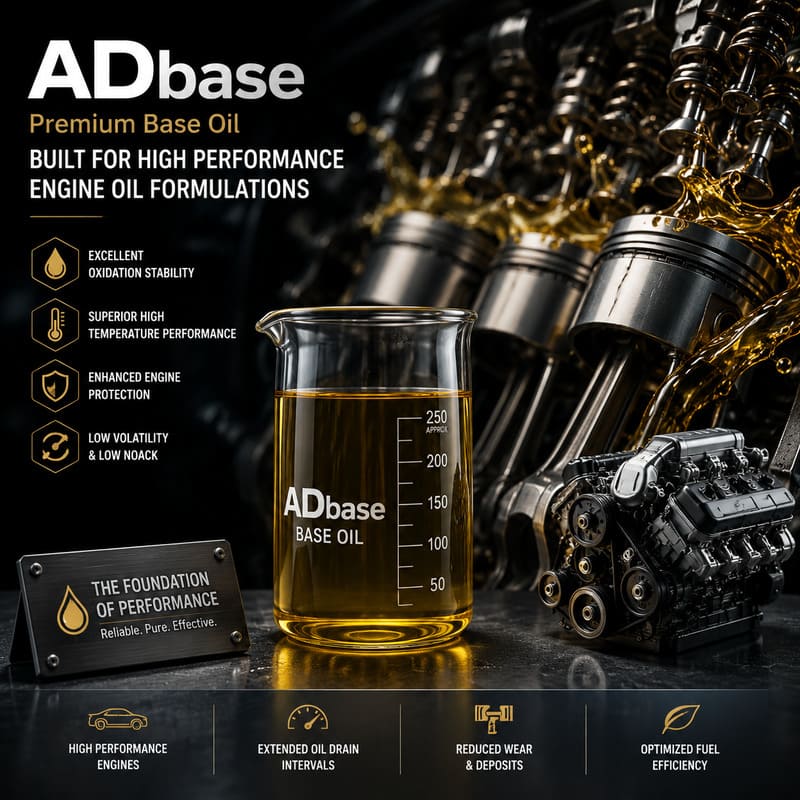
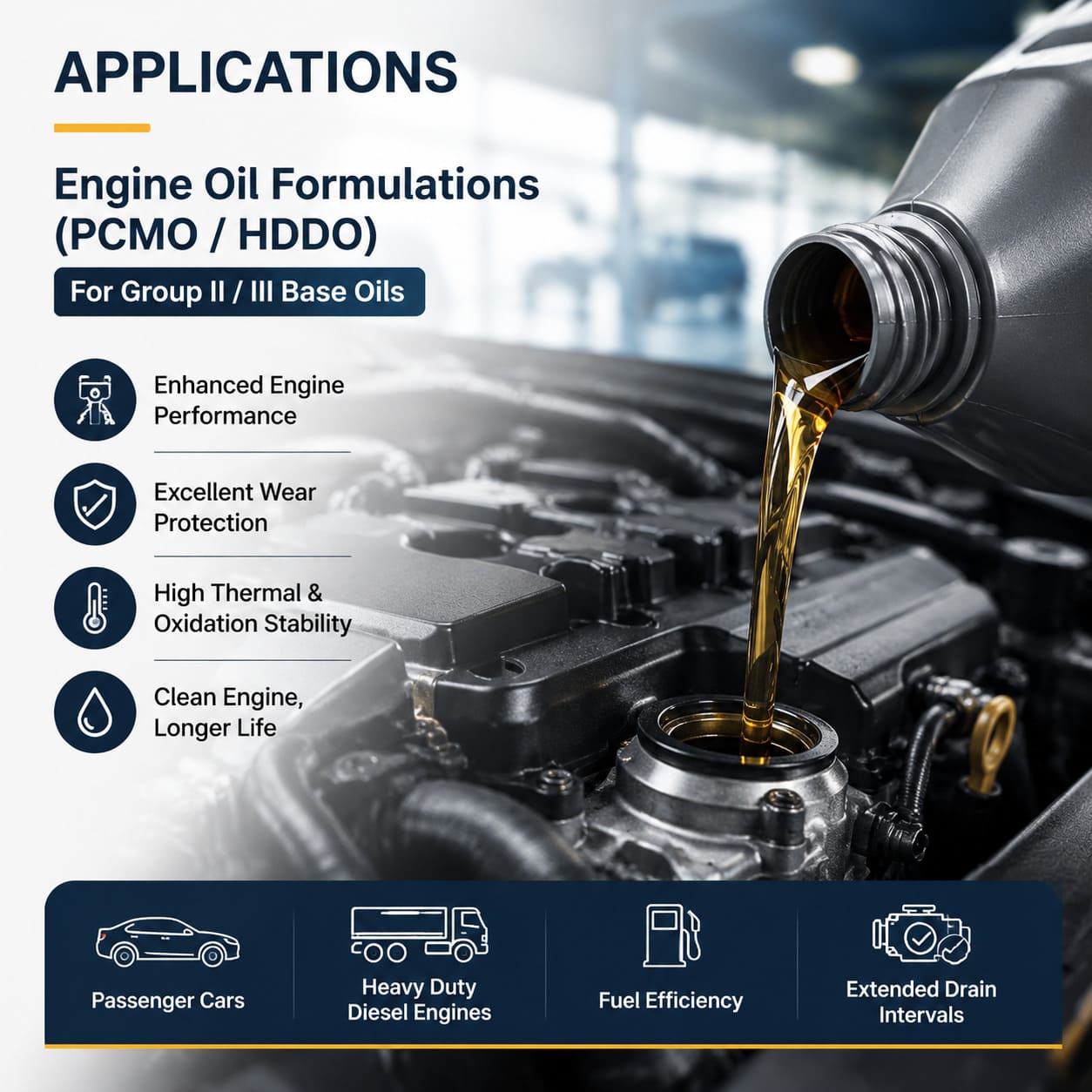
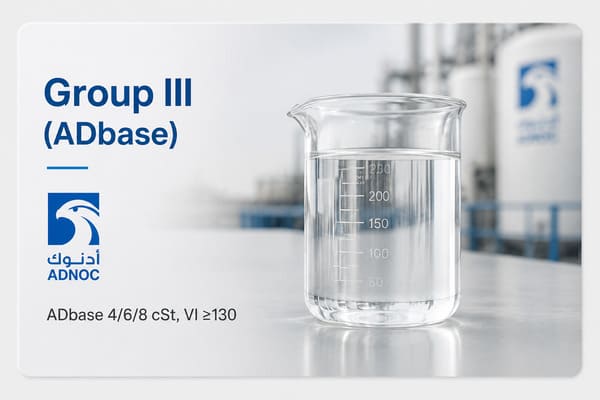
For most premium engine oil formulations, Group III base oil (such as ADNOC ADbase) is the cost-effective choice. Synthetic Group IV / V become necessary in specific demanding scenarios.

Group III (Stick with mineral premium)Most common case

  • Premium PCMO — 5W-30, 5W-40 ACEA C3, dexos1, MB-229.31
  • HDDEO meeting API CK-4 / FA-4 specifications
  • Premium industrial gear and hydraulic oils
  • ATF and CVT fluids (standard performance)
  • Operating temperature −30 to +130 °C
  • Cost-conscious premium formulations

Group IV / V (Synthetic justified)Specific demanding cases

  • Arctic operation below −40 °C — PAO essential
  • Continuous operation above 150 °C — esters or PAO+ester blend
  • Full-synthetic marketing positioning required by OEM
  • Racing oils, motorsport, aviation lubricants
  • HFC / HFO refrigeration compressor oils (POE required)
  • Biodegradable hydraulic fluids — ester base oil mandatory
  • Long-drain extended-service applications

For most premium lubricant applications, Group III ADNOC ADbase delivers excellent performance at significantly lower cost than full-synthetic.

Applications

Where synthetic base oil delivers

Synthetic base oils enable extreme-performance lubricants for the most demanding industrial, automotive and aerospace applications.

Synthetic base oil for aviation turbine oils and aerospace lubricants
Polyolester · Aviation
Aviation turbine oils
MIL-PRF-23699 and MIL-PRF-7808 aviation turbine engine oils. Polyolester base stock is mandatory for thermal stability above 200°C in jet engine bearings and gearboxes.
PAO synthetic base oil for full-synthetic engine oils
PAO · Full-Synthetic PCMO
Full-synthetic engine oils
0W-20, 0W-40, 5W-50 full-synthetic engine oils for premium PCMO positioning. PAO 4 + 6 + ester blend delivers low-temp pumpability and high-temp protection.
High-viscosity PAO for industrial gear oil and synthetic greases
PAO 40 / 100 · Industrial
Synthetic gear oils & greases
PAO 40 and 100 are the workhorses for synthetic industrial gear oils (ISO VG 220–680) and premium PAO-thickened greases for extreme-pressure, long-life lubrication.
POE polyolester refrigeration oil for HFC and HFO compressors
POE · Refrigeration
HFC / HFO refrigeration oils
Polyolester (POE 32, POE 68) is the base stock for modern HFC and HFO refrigeration compressor oils. Mineral and PAO oils are incompatible with HFC refrigerants.
How Sinolook Works

Project-based sourcing for our base oil customers

Synthetic base oil supply works differently from our mineral base oil contracts. Here's the four-step process for sourcing PAO or ester for your formulation project.

Specify Requirements

Share grade (e.g., PAO 6 or POE 32), required volume, target specs, batch frequency and timing. The more specific, the faster we can confirm sourcing.

Supplier Identification

We query our network of China-based PAO and ester suppliers. Most projects can be sourced within 5–10 working days for confirmation of availability and pricing.

Quality Verification

Manufacturer COA, TDS and (where requested) third-party SGS inspection at loading port. Pre-shipment sample available for your formulation testing.

Delivery & Documentation

Drum or ISO tank shipment via Sinolook bonded logistics, alongside your regular mineral base oil cargo when applicable. Full export documentation included.

FAQ

Frequently asked questions

What is synthetic base oil?
Synthetic base oil is base oil produced by chemical synthesis rather than refining of crude oil. The two main categories are polyalphaolefin (PAO, API Group IV) and esters (API Group V). Synthetic base oils offer superior viscosity index, oxidation stability, low-temperature performance and thermal stability compared to mineral base oils — making them the preferred base stock for high-performance lubricants, full-synthetic engine oils, industrial gear oils and aviation lubricants.
What is the difference between Group IV PAO and Group V esters?
Group IV (PAO) — polyalphaolefin, a synthetic hydrocarbon with VI 130–145, excellent oxidation stability, very low pour point and good shear stability.

Group V — a catch-all category including ester base oils (polyolester, diester, dibasic ester) and other non-PAO synthetics. Esters offer even better thermal stability, additive solubility and seal compatibility than PAO, but at higher cost.

Many premium synthetic lubricants blend PAO with 10–30% ester to combine the strengths of both.
Does Sinolook stock PAO and ester base oils?
Sinolook offers synthetic base oils on a project-based sourcing model rather than from continuous stock. We work with China-based PAO and ester suppliers to source the specific viscosity grades and quantities our base oil customers require for synthetic and semi-synthetic lubricant formulations.

For customers requiring dedicated continuous PAO-only supply contracts, we recommend evaluating major synthetic specialists such as ExxonMobil (SpectraSyn), INEOS (Durasyn), Chevron Phillips (Synfluid) or LANXESS directly. This is honest positioning — we're a leading mineral base oil distributor in China, not a dedicated synthetic specialist.
What synthetic base oil grades can Sinolook source?
Common viscosities Sinolook can source for our base oil customers:
Low-vis PAO: PAO 2, 4, 6, 8, 10 cSt
High-vis PAO: PAO 40, 100 cSt (for grease and gear oil)
Diesters: DOS (dioctyl sebacate), DOA (dioctyl adipate)
Polyolesters: TMP-based, POE 32, POE 68 (HFC/HFO refrigeration)

Specific brand and origin depend on current China market availability and project requirements.
When should I use synthetic base oil instead of Group III?
Group III base oil (such as ADNOC ADbase) covers many premium engine oil and ATF formulations at lower cost than PAO.

Synthetic PAO becomes justified when:
• Application requires temperatures below −40 °C
• Prolonged operation above 150 °C
• Severe oxidation conditions
• Full-synthetic OEM positioning required

Esters become necessary when:
• Additive solubility is critical
• Seal swell control needed
• Aviation lubricants (MIL-PRF-23699)
• HFC/HFO refrigeration oils
• Biodegradable hydraulic fluids
What is the minimum order quantity for synthetic base oil sourcing?
Typical minimum order is one full pallet of drums (4 MT) for trial quantities, or one full container (20 MT) for production-scale orders. Smaller sample-scale requests (200L drum) can be arranged for formulation testing.

Synthetic base oil sourcing typically takes 2–4 weeks from confirmed order to delivery, depending on supplier availability and shipping schedule. We can usually consolidate synthetic cargo with your regular mineral base oil shipment to reduce logistics cost.
Is synthetic base oil biodegradable?
PAO (Group IV) has limited biodegradability similar to mineral oil.

Many ester base oils, particularly natural and biobased esters, are readily biodegradable per OECD 301B test and can support EU Ecolabel and US EPA Vessel General Permit (VGP) compliant lubricants. Common biodegradable ester base oils include saturated polyolesters and complex esters.

Polyolester refrigeration oils used in HFC and HFO systems are usually not biodegradable — biodegradability is a function of the ester chemistry and base stock specification, not the Group V classification itself.
Related Products

Explore Sinolook's core base oil portfolio

Need synthetic base oil for your formulation project?

Share your grade, volume and target specs — we'll confirm sourcing options within 5–10 working days, including manufacturer COA, pricing and consolidated delivery with your mineral base oil cargo where possible.

Discuss Your Project
滚动至顶部