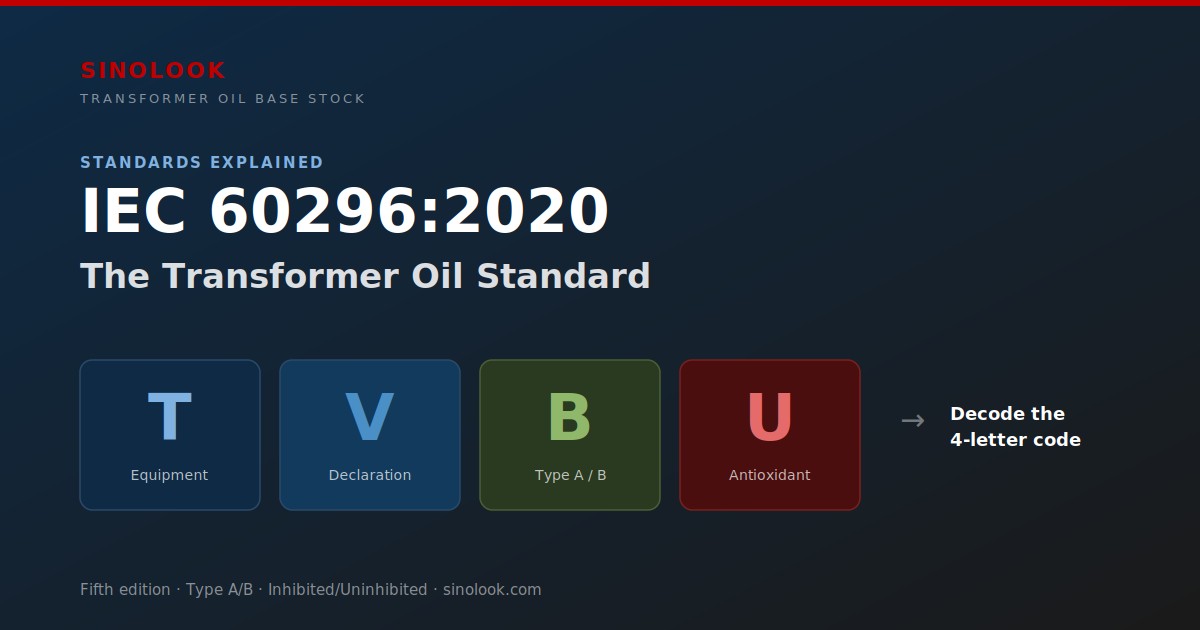
If you manufacture, buy or specify transformer oil, one standard governs it above all others: IEC 60296. It defines what unused mineral insulating oil must deliver — from dielectric strength to oxidation stability to environmental safety. But its classification system, especially the four-letter ordering code introduced in the 2020 edition, confuses many people.
This guide decodes IEC 60296:2020 in plain language — what it covers, how the code works, and what the key requirements mean in practice.
What is IEC 60296?
IEC 60296 is the international standard for unused mineral insulating oils used in transformers and switchgear. Its full title is "Fluids for electrotechnical applications — Mineral insulating oils for electrical equipment." Published by the International Electrotechnical Commission (IEC), it specifies the requirements and test methods across three broad areas:
- Functional properties — viscosity, pour point, dielectric strength, dissipation factor and more
- Refining & stability — oxidation stability, corrosive sulphur, interfacial tension, additive content
- Health, safety & environmental (HSE) — flash point, PCA, PCB content
The current version is IEC 60296:2020, the fifth edition, published in 2020. It's the benchmark most transformer oil buyers and producers around the world specify against.
When a transformer oil is described as "meeting IEC 60296:2020," it means the oil has been tested against a defined set of dielectric, physical, chemical and safety requirements — giving buyers a common, internationally recognized language for quality.
2012 vs 2020: what changed
The fifth edition (2020) replaced the fourth edition (2012). If you've worked with the older edition, here's what's different:
- New four-letter ordering code — a more structured way to specify exactly which oil you need.
- Type A / Type B grades introduced — a performance grouping based on oxidation stability, separate from the inhibited/uninhibited distinction.
- Updated corrosive sulphur & DBDS focus — stronger emphasis on copper-corrosion prevention.
- Refined HSE requirements — clearer limits on PCA and related properties.
The four-letter ordering code
The heart of IEC 60296:2020 is its four-letter ordering code. Each letter answers one question about the oil:
Type A vs Type B explained
The Type A / Type B distinction (the third letter) was one of the biggest additions in the 2020 edition. It's a performance grouping based on oxidation stability:
| Aspect | Type A | Type B |
|---|---|---|
| Grade | High grade | Standard grade |
| Oxidation stability | More stringent | Standard requirement |
| Typical duty | Higher thermal / longer life | General purpose |
| Core dielectric requirements | Must meet | Must meet |
Importantly, Type A vs Type B is separate from inhibited vs uninhibited. An oil can be Type A uninhibited, Type B uninhibited, Type A inhibited, and so on. The Type letter tells you about oxidation-stability performance; the antioxidant letter tells you whether a synthetic inhibitor was added. For more on the inhibited/uninhibited distinction, see our guide on inhibited vs uninhibited transformer oil.
Key requirement categories
IEC 60296:2020 sets requirements across many properties. Here are the most important ones and what they mean:
| Property | Why it matters | Typical test |
|---|---|---|
| Breakdown voltage | Core dielectric strength — the oil's ability to insulate | IEC 60156 |
| Dissipation factor (tan δ) | Dielectric loss — lower means cleaner insulation | IEC 60247 |
| Pour point | Low-temperature fluidity for cold climates | ISO 3016 |
| Oxidation stability | Resistance to aging — defines Type A vs B | IEC 61125 |
| Corrosive sulphur | Protects copper windings from corrosion | DIN 51353 / IEC 62535 |
| Interfacial tension | Indicates refining quality & aging resistance | ISO 6295 |
| Flash point | Fire safety margin | ISO 2719 |
| PCA content | Health & environmental safety | IP 346 |
The 2020 edition emphasizes non-corrosive behaviour toward copper. Corrosive sulphur compounds — DBDS being the most notorious — can form conductive copper sulphide on windings, a known cause of transformer failure. Read more in our guide to DBDS & corrosive sulphur.
Real examples: reading the code
Let's decode the designations of three real transformer oil base stocks that Sinolook supplies:
| Grade | IEC reading | Key characteristic |
|---|---|---|
| TOBS V9-TBU | TVBU — Transformer, Virgin, Type B, Uninhibited | Additive-free, DBDS not detected, pour point −60°C |
| TOBS V9 | Transformer, Virgin, Inhibited (antioxidant 0.038%) | Zero aromatic carbon, breakdown 43.3 kV |
| Paraffinic TOBS 60N | Paraffinic insulating base stock | VI 112, tan δ 0.0002, flash point 180°C |
Once you can read the code, specifying transformer oil becomes precise: you're no longer just asking for "naphthenic transformer oil," but for exactly the equipment type, freshness, grade and antioxidant status your application requires.
Transformer oil base stock, meeting IEC 60296:2020
Sinolook supplies naphthenic TOBS V9 & V9-TBU (TVBU) plus paraffinic TOBS 60N — engineered to meet IEC 60296:2020, with SGS verification on every shipment.
Explore Transformer Oil Base StockFrequently asked questions
What is IEC 60296?
IEC 60296 is the international standard for unused mineral insulating oils used in transformers and switchgear, titled "Fluids for electrotechnical applications — Mineral insulating oils for electrical equipment." It specifies requirements and test methods for functional properties, refining and stability, and health, safety and environmental performance. The current version is IEC 60296:2020, the fifth edition.
What is the difference between IEC 60296:2012 and 2020?
The 2020 fifth edition replaced the 2012 fourth edition. The main change is a new classification structure: a four-letter ordering code and a split into Type A and Type B based on oxidation stability, in addition to the existing inhibited/uninhibited/trace-inhibited classification. It also updated requirements around corrosive sulphur, DBDS and HSE properties.
What does the IEC 60296 four-letter code mean?
Four letters: 1st = equipment (T transformer / S switchgear); 2nd = declaration (V virgin / R recycled); 3rd = type (A high grade / B standard grade); 4th = antioxidant (I inhibited / U uninhibited / T trace-inhibited). For example, TVBU = Transformer, Virgin, Type B, Uninhibited.
What is the difference between Type A and Type B transformer oil?
Both are performance grades based on oxidation stability. Type A is the higher grade, meeting more stringent oxidation stability requirements for higher thermal duty and longer service. Type B is the standard grade. Both must still meet the core dielectric, physical and HSE requirements.
Does IEC 60296 require DBDS-free transformer oil?
IEC 60296:2020 requires oil to be non-corrosive to copper and specifies limits related to corrosive sulphur. DBDS is a known corrosive sulphur compound, and modern oils are typically DBDS-free to prevent copper sulphide formation. "DBDS not detected" is a common, desirable characteristic for meeting the corrosive sulphur requirements. See our DBDS guide for details.
IEC 60296:2020 gives the whole transformer oil industry a shared language. Once you can read its four-letter code and understand its requirement categories, specifying and sourcing the right insulating oil becomes far simpler — and far more precise.