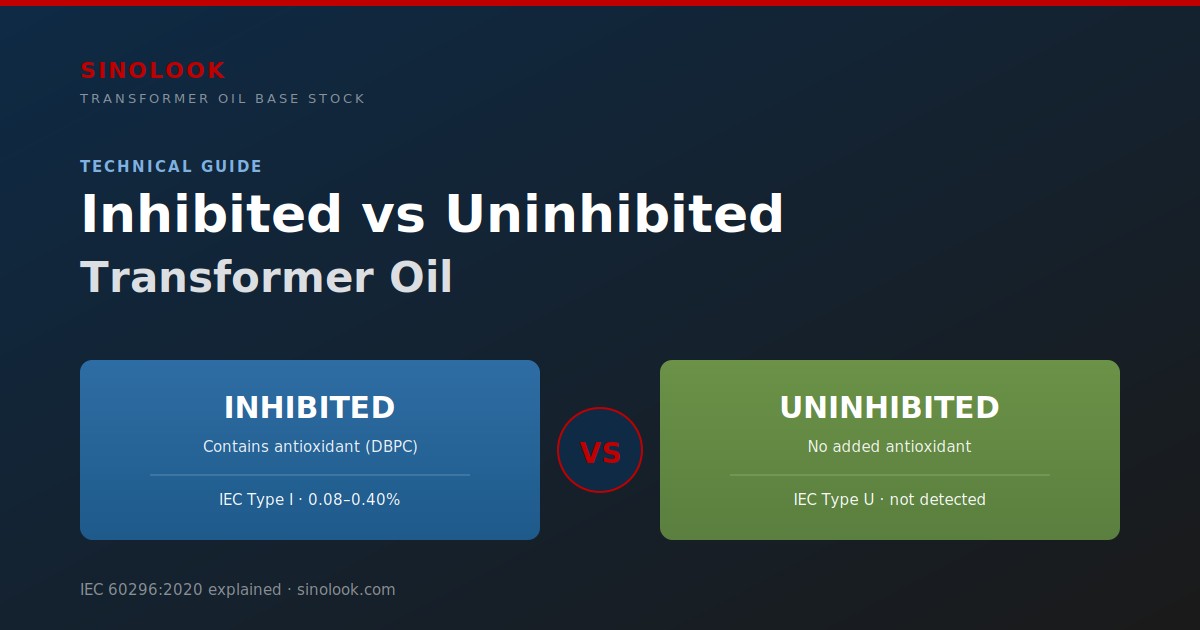
If you manufacture or source transformer oil, you've faced the choice: inhibited or uninhibited? Both are highly refined mineral insulating oils that meet the same core dielectric requirements. The difference is whether the oil contains a synthetic antioxidant additive — and that single distinction affects oxidation life, aging behaviour and which standard designation the oil carries.
This guide explains the difference clearly, shows how the IEC 60296 classification works, and uses two real base stock grades — an inhibited and an uninhibited naphthenic oil — to illustrate the practical trade-offs.
What "inhibited" and "uninhibited" actually mean
The terms refer to whether an oxidation inhibitor — an antioxidant additive — has been blended into the oil:
- Inhibited transformer oil contains a synthetic antioxidant, most commonly DBPC (2,6-di-tert-butyl-para-cresol, also called BHT), sometimes with DBP. The additive actively slows oxidation.
- Uninhibited transformer oil contains no added synthetic antioxidant. It relies only on the natural antioxidants (such as certain sulphur and aromatic compounds) that remain in the refined base oil.
Both start from the same kind of highly refined base stock. In fact, inhibited oil is often just uninhibited base stock with antioxidant blended in — which is why many transformer oil producers buy uninhibited base stock and add inhibitor themselves.
"Inhibited" doesn't mean higher quality — it means an antioxidant has been added to extend oxidation life. A premium uninhibited oil can outperform a mediocre inhibited one. Base stock refining quality matters as much as the additive.
Why oxidation matters in transformer oil
Inside an operating transformer, oil is exposed to heat, oxygen, and catalytic metals (copper, iron) for decades. Over time this causes oxidation — the oil reacts with oxygen to form acids, sludge and polar compounds. The consequences:
- Acidity rises — corrosive to insulation and metal
- Sludge forms — deposits on windings, reducing cooling efficiency
- Dielectric properties degrade — the oil insulates less well
Antioxidants interrupt the oxidation chain reaction. That's the entire purpose of "inhibiting" the oil — to extend the time before oxidation products accumulate to harmful levels. An uninhibited oil isn't defenseless; its natural antioxidants provide some protection, but it typically oxidizes faster than a well-inhibited oil under the same conditions.
The IEC 60296 classification (Type I, U, T)
The current standard, IEC 60296:2020 (fifth edition), classifies mineral insulating oils by antioxidant content using a letter in its four-letter ordering code:
| Designation | Name | Antioxidant content |
|---|---|---|
| U | Uninhibited | Not detected (<0.01%) |
| T | Trace-inhibited | Up to 0.08% |
| I | Inhibited | 0.08% – 0.40% |
This antioxidant letter is the fourth character in the full IEC 60296:2020 ordering code. The complete code has four letters:
Note that the 2020 edition added the Type A / Type B grouping (based on oxidation-stability performance), separate from the inhibited/uninhibited letter. So an oil can be, for example, Type B and uninhibited (TVBU), or Type A and inhibited (TVAI).
Side-by-side comparison
| Factor | Inhibited | Uninhibited |
|---|---|---|
| Antioxidant additive | Yes (DBPC/DBP) | None (natural only) |
| Oxidation stability | Higher / longer | Good, ages naturally |
| Service life (thermal duty) | Generally longer | Shorter under equal stress |
| Aging predictability | Depends on additive depletion | Well-understood natural aging |
| Additive-free requirement | No | Yes — additive-free fluid |
| IEC 60296 letter | I | U |
| Typical preference | Many global markets | Some regions & utilities |
A real example: inhibited V9 vs uninhibited V9-TBU
To make this concrete, here are two real naphthenic transformer oil base stocks — one inhibited, one uninhibited — that Sinolook supplies. They share the same naphthenic chemistry but differ in antioxidant status:
| Property | TOBS V9 (Inhibited) | TOBS V9-TBU (Uninhibited) |
|---|---|---|
| Antioxidant additive | 0.038% | Not detected |
| IEC designation | Inhibited (I) | TVBU (Type B, Uninhibited) |
| Pour point | −54 °C | −60 °C |
| Breakdown voltage | 43.3 kV | 39 kV (untreated) |
| Dissipation factor (90°C) | 0.00123 | 0.00048 |
| Aromatic carbon (Ca) | 0% | 3.18% |
| DBDS | — | Not detected |
Notice how the two grades reflect their design intent. The inhibited V9 pairs its antioxidant with an exceptionally clean composition (zero aromatic carbon) and higher dielectric strength — built for maximum oxidation stability. The uninhibited V9-TBU forgoes additives entirely, instead emphasizing a clean health-safety-environmental profile (DBDS not detected, low pour point −60°C) for applications that require an additive-free fluid.
Source both inhibited & uninhibited transformer oil base stock
Sinolook supplies naphthenic TOBS in inhibited (V9) and uninhibited Type B (V9-TBU) grades, plus paraffinic TOBS 60N — meeting IEC 60296:2020, with SGS verification on every shipment.
Explore Transformer Oil Base StockHow to choose
Use this simple framework:
- Choose inhibited if your priority is maximum oxidation life and long service under demanding thermal duty, or if your target market/standard specifies inhibited oil.
- Choose uninhibited if your application or utility requires an additive-free fluid, if you prefer well-understood natural aging behaviour, or if a cleaner HSE profile (DBDS-free, low PCA) is a priority.
- If you're a blender, sourcing a high-quality uninhibited base stock gives you flexibility — you can supply it as-is, or add DBPC antioxidant in-house to produce inhibited oil to your customer's spec.
Frequently asked questions
What is the difference between inhibited and uninhibited transformer oil?
Inhibited transformer oil contains a synthetic antioxidant (typically DBPC/BHT) to boost oxidation stability. Uninhibited relies only on the natural antioxidants in the refined base oil. Inhibited generally offers longer oxidation life; uninhibited is preferred where an additive-free fluid is required. Under IEC 60296:2020, oils are classified as inhibited (I), uninhibited (U) or trace-inhibited (T).
What does Type U transformer oil mean?
Type U in IEC 60296:2020 designates an uninhibited transformer oil — no synthetic inhibitor added, antioxidant not detected. It's the fourth letter in the ordering code. For example, Sinolook TOBS V9-TBU carries the designation TVBU (Transformer, Virgin, Type B, Uninhibited).
Is inhibited transformer oil better than uninhibited?
Neither is universally better. Inhibited generally has higher oxidation stability and longer service life. Uninhibited provides an additive-free fluid with predictable natural aging and can offer a cleaner HSE profile. The right choice depends on transformer duty, target standard and regional preference.
What antioxidant is used in inhibited transformer oil?
The most common is DBPC (2,6-di-tert-butyl-para-cresol, also called BHT), sometimes with DBP. IEC 60296 limits: uninhibited = none detected; trace-inhibited = up to 0.08%; inhibited = 0.08–0.40%. The additive interrupts the oxidation chain reaction, extending service life.
Can I convert uninhibited transformer oil to inhibited?
Yes. Blenders commonly add DBPC antioxidant to an uninhibited base stock to produce inhibited oil. Starting from a high-quality uninhibited base stock, a controlled dose is blended to reach the target inhibited spec. This is why many producers source uninhibited base stock and add inhibitor in-house.
Inhibited or uninhibited, the foundation of good transformer oil is a well-refined base stock. Get that right, and both paths lead to reliable insulating oil — the choice simply matches the oil to your duty, standard and market.