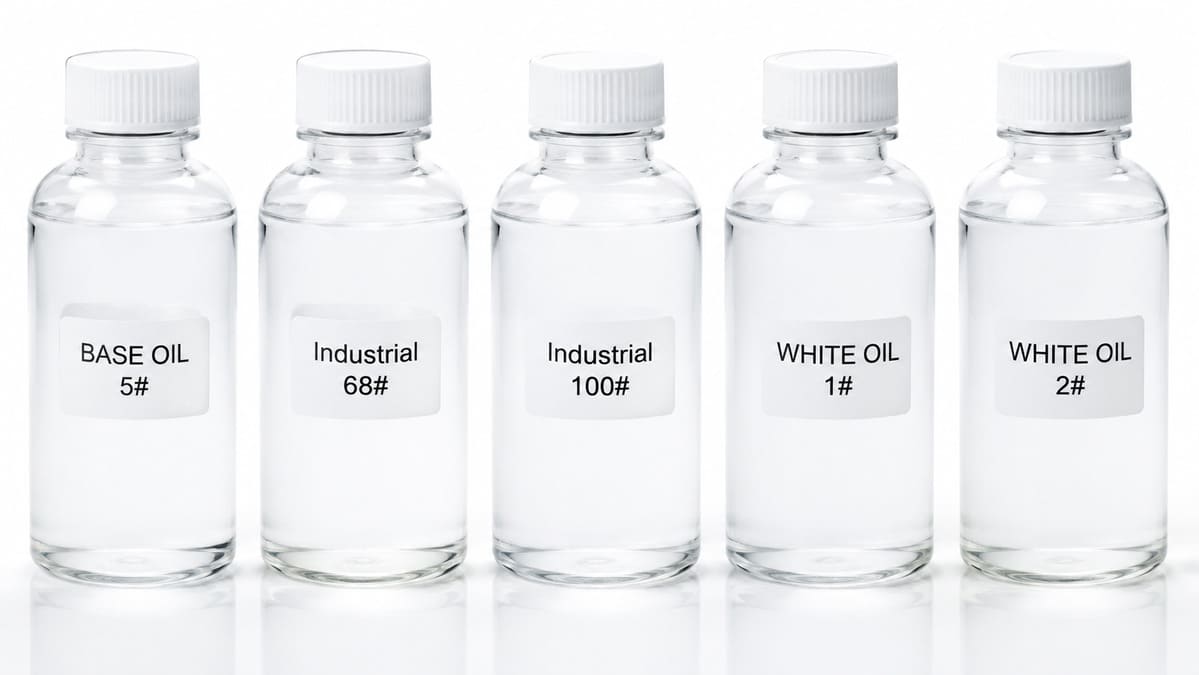
If you've ever held a bottle of baby oil, used a PVC product, or applied skin lotion, you've used white oil. It's one of the most widely used petroleum derivatives in the world — but most people, even those who buy it for industrial use, don't fully understand what makes it different from regular base oil, or what to look for when sourcing.
This guide breaks down everything you need to know: what white oil actually is, the difference between industrial and refined grades, the key technical parameters that matter, where it's used — and importantly, how to think about USP, FDA and food-grade certification when sourcing.
What is white oil?
White oil — also called white mineral oil or liquid paraffin — is highly refined paraffinic mineral oil that has gone through severe hydrotreatment to remove virtually all aromatic compounds, sulphur and nitrogen.
The result is an oil that is:
- Colorless — water-clear (Saybolt color +30 or above)
- Odorless — no detectable smell
- Tasteless — no flavor or aftertaste
- Chemically inert — doesn't react with most substances
These properties make white oil unique in the base oil family. While ordinary Group I, II and III base oils are designed to be blended with additives into lubricants, white oil is designed to be used directly in applications where chemical inertness, color, odor and taste matter — plastics, cosmetics, food packaging, pharmaceutical products.
White oil isn't a different molecule from base oil — it's base oil refined to a higher purity level. The same crude oil can become Group I (industrial lubricant) or white oil (cosmetic carrier) depending on how aggressively it's hydrotreated.
White oil vs regular base oil
White oil and ordinary base oil come from the same starting material — vacuum gas oil from crude oil refining. The difference is how far the refining goes:
| Property | Group I/II Base Oil | White Oil |
|---|---|---|
| Refining process | Solvent-refined or hydrocracked | Severely hydrotreated |
| Color | Yellowish to water-white | Water-white (Saybolt +30) |
| Aromatic content | Up to 5% | Less than 2.5%, often less than 0.1% |
| Sulphur | Up to 0.5% | Below 3 ppm typical |
| Odor | Mild oily smell | None detectable |
| Primary use | Blended into lubricants with additives | Used directly or as carrier in formulations |
| Typical end products | Engine oil, hydraulic, gear oil | PVC, baby oil, cosmetics, food packaging |
In a way, white oil is what you get when you keep refining base oil past the point that lubricant performance requires — pushing for cleanliness instead of viscosity index or oxidation stability.
Industrial vs refined: two product lines
White oil isn't a single product — it's a category that spans two distinct product lines with very different purity requirements:
Industrial White Oil
For non-food, non-cosmetic industrial use — where chemical inertness matters but human contact is indirect.
- Saybolt color +30 (water-clear)
- Sulphur 2 to 3 ppm
- Aromatic hydrocarbon under 2.5%
- No water-soluble acids or alkalis
Used in: plastics, textiles, rubber, defoamer, industrial chemicals
Refined White Oil
For applications with direct human contact or stringent purity requirements — cosmetic, personal care, sensitive industrial.
- PAH (UV absorbance) under 0.1 cm
- Lead under 1 mg/kg, arsenic under 1 mg/kg
- Heavy metals as Pb under 10 mg/kg
- Passes readily carbonizable substances test (ASTM D565)
Used in: cosmetics, baby oil, skin care, refined industrial
Both categories are made by the same severe hydrotreatment process — the difference is the aggressiveness of final polishing (additional hydrotreatment, clay treatment, fractionation) and the specific contamination tests the finished product must pass.
Key technical parameters
When evaluating white oil quality — particularly for cosmetic or sensitive industrial applications — these are the parameters that matter:
1. Polycyclic Aromatic Hydrocarbons (PAH)
Measured by UV absorbance between 260–420 nm via ASTM D2008. Refined white oils should be below 0.1 cm absorbance. Lower is better — some refined grades reach 0.011 cm.
2. Heavy metals (lead, arsenic)
Lead measured via ASTM D3237, arsenic via ASTM D4951. Refined grades should be below 1.0 mg/kg for each, with total heavy metals (as Pb) below 10 mg/kg.
3. Readily carbonizable substances
A sulfuric acid color test (ASTM D565) that detects trace reactive compounds. Must pass for any pharmaceutical or food-grade application.
4. Saybolt color
A visual purity indicator (ASTM D156). White oils should be +25 or above (visibly water-clear). Anything lower indicates incomplete refining.
5. Water-soluble acids and alkalis
Indicates residual contamination from refining chemicals. Should be "none detected" per GB/T 259 or equivalent.
Six main applications
Plastics processing
PVC plasticizer, polystyrene mold release, polyethylene processing aid. Industrial 68# and 100# are the workhorses — they soften PVC compounds and prevent sticking during extrusion.
Textile lubrication & finishing
Spin finishes, knitting oils, weaving lubricants, fiber processing aids. White oil's chemical inertness prevents staining and yellowing of finished textiles.
Rubber compounding & processing
Rubber softener, EPDM extension oil, NBR processing aid. White oil is the cleanest option when finished rubber color matters (white sealing strips, light-colored rubber products).
Cosmetics & skin care
Carrier oil in lotions, creams, baby oil, sunscreens. Refined white oil dissolves into cosmetic formulations without changing color, smell or skin feel.
Food packaging & processing
Food-grade white oil (with FDA 21 CFR or NSF certification) is used in food packaging, processing equipment lubrication, baking pan release agents, and as an indirect food additive.
Pharmaceutical & medicinal
USP-grade white oil (liquid paraffin) is used in ointment bases, laxatives, capsule release agents and as an excipient in pharmaceutical formulations. Requires formal USP certification.
The truth about USP, FDA & food-grade certification
This is where many buyers get confused — and where some suppliers stretch the truth. Here's the straight story:
"USP white oil" means white oil meeting the United States Pharmacopeia (USP) specification — a formal monograph with specific tests and limits. To legally claim USP-grade, the supplier must hold third-party certification specific to each batch.
"FDA 21 CFR 178.3620" covers white oil for food contact (machinery lubricants, packaging, processing aids). To legally claim FDA-compliant, the supplier must demonstrate compliance with the specific CFR clause and typically hold third-party certification.
"Food-grade" or "pharmaceutical-grade" in the US and EU have specific legal meanings tied to these certifications. You cannot legally market a finished product as containing "USP mineral oil" if your white oil supplier doesn't hold USP certification — even if the technical specs look the same.
Sinolook produces white oils meeting the technical parameters typical of USP white oil specifications (low PAH, controlled heavy metals, chemical inertness). However, Sinolook does not currently hold third-party USP, FDA 21 CFR or NSF certification documents for these products.
For applications requiring formally certified pharmaceutical-grade or food-contact white oil, buyers should consult dedicated certified suppliers such as Sonneborn, Sasol, Petro-Canada or other producers with current third-party certifications, and conduct their own qualification testing.
For industrial applications (plastics, textiles, rubber) and for formulation development testing in cosmetics, our refined white oil grades offer excellent technical performance at competitive pricing.
How to choose the right white oil grade
Start by classifying your application by regulatory tier, then by viscosity:
For non-regulated industrial applications (plastics, textiles, rubber, defoamer, industrial chemicals):
- Light industrial (KV100 ~5) → Industrial light grades like BASE OIL 5#
- Medium industrial (KV100 ~9) → Industrial 68# — most popular for PVC, textiles
- Heavy industrial (KV100 ~10, KV40 high) → Industrial 100# — for heavy plasticizer use
For cosmetic and personal care formulation development:
- Light skin-feel applications → WHITE OIL 1# (KV100 = 2.7) — baby oil, lightweight lotions
- Medium-body applications → WHITE OIL 2# (KV100 = 4.4) — body oil, richer lotions, sunscreen
For regulated food contact or pharmaceutical applications:
- Source from suppliers holding current USP, FDA 21 CFR or NSF certifications
- Always conduct your own qualification testing for each batch
- Verify supplier certificates are current and specific to your target market
Sinolook supplies 5 white oil grades for industrial & cosmetic use
From cost-effective industrial PVC plasticizer to refined grades suitable for cosmetic formulation testing — SGS verified, with full technical data sheets and batch COA on every shipment.
Explore White Oil GradesFrequently asked questions
What is white oil?
White oil (also called white mineral oil or liquid paraffin) is highly refined paraffinic mineral oil that has undergone severe hydrotreatment to remove virtually all aromatic compounds, sulphur and nitrogen. The result is a colorless, odorless, tasteless and chemically inert oil used in plastics, textiles, rubber, cosmetics, personal care and many industrial applications where chemical inertness and purity matter.
What is the difference between white oil and base oil?
White oil is essentially highly refined base oil that has gone through additional severe hydrotreatment. While Group I, II and III base oils are designed for lubricant blending with additives, white oil is designed to be chemically inert and used directly in applications where contamination, color or odor cannot be tolerated. The same crude oil can become Group I base oil (industrial lubricant) or white oil (cosmetic carrier) depending on how aggressively it is hydrotreated.
What is the difference between industrial and food grade white oil?
Industrial white oil is suitable for non-food, non-cosmetic industrial use — plastics, textiles, rubber, PVC plasticizer.
Food grade white oil has lower PAH, lower heavy metals, and must hold specific compliance certifications such as FDA 21 CFR 178.3620, NSF HX-1, or EU food contact. The technical specs are often similar in many parameters, but food and pharmaceutical grades require formal third-party certification specific to each batch and supplier.
Is white oil safe for cosmetic and skin care use?
Refined white oils suitable for cosmetic applications have PAH (UV absorbance) below 0.1 cm, lead below 1 mg/kg, arsenic below 1 mg/kg and pass readily carbonizable substances testing. They have a long history of use in baby oil, body lotions and skin care.
However, for end-product compliance in your target market (EU Cosmetics Regulation EC 1223/2009, US FDA cosmetic ingredient compliance, etc.), buyers should always conduct their own qualification testing and verify supplier certifications for each batch.
What is liquid paraffin?
Liquid paraffin is another name for white oil — particularly the highly refined grades used in pharmaceutical and cosmetic applications.
In pharmaceutical contexts, liquid paraffin specifically refers to USP-grade white oil meeting United States Pharmacopeia specifications.
In cosmetic contexts, liquid paraffin is interchangeable with "mineral oil."
Industrial white oil and pharmaceutical liquid paraffin are produced by the same severe hydrotreatment process but differ in final purity controls and certifications.
What are the main applications of white oil?
Six major application areas:
1. Plastics processing — PVC plasticizer, polystyrene mold release
2. Textile lubrication — spin finishes, knitting oils
3. Rubber compounding — softener, EPDM extension oil
4. Personal care — baby oil, lotions, skin care
5. Food contact — packaging, processing (requires FDA 21 CFR cert)
6. Pharmaceutical — ointment base, laxative (requires USP cert)
Does white oil need to be USP or FDA certified?
It depends entirely on the application:
• Industrial use (plastics, textiles, rubber) → No certification required
• Pharmaceutical use → Requires USP certification
• Direct food contact → Requires FDA 21 CFR 172.878 or 178.3620 (or equivalent regional cert)
• Cosmetics → Requires compliance with regional cosmetic regulations
For any food, pharmaceutical or cosmetic end-product, source from suppliers holding the specific third-party certification required for your target market.
White oil is one of the most versatile refined petroleum products — but "white oil" can mean very different things depending on the application and certification level. Get the technical parameters and regulatory tier right, and you'll source the right grade. Get them wrong, and you can end up with either an over-priced industrial product, or worse, a compliance failure in your finished goods.