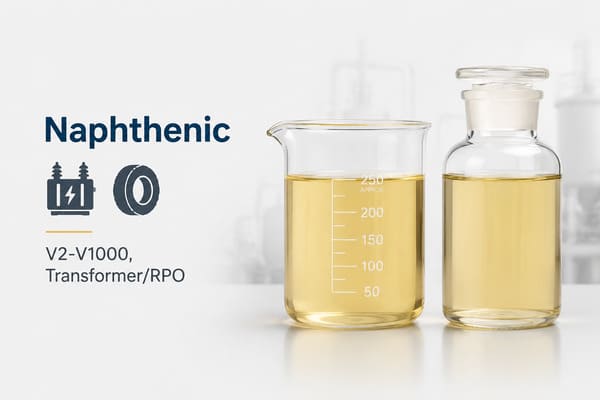
Naphthenic Base Oil — V2 to V1000
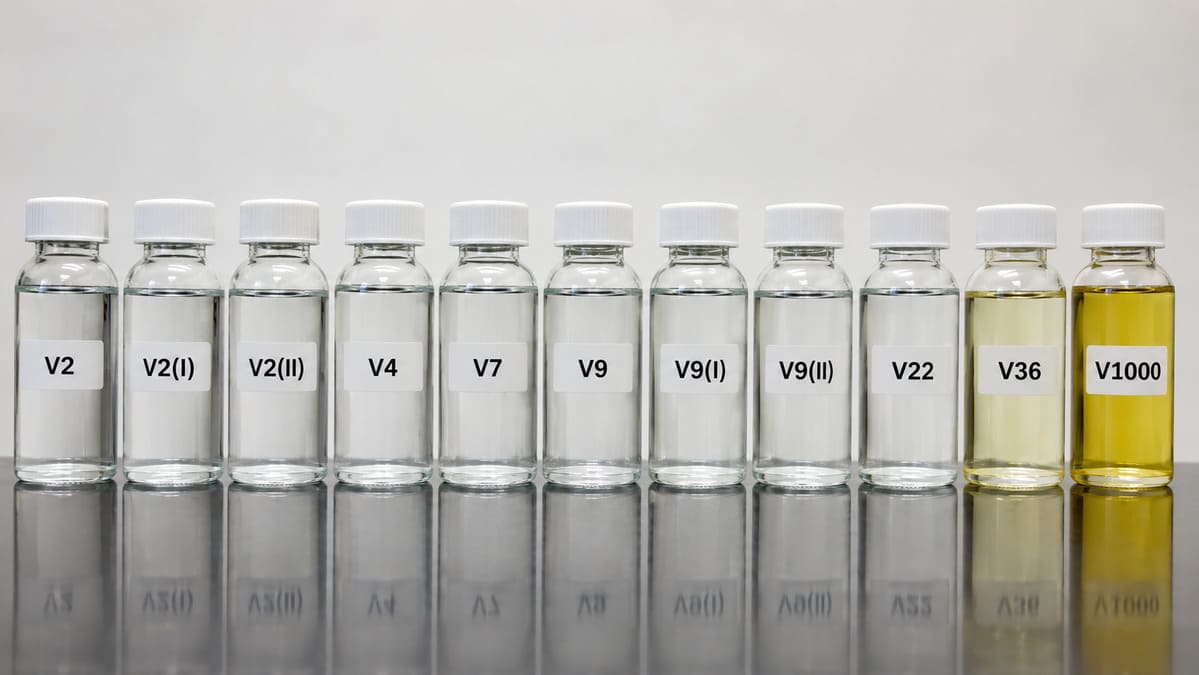
Twelve naphthenic base oil grades from light V2 to heavy V1000. Ultra-low pour point as low as −70°C and exceptional solvency for transformer oil, rubber process oil, refrigeration oil and specialty industrial fluids.
The specialty base stock for non-engine-oil applications
While paraffinic base oils dominate engine oil and general lubricant blending, naphthenic base oils are the preferred specialty stock for transformer oil, rubber compounding, refrigeration systems and many industrial fluids.
Refined from crude oils rich in cyclic saturated hydrocarbons (naphthenes) rather than straight-chain paraffins, naphthenic base oil delivers a unique combination of very low pour point (some grades below −70°C), excellent solvency for additives and elastomers, low aniline point, and higher density than paraffinic oils.
Sinolook supplies a complete naphthenic portfolio — 12 grades from V2 to V1000 — covering every viscosity requirement from refrigeration oil to heavy rubber process oil. All grades come with detailed typical-value data sheets and full SGS verification.
Ultra-Low Pour Point
Down to −70°C — outperforms any paraffinic base oil in cold flow.
Excellent Solvency
High aromatic and naphthenic content dissolves additives and softens elastomers.
Wide Viscosity Range
KV40 from 1.5 to over 1000 mm²/s — single-source supply for every application.
SGS Verified
Third-party testing on every shipment — full traceability and TDS/COA.
How naphthenic differs from paraffinic base oils
Both are mineral base oils, but their molecular structures lead to very different properties — and very different applications. If you're choosing between paraffinic Group I/II and naphthenic for a specialty application, this comparison should help.
Paraffinic Base Oil (Group I/II/III)
- StructureStraight & branched paraffins
- Pour Point−6 to −24 °C typically
- Viscosity IndexHigh (90–150)
- SolvencyLimited
- Aniline PointHigh (95–110 °C)
- DensityLower (0.84–0.89)
- Best forEngine oils, gear oils, hydraulic
Naphthenic Base Oil ★
- StructureCyclic saturated (naphthenes)
- Pour Point−30 to below −70 °C
- Viscosity IndexLow to moderate (negative to 80)
- SolvencyExcellent
- Aniline PointLow (70–95 °C)
- DensityHigher (0.85–0.93)
- Best forTransformer, RPO, refrigeration, MWF
Need paraffinic instead? View Group I SN range → or Group II hydrocracked →
Why naphthenic oil behaves differently
The defining feature of naphthenic base oil is its hydrocarbon composition — measured by the n-d-M analysis (ASTM D2140) as CA (aromatic carbon), CN (naphthenic carbon) and CP (paraffinic carbon). Naphthenic grades are dominated by CN content, which drives all the unique properties.
Sinolook V36 — Typical n-d-M Composition
Naphthenic carbon (CN) dominates — driving low pour point and high solvency. CA content provides additional solvency for elastomers and additives.
What this means in practice
- ★ Low pour point — Cyclic structures resist crystallization at cold temperatures.
- ★ High solvency — Dissolves polar additives, elastomers and resin systems readily.
- ★ Higher density — Naphthene rings pack tighter than paraffin chains.
- ★ Lower VI (intentional) — Not a drawback in specialty applications where viscosity stability is not critical.
Twelve grades organized by viscosity tier
Choose by required viscosity. Sinolook's full lineup covers the entire naphthenic spectrum from ultra-light V2 (KV40 = 1.5) to ultra-heavy V1000 (KV40 = 1014).
Medium-Light
Medium-Heavy
Heavy
All 12 naphthenic grades — typical value data
Typical values from recent production batches. All grades tested per ASTM standards. Batch-specific COA available with each shipment.
| Property | V2 | V2(I) | V2(II) | V4 | V7 | V9 | V9(I) | V9(II) | V22 | V36 | V100 | V1000 |
|---|---|---|---|---|---|---|---|---|---|---|---|---|
| KV @ 40°C (mm²/s) | 1.465 | 1.604 | 1.796 | 3.27 | 8.387 | 8.27 | 9.654 | 8.744 | 22.32 | 32.66 | 92.6 | 1014 |
| KV @ 100°C (mm²/s) | — | — | — | — | — | — | — | — | 3.65 | 5.33 | 8.30 | 23.97 |
| Density @ 20°C (kg/m³) | 832.8 | 835.4 | 838.1 | 870 | 887.6 | 889.5 | 896.4 | 891.9 | 912 | 903.4 | 903 | 929.2 |
| Flash Point (°C) | 65.5 | 72 | 85.5 | 115 | 137.5 | 138 | 146 | 138 | 173 | 206 | 222 | 228 |
| Pour Point (°C) | <−60 | <−60 | <−70 | <−50 | <−50 | −48 | <−48 | <−54 | −30 | <−50 | −43 | −4 |
| Saybolt Color | >+30 | >+30 | >+30 | >+30 | +30 | +30 | +30 | +25 | +30 | +19 | — | — |
| Sulphur (wt%) | 0.01 | 0.01 | 0.01 | — | — | — | — | 0.3 | — | 0.42 | 0.46 | 0.031 |
| Aniline Point (°C) | — | — | 80.6 | — | 70 | — | — | — | 93.5 | — | — | — |
All values per ASTM D445 (viscosity), D4052 (density), D92/D93 (flash), D97 (pour), D156 (color), D4294 (sulphur), D611 (aniline). Detailed n-d-M carbon analysis (CA/CN/CP per ASTM D2140) available on request.
Where Sinolook naphthenic base oil performs
Five major specialty markets rely on naphthenic base oil where paraffinic alternatives cannot match the pour point, solvency or elastomer compatibility required.
Transformer oil & insulating fluid
Light naphthenic grades meet IEC 60296 transformer oil specifications — combining very low pour point for cold-climate installations, high dielectric strength, and excellent oxidation resistance. Used in distribution transformers, power transformers, switchgear and capacitors worldwide.
Rubber process oil (RPO)
The largest naphthenic application globally. Used in tire treads, EPDM weather seals, NBR/HNBR oil seals, SBR and CR rubber compounding. Naphthenic RPO outperforms paraffinic for low-temperature flexibility, mixing behavior, and compatibility with most synthetic rubbers.
Refrigeration oil base stock
Naphthenic base oil with pour point below −60°C is the traditional refrigeration oil base, particularly for ammonia (NH₃) refrigeration in industrial chillers, food processing and cold storage. Also used in HFC systems where mineral compatibility is acceptable.
Metal-working fluid & specialty lubes
Naphthenic base oil's high solvency makes it ideal for soluble cutting fluids, neat cutting oils, drawing compounds and quenching oils. Also used in printing inks (offset, screen), adhesives, sealants, and as a carrier in specialty industrial chemicals.
Flexible delivery for every grade
Light grades (V2 to V9) ship in clean food-grade ISO tanks or drums to prevent any contamination — important for transformer oil and refrigeration oil applications. Heavy grades (V100, V1000) ship in standard ISO tanks and bulk vessels.
Drum (200 L)
80 drums per 20' container · sealed steel
Flexitank (24 MT)
Heavy grades only (V22+) · single-use
ISO Tank (20–22 MT)
Light grades use food-grade tanks
Bulk Vessel
Heavy grades · 1,000+ MT shipments
Frequently asked questions
What is naphthenic base oil?
What is the difference between naphthenic and paraffinic base oil?
Naphthenic contains cyclic saturated hydrocarbons — giving very low pour point (often below −50°C), excellent solvency, low aniline point, higher density.
Paraffinic dominates engine oil and general lubricant blending. Naphthenic dominates specialty applications: transformer oil, rubber process oil, refrigeration oil, metal-working fluids.
How many naphthenic grades does Sinolook supply?
• Light (KV40 1.5–4): V2, V2(I), V2(II), V4
• Medium-light (KV40 7–10): V7, V9, V9(I), V9(II)
• Medium-heavy (KV40 22–100): V22, V36, V100
• Heavy (KV40 1014): V1000
The number refers approximately to KV at 40°C in mm²/s.
Which naphthenic grade is used for transformer oil?
What is rubber process oil and which naphthenic grade is used?
Common grades: V22, V36, V100 (KV40 22–100), with V100 being the global workhorse in tire compounding.
Can naphthenic base oil be used as refrigeration oil?
For modern HFC and HFO refrigerants, polyolester (POE) synthetic oils have largely replaced naphthenic mineral oil — though naphthenic remains common in ammonia systems and some HFC applications.
What is "aniline point" and why does it matter for naphthenic oil?
Naphthenic base oils typically have aniline point 70–95°C, significantly lower than paraffinic (95–110°C). This is why naphthenic is preferred for rubber process oil (elastomer swell), printing ink (resin solubility) and additive carriers.
How is Sinolook naphthenic base oil packaged?
• 200L drums (80 per 20' container) — most common for light grades
• Flexitank (24 MT, heavy grades only)
• ISO tank (20–22 MT) — light grades use food-grade clean tanks
• Bulk vessel (1,000+ MT) — for heavy grades
Bonded storage at Yingkou, Nantong and Guangdong in China, plus partner facilities in Singapore and Malaysia.
Explore other base oil categories

Group I Base Oil
Solvent-refined paraffinic — SN150, SN250, SN500, SN650 & BS150 for industrial & marine lubricants.
View Group I
Group II Base Oil
Hydrocracked paraffinic — 100N, 150N & 500N. Multi-source from major Chinese refineries.
View Group II
White Oil
Highly refined white mineral oil from industrial through USP pharmaceutical grade.
View white oilNeed a naphthenic base oil quote?
Tell us the grade(s), volume and end-use application — we'll respond within 24 hours with batch-current TDS, SGS report, pricing and logistics options for any of our 12 grades.
Request a Quote