Xiamen Sinolook Oil Co., Ltd

Pour Point Depressant Additive Supplier — PMA & EVA Cold Flow Improvers | Sinolook

★ PMA & EVA Types · T866 · T866A · T809
Keep oil flowing in the cold — disrupt wax crystals before they gel the oil.

PMA-type (T866, T866A) and EVA-type (T809) pour point depressants that modify wax crystallization for low-temperature flow. Three chemistries covering Group I, II, III and high-wax base oils — for engine oils, hydraulic, gear oils and diesel.

3
PPD Chemistries
10–30°C
Typical PP Reduction
PMA·EVA
Types Supplied
60+
Countries Served
About Pour Point Depressants

The additive that keeps oil pourable in the cold

Every mineral base oil contains dissolved paraffin wax. As temperature drops, that wax crystallizes — and without a pour point depressant, the crystals interlock into a rigid network that gels the entire oil, stopping it from flowing.

A pour point depressant (PPD), also called a cold flow improver, prevents this. PPD molecules co-crystallize with the wax as it forms, keeping the crystals small and isolated so they cannot build a continuous gel network — leaving the oil free to flow at much lower temperatures. PPDs are highly active, typically lowering the pour point 10–30°C at treat rates of just 0.05–1.0%. Sinolook supplies both PMA-type (T866, T866A — versatile across Group I/II/III) and EVA-type (T809 — best for high-wax stocks), so you can match the PPD to your exact base oil.

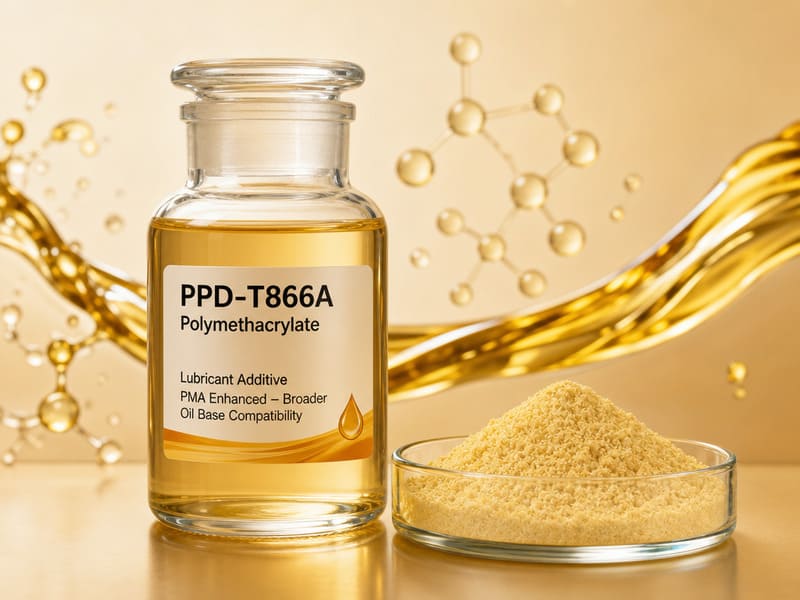
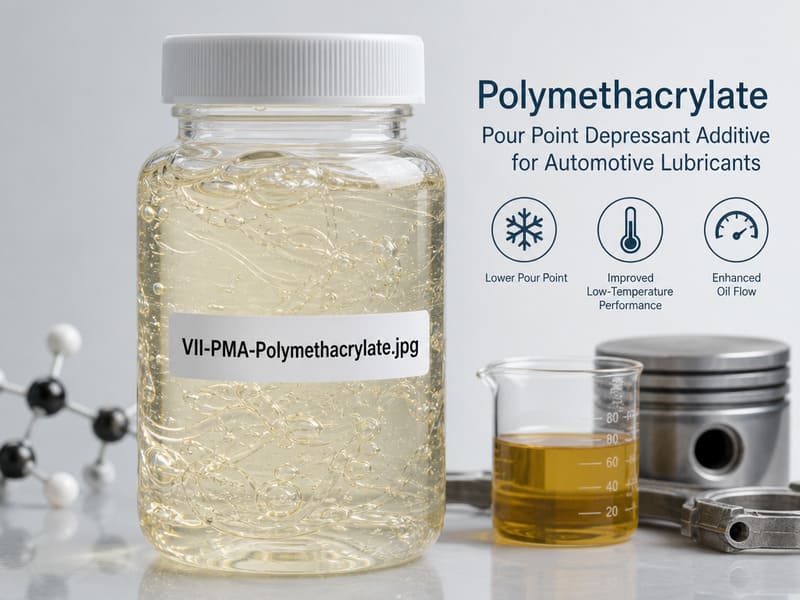
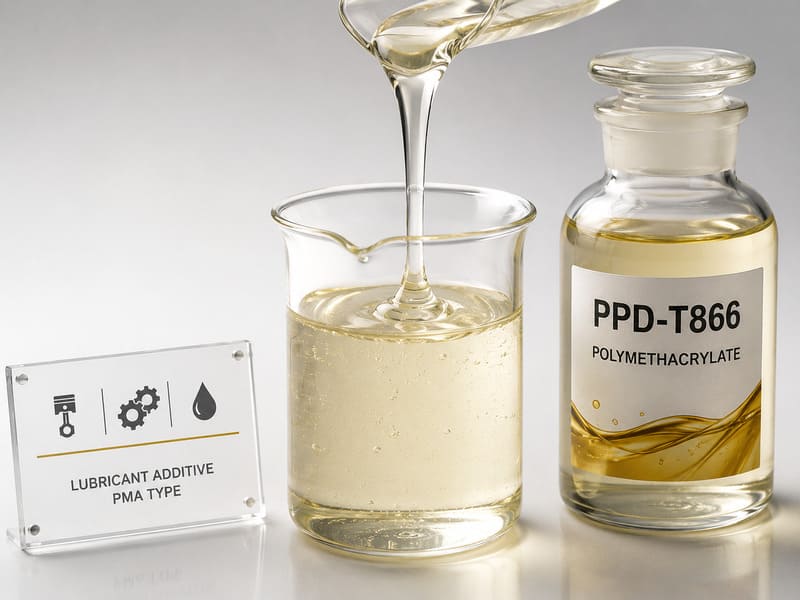
T866 polymethacrylate pour point depressant additive sample
How a Pour Point Depressant Works

Disrupting the wax network — small crystals instead of a gel

A PPD does not dissolve wax or stop it appearing. Instead it changes the shape of the wax crystals as they form — turning large interlocking plates that gel the oil into small isolated crystals that let the oil keep flowing.

Wax crystallization at low temperature — without vs with PPD PPD modifies crystal shape so wax cannot build a continuous gel network WITHOUT PPD Large interlocking wax plates → Oil GELS · will not pour ✗ + PPD WITH PPD Small isolated crystals → Oil FLOWS · stays pourable ✓ KEY POINT PPD does not stop wax appearing (cloud point unchanged) — it stops wax from gelling the oil (pour point lowered)

Because the PPD must co-crystallize with the specific wax in your base oil, response is base-oil-specific — always confirm with a pour point response curve in the actual stock. PMA-type PPDs additionally provide some viscosity index improvement — see viscosity index improvers →.

Pour Point Reduction

From -9°C to -39°C — what a PPD delivers

A small dose of pour point depressant transforms a base oil's cold-flow behaviour. The chart below shows a typical pour point response — actual reduction depends on the base oil wax profile and PPD type.

Typical pour point response to PPD treat rate Illustrative Group II base oil · actual response is base-oil-specific and must be tested Pour Point (°C) 0 -10 -20 -30 -40 -9°C Base oil no PPD -21°C + 0.1% PPD -33°C + 0.3% PPD -39°C + 0.5% PPD ≈ optimum 30°C pour point reduction at just 0.5% treat

Note the diminishing return — most of the benefit comes by 0.3%, and beyond the optimum, extra PPD gives little further reduction (and can occasionally raise the pour point). This is why a pour point response curve in your actual base oil is essential.

Our Pour Point Depressant Range

Three PPD chemistries for every base oil type

PMA-type T866 and T866A for versatile Group I/II/III performance, plus EVA-type T809 for high-wax stocks — click any product for full TDS and bulk-supply quotation.

T866A polymethacrylate pour point depressant wide base oil range
T866A · PMA

T866A Polymethacrylate PPD

PMA type · wider base range · Per TDS

An improved PMA-type PPD with broader base-oil compatibility and optimized side-chain distribution — for formulators needing reliable response across mixed or varying base stocks.

View details
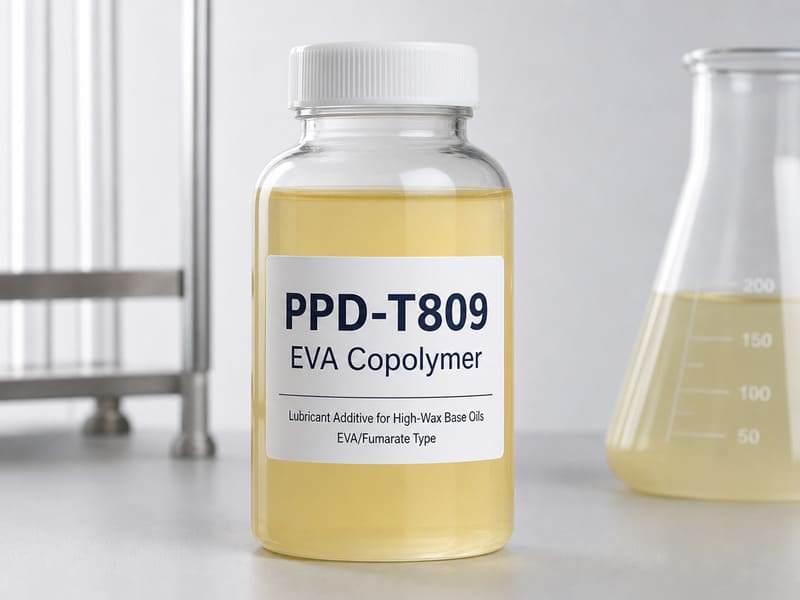
T809 EVA ethylene vinyl acetate pour point depressant high wax
T809 · EVA

T809 EVA PPD

EVA / fumarate type · high-wax · Per TDS

Ethylene-vinyl acetate type PPD, particularly effective in highly paraffinic, high-wax base oils. Often the most cost-effective choice for Group I and high-wax stocks.

View details
Selection Guide

Three PPD grades at a glance

Quick comparison across all three Sinolook pour point depressants. Click any row to open the full TDS.

Product Type Best Base Oil Typical Treat Rate Key Strength TDS
T866A Polymethacrylate (PMA) Mixed / varying stocks 0.1–0.5% Wider base-oil compatibility View →
T809 EVA / fumarate ester Group I, high-wax 0.05–1.0% Best for high-wax · cost-effective View →

Treat rates indicative. PPD response is base-oil-specific — always confirm with a pour point response curve in your actual base oil.

Where Pour Point Depressants End Up

Anywhere oil must flow in the cold

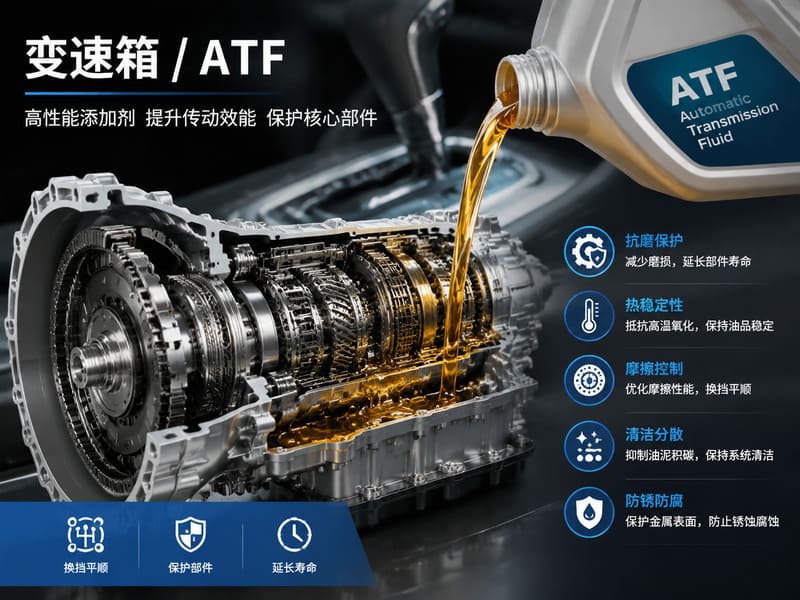
Any lubricant that operates in cold climates or starts up cold needs a pour point depressant — from winter engine oils to outdoor hydraulic systems and cold-store gear drives.

Why Sinolook Pour Point Depressants

Both PMA and EVA chemistries — matched to your base oil

PPD performance depends entirely on matching the additive to the base oil's wax profile. Sinolook carries both PMA and EVA chemistries so you can select — or test — the best response for your exact stock.

ADVANTAGE 01

PMA + EVA in one supply chain

T866 / T866A (PMA) for Group I/II/III versatility plus T809 (EVA) for high-wax stocks — select the right chemistry for your base oil without switching suppliers.

ADVANTAGE 02

PPD selection support

Tell us your base oil type and target pour point, and we'll recommend the best-matched chemistry and a starting treat-rate range for your pour point response testing.

ADVANTAGE 03

Dual-function PMA grades

Our PMA-type PPDs deliver pour point depression plus viscosity index improvement — see our viscosity index improvers for the VII-focused PMA grades.

ADVANTAGE 04

Drum to ISO tank, sample to bulk

Start with a 200L drum for formulation qualification, scale to IBC tote, flexitank or ISO tank for commercial supply across 60+ countries.

Related Additive Categories

Pair pour point depressants with viscosity modifiers for full cold-flow performance

Cold-weather multigrade oils combine pour point depressants (for the gel point) with viscosity modifiers (for the viscosity-temperature curve). PMA chemistry bridges both — Sinolook supplies the complete cold-flow toolkit:

FAQ

Frequently asked questions about pour point depressants

What is a pour point depressant?
A pour point depressant (PPD), also called a cold flow improver, is a polymer additive that lowers the temperature at which a lubricant stops flowing. Base oils contain dissolved wax (paraffin) that crystallizes as temperature drops; without a PPD, these wax crystals grow and interlock into a rigid three-dimensional network that traps the oil and prevents it from pouring. A pour point depressant co-crystallizes with the wax, modifying the crystal shape so the crystals stay small and isolated, leaving the oil free to flow. PPDs typically lower the pour point by 10–30°C at treat rates of just 0.05–1.0%.
How does a pour point depressant work?
A PPD works by interfering with wax crystallization, not by dissolving the wax. PPD molecules have alkyl side chains similar in length to the paraffin wax in the base oil. As the oil cools, the PPD co-crystallizes onto the growing wax crystal surfaces, disrupting their normal plate-like growth. Instead of forming large interlocking plates that gel the entire oil volume, the wax forms small, compact, isolated crystals that cannot build a continuous network. The oil therefore continues to flow at much lower temperatures.

Important: the PPD does not lower the cloud point (the temperature where wax first appears) — it only stops the wax from gelling the oil, lowering the pour point.
What is the difference between PMA-type and EVA-type pour point depressants?
PMA-type (polymethacrylate, such as T866 and T866A) pour point depressants are the most versatile — effective across a wide range of base oil types including Group I, II and III. They have comb-like alkyl side chains that co-crystallize with wax and additionally provide some viscosity index improvement.

EVA-type (ethylene-vinyl acetate, such as T809) and fumarate ester PPDs are particularly effective in highly paraffinic base oils with high wax content, and are often more cost-effective for these high-wax stocks.

The best PPD for a given oil depends on the base oil wax structure, so response should always be confirmed by testing in the actual base oil.
Does a pour point depressant work in every base oil?
No — PPD response is highly specific to the base oil. The PPD alkyl side-chain length must match the wax chain-length distribution of the particular base oil to co-crystallize effectively. A PPD that lowers the pour point of one base oil by 27°C may only achieve 9°C in a different base oil with a different wax profile.

This is why formulators must always test PPD response (a pour point response curve at several treat rates) in the exact base oil being used. Sinolook supplies three PPD chemistries so formulators can select the best match for Group I, II, III or high-wax stocks — contact us and we'll help you choose a starting point.
How much pour point depressant do I need?
Pour point depressants are highly active at low treat rates. Typical ranges:
Engine oils: 0.1–0.5%
Hydraulic & gear oils: 0.05–0.3%
High-wax or difficult base oils: up to 1.0%

Because response is non-linear, more PPD does not always mean a lower pour point — there is usually an optimum treat rate beyond which additional PPD gives little further benefit, or can even raise the pour point slightly (over-treat reversal). Always determine the optimum by running a pour point response curve in your actual base oil.
What is the difference between pour point and cloud point?
Cloud point is the temperature at which wax first becomes visible as the oil turns hazy/cloudy — the very start of wax crystallization. Pour point is the lower temperature at which the oil stops flowing entirely because the wax network has gelled the whole volume.

A pour point depressant lowers the pour point but does not lower the cloud point — wax still starts appearing at the same temperature, but the PPD prevents those crystals from building the gel network. If you need to lower the cloud point (e.g. for some fuel or clarity-critical applications), that requires different chemistry. For lubricants, pour point is the property that matters for cold-start pumpability.
What packaging and MOQ does Sinolook offer?
PPDs are viscous polymer solutions. Packaging: 200L drum (sample / qualification), 1000L IBC tote (pilot batches), and ISO tank for bulk. IBC and ISO tank deliveries include heated-discharge guidance for viscous grades. MOQ typically 1 drum for samples and 1 ISO tank for commercial. Global bonded storage across strategic Asia-Pacific hubs enables fast delivery worldwide. HS Code 3811.21 / 3902 depending on polymer type.
Can Sinolook provide TDS, MSDS, COA and pour point response data?
Yes. Technical Data Sheet (TDS), Material Safety Data Sheet (MSDS / SDS in GHS format), and batch-specific Certificate of Analysis (COA) are provided for every pour point depressant in English or Chinese. We can also assist with selecting the right PPD chemistry for your base oil type and recommend a starting treat-rate range for your pour point response testing. Email sales@sinolook.com or message us on WhatsApp.

Ready to source pour point depressants from Sinolook?

Tell us your base oil type (Group I/II/III or high-wax), target pour point and volume — we'll recommend the right PPD chemistry and respond within 24 hours with TDS and a delivered quotation.

Request a Quote
滚动至顶部