Xiamen Sinolook Oil Co., Ltd

Viscosity Index Improver Supplier — PMA, OCP & HSD Viscosity Modifiers | Sinolook

★ PMA · OCP · HSD — 3 Polymer Chemistries
The polymer backbone of every multigrade oil — fluid when cold, thick when hot.

Polymethacrylate (PMA), olefin copolymer (OCP) and hydrogenated styrene-diene copolymer (HSD) viscosity modifiers — three chemistries covering thickening efficiency, low-temperature performance and shear stability for multigrade engine oils, ATF, gear oils and HVI hydraulic fluids.

3
Polymer Chemistries
PMA·OCP·HSD
VII Types Supplied
Multigrade
5W-30 · 15W-40 · HVI
60+
Countries Served
About Viscosity Index Improvers

The polymer that makes multigrade oil possible

Without a viscosity index improver, a single oil cannot be both thin enough for a cold winter start and thick enough to protect a hot running engine. The VII is what turns a single-grade base oil into a 5W-30 or 15W-40 multigrade.

A viscosity index improver (VII), also called a viscosity modifier (VM), is a polymer that dissolves in the base oil and changes shape with temperature. When cold, the polymer coils contract and contribute little viscosity, so the oil stays fluid for easy cold starts; when hot, the coils expand and thicken the oil, compensating for the base oil's natural thinning. Sinolook supplies all three major VII chemistries — PMA (best low-temperature + pour point depression), OCP (most cost-effective workhorse), and HSD (best shear stability) — so you can match the exact viscosity, low-temperature and durability targets of your finished lubricant.

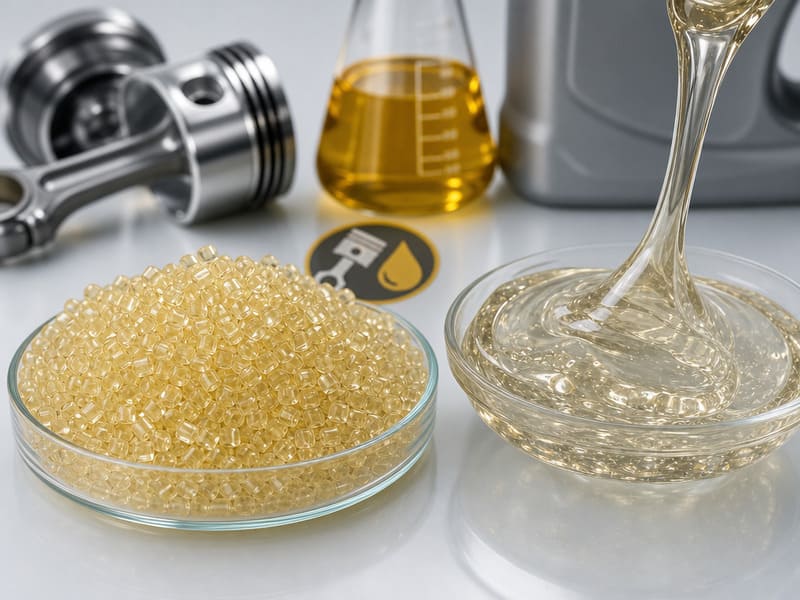
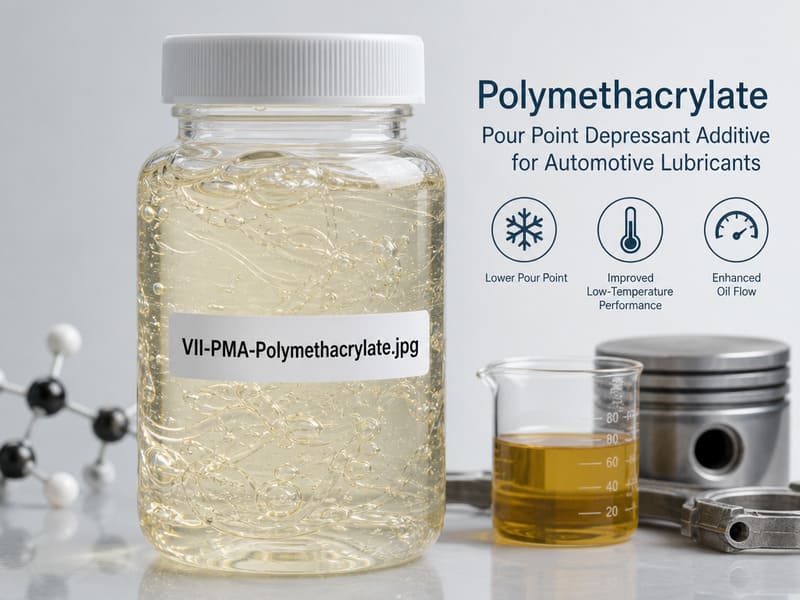
Polymethacrylate PMA viscosity index improver sample
How a Viscosity Index Improver Works

Coil expansion: thin when cold, thick when hot

The VII polymer changes shape with temperature. This temperature-dependent coil expansion is the entire reason multigrade oils exist — it flattens the viscosity-temperature curve so the oil behaves correctly at both extremes.

VII coil expansion with temperature Contracted coils when cold (low thickening) → expanded coils when hot (high thickening) COLD (e.g. -20°C) Coils contracted = small volume Low viscosity contribution → oil stays fluid for cold start heat ↑ HOT (e.g. 100°C) Coils expanded = large volume High viscosity contribution → oil thickens to protect hot engine Result: flatter viscosity-temperature curve (higher VI) visc temp → base oil (low VI, steep) with VII (high VI, flat = multigrade)

The flatter the viscosity-temperature curve, the higher the Viscosity Index (VI) — and the wider the multigrade span the oil can achieve (e.g. 5W-40 vs 20W-40). VIIs are what make wide-span fuel-economy grades like 0W-20 and 5W-30 possible.

PMA vs OCP vs HSD

Three chemistries, three performance balances

No single VII is best at everything. OCP wins on cost and thickening efficiency, PMA wins on low-temperature performance (plus pour point depression), and HSD wins on shear stability. Choose by what your finished oil specification prioritizes.

VII performance comparison — relative strengths Longer bar = stronger performance in that property PMA OCP HSD Thickening efficiency Shear stability (low SSI) ★ HSD best Low-temperature performance ★ PMA best Cost efficiency ★ OCP best OCP = cost-effective workhorse · PMA = low-temp + pour point depression · HSD = shear stability for long-drain oils

Bonus: PMA uniquely doubles as a pour point depressant thanks to its comb-like side chains — see pour point depressants →. Many formulations blend two VII types to balance cost and performance.

Our Viscosity Modifier Range

Three VII chemistries for every multigrade target

From cost-effective OCP for mainstream engine oils to shear-stable HSD for long-drain HDDO and low-temperature PMA for hydraulic and ATF — click any product for full TDS and bulk-supply quotation.

Olefin copolymer OCP ethylene propylene viscosity index improver
OCP

Olefin Copolymer (OCP)

Ethylene-propylene · Per TDS

The most widely used and most cost-effective viscosity modifier — good thickening efficiency, the mainstream workhorse for passenger car and heavy-duty multigrade engine oils.

View details
Selection Guide

Three VII grades at a glance

Quick comparison across all three Sinolook viscosity modifier products. Click any row to open the full TDS.

Product Chemistry Typical Treat Rate Primary Application Key Strength TDS
Olefin Copolymer (OCP) Ethylene-propylene 4–12% PCMO & HDDO multigrade engine oil Cost-effective workhorse View →

Treat rates indicative for typical formulations on an as-supplied basis. Refer to product TDS, your viscosity targets (SAE J300) and the maximum SSI allowed by your specification.

Where Viscosity Modifiers End Up

Three application zones, three VII strategies

The right VII depends on whether the finished lubricant prioritizes cost, low-temperature flow, or shear stability under sustained mechanical stress.

Why Sinolook Viscosity Modifiers

Three chemistries, consistent SSI, one supply chain

VII performance depends entirely on molecular-weight consistency — the difference between hitting your viscosity target on the first blend or reformulating. Every Sinolook VII batch is verified for thickening efficiency and shear stability.

ADVANTAGE 01

All three VII chemistries in one source

PMA, OCP and HSD under one PO — match cost, low-temperature and shear-stability targets without qualifying separate suppliers for each polymer type.

ADVANTAGE 02

Consistent thickening & SSI

Molecular-weight and shear-stability index verified per batch — predictable thickening response means fewer reformulations and stable viscosity grade in production.

ADVANTAGE 03

Dual-function PMA

Our PMA grades deliver viscosity index improvement plus pour point depression in one additive — simplifying low-temperature multigrade hydraulic and ATF formulations.

ADVANTAGE 04

Drum to ISO tank, sample to bulk

Start with a 200L drum for formulation qualification, scale to IBC tote, flexitank or ISO tank for commercial supply across 60+ countries.

Related Additive Categories

Pair viscosity modifiers with pour point depressants and dispersants

Multigrade oils combine viscosity modifiers with pour point depressants for cold-flow performance, and dispersant-type VIIs overlap with the dispersant function. Sinolook supplies the full bench:

FAQ

Frequently asked questions about viscosity index improvers

What is a viscosity index improver?
A viscosity index improver (VII), also called a viscosity modifier (VM), is a polymer additive that reduces the rate at which a lubricant thins as temperature rises. At low temperature the polymer coils contract and contribute little to viscosity, so the oil stays fluid for easy cold starts; at high temperature the coils expand and thicken the oil, compensating for the natural thinning of the base oil. This coil expansion behaviour is what makes multigrade oils such as 5W-30 and 15W-40 possible — a single oil that behaves like a thin oil when cold and a thick oil when hot. VIIs are essential in engine oils, transmission fluids, gear oils and multigrade hydraulic oils.
What is the difference between PMA, OCP and HSD viscosity modifiers?
The three differ in polymer chemistry and performance balance:
OCP (olefin copolymer, ethylene-propylene) — the most widely used and most cost-effective viscosity modifier, with good thickening efficiency. The workhorse for engine oils.
PMA (polymethacrylate) — the best low-temperature performance, and uniquely also acts as a pour point depressant. Ideal for multigrade hydraulic oils, ATF and Arctic-grade lubricants.
HSD (hydrogenated styrene-diene copolymer, often star-shaped) — the best shear stability, retaining viscosity under high mechanical stress. Preferred for long-drain heavy-duty diesel and high-performance engine oils.

Many formulations blend two VII types to balance cost and performance.
What is shear stability index (SSI) and why does it matter?
Shear stability index (SSI) measures how much viscosity a polymer-thickened oil permanently loses when its polymer chains are mechanically broken by the high shear forces inside an engine or gear set. A lower SSI = more shear-stable = retains viscosity longer in service.

The trade-off: high-molecular-weight polymers give more thickening per gram but shear down faster (high SSI); low-molecular-weight polymers are more shear-stable (low SSI) but need a higher treat rate. HSD copolymers are engineered for very low SSI, making them ideal for long-drain heavy-duty applications; OCP is moderate; PMA varies by grade. The finished oil specification dictates the maximum allowable SSI (e.g. heavy-duty diesel oils often require SSI ≤ 35 or lower).
Why does PMA also work as a pour point depressant?
Polymethacrylate has a comb-like molecular structure with alkyl side chains similar to the wax molecules that crystallize in base oil at low temperature. These side chains co-crystallize with the wax, disrupting the formation of the rigid three-dimensional wax network that would otherwise gel the oil. This is the same mechanism used by dedicated pour point depressants.

As a result, PMA viscosity modifiers deliver dual functionality — viscosity index improvement plus pour point depression — which is why PMA is the preferred choice for low-temperature multigrade hydraulic oils, ATF and Arctic-grade lubricants where both properties are critical. See pour point depressants for dedicated cold-flow products.
How much viscosity index improver do I need in my formulation?
Treat rate depends on the viscosity spread required and the polymer's thickening efficiency. Typical ranges (as-supplied basis):
PCMO multigrade (5W-30, 5W-40): 5–12% OCP or HSD
HDDO multigrade (15W-40): 4–8%
Multigrade HVI hydraulic (HV / HVLP): 3–8% PMA
Automatic transmission fluid: 6–12% PMA

Wider viscosity spreads (e.g. 0W-40) require more polymer or higher-efficiency grades. Always reference the finished oil viscosity targets (SAE J300 for engine oils) and the maximum SSI allowed by the specification.
What is the difference between a viscosity index improver and a viscosity modifier?
They are two names for the same thing. "Viscosity Index Improver (VII)" is the traditional term emphasizing the effect — raising the oil's viscosity index. "Viscosity Modifier (VM)" is the more modern term preferred in current API and ACEA documentation, emphasizing that the polymer modifies the viscosity-temperature relationship. Both refer to the polymer additives (PMA, OCP, HSD) that enable multigrade oils. You may also see "VI Improver" or "VM polymer" — all the same additive class.
What packaging and MOQ does Sinolook offer?
VIIs are high-viscosity polymers (often solid or gel at ambient for OCP, viscous liquid for PMA / HSD). Packaging: 200L drum (liquid grades), solid bales / bags (solid OCP), 1000L IBC tote, and ISO tank for liquid bulk. IBC and ISO tank deliveries of liquid VII include heated-discharge guidance. MOQ typically 1 drum / 1 bale for samples and 1 ISO tank or full bale-lot for commercial. Global bonded storage across strategic Asia-Pacific hubs enables fast delivery worldwide. HS Code 3811.21 / 3902 depending on polymer type.
Can Sinolook provide TDS, MSDS, COA and starting formulations?
Yes. Technical Data Sheet (TDS), Material Safety Data Sheet (MSDS / SDS in GHS format), and batch-specific Certificate of Analysis (COA) are provided for every viscosity modifier in English or Chinese. We can also share reference starting formulations for:
• SAE 5W-30 / 5W-40 / 0W-20 PCMO
• SAE 15W-40 HDDO
• Multigrade HVI hydraulic oil (HV 32 / 46 / 68)
• Automatic transmission fluid
With recommended VII type, treat rate and SSI targets. Email sales@sinolook.com or message us on WhatsApp.

Ready to source viscosity modifiers from Sinolook?

Tell us the polymer type (PMA, OCP, HSD), target viscosity grade and SSI requirement — we'll respond within 24 hours with TDS, reference treat rate and a delivered quotation.

Request a Quote
滚动至顶部