Pour Point Depressants Compared: T866 vs T866A vs T809
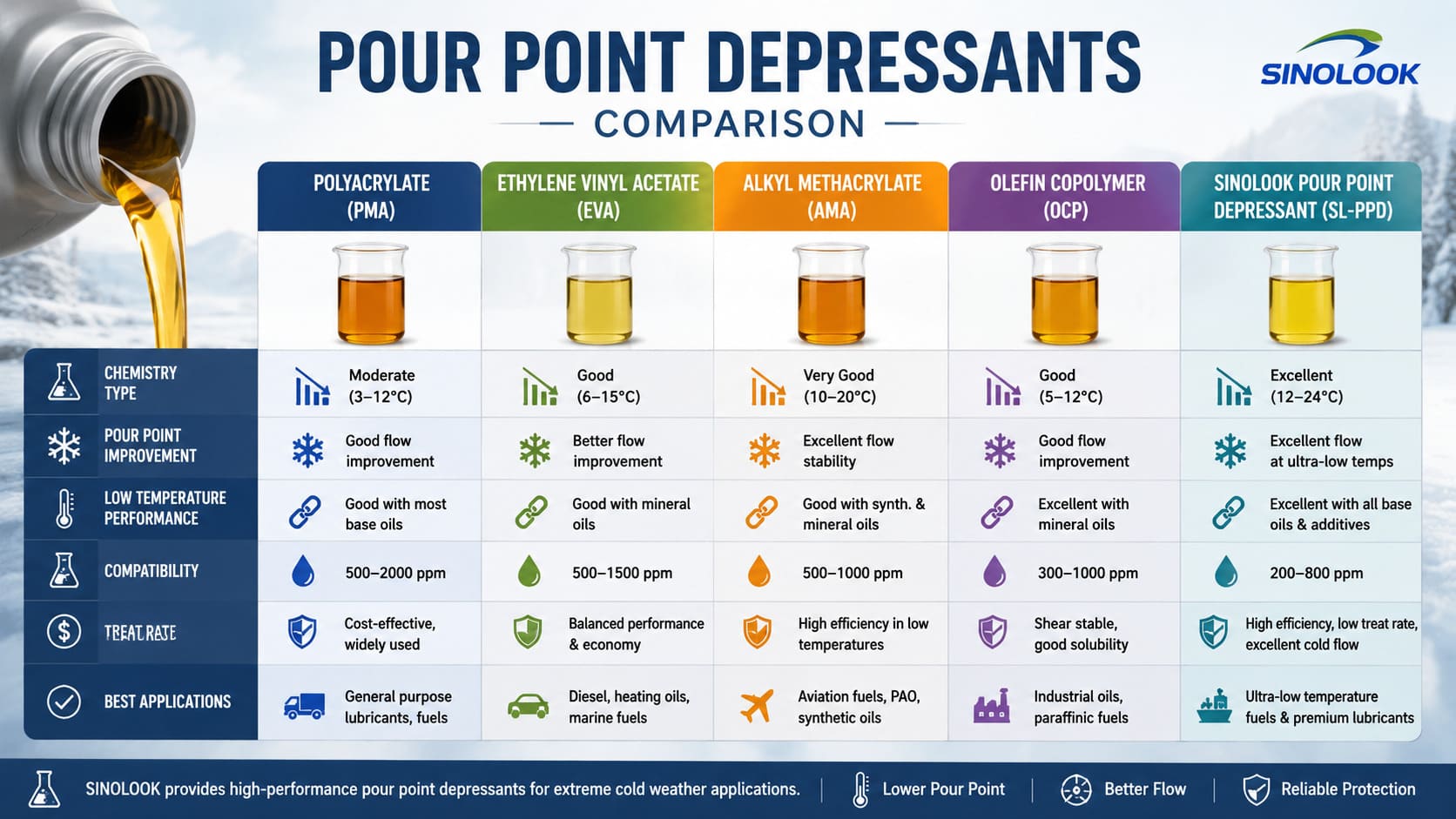
As oil cools, paraffin wax crystallizes and the oil stops flowing. A pour point depressant (PPD) modifies how those wax crystals grow, keeping the oil pumpable in the cold. But the best PPD depends heavily on your base oil's wax — here is how the main types differ and how to choose.
What a pour point depressant does
Mineral base oils contain paraffin wax. As the oil cools, that wax crystallizes and the crystals interlock into a rigid network that traps the oil and stops it flowing — the temperature at which this happens is the pour point. A pour point depressant (PPD) co-crystallizes with the wax, modifying crystal growth so the rigid network cannot form, keeping the oil pumpable at lower temperatures.
An important distinction: a PPD lowers the pour point (when the oil stops flowing), but it does not change the cloud point (when wax first becomes visible). PPDs target pourability and cold pumpability, not the onset of wax formation. They are essential in engine, hydraulic, gear and industrial oils used in cold conditions.
PMA vs EVA chemistry
T866 — polymethacrylate (PMA)
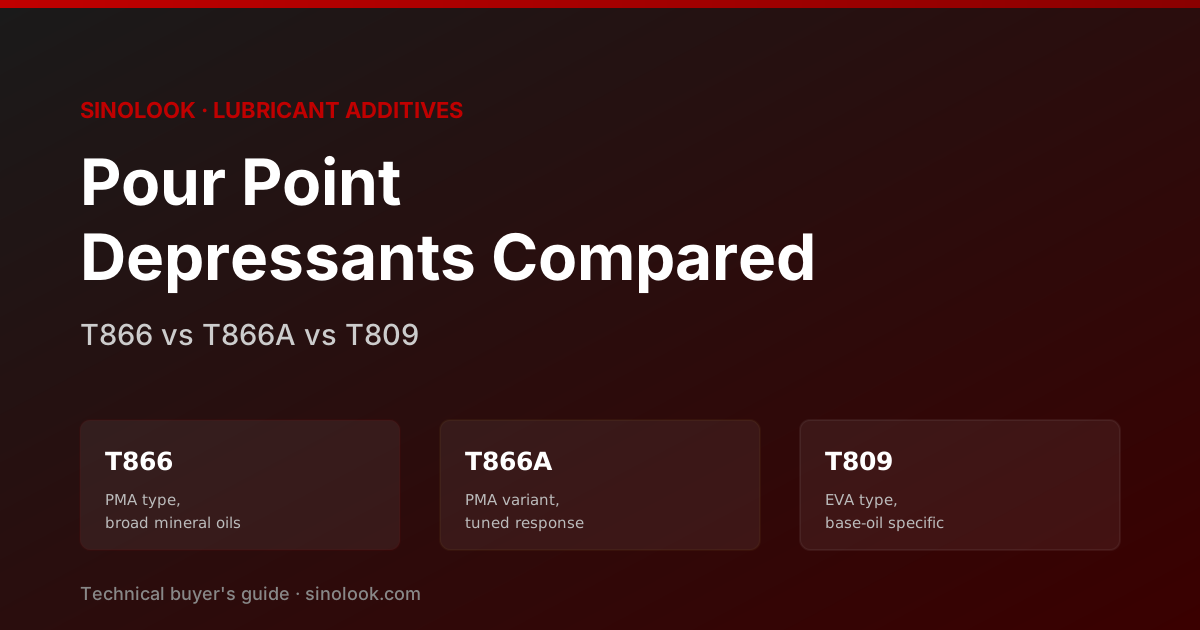
T866 is a polymethacrylate PPD, effective across a broad range of mineral base oils. PMA chemistry is the versatile, widely-used choice for general pour point depression.
T866A — polymethacrylate variant
T866A is a tuned variant in the same PMA family, with characteristics (such as molecular weight or treat response) optimized for particular base oils and pour point targets — an alternative when T866 is not the best match.
T809 — ethylene-vinyl acetate (EVA)
T809 is an EVA copolymer PPD. EVA chemistry can be highly effective — and sometimes more economical — in specific base oils and wax types where it matches the wax structure especially well, giving a different chemistry to try.
| Property | T866 (PMA) | T866A (PMA) | T809 (EVA) |
|---|---|---|---|
| Polymer type | Polymethacrylate | Polymethacrylate | Ethylene-vinyl acetate |
| Base oil range | Broad | Broad (tuned) | Specific wax types |
| Best fit | General mineral oils | When T866 underperforms | Where EVA matches wax |
| Versatility | High | High | Base-oil dependent |
| Economy | Good | Good | Can be best for some oils |
| Approach | First choice | Alternative PMA | Different chemistry to test |
Key insight: there is no universal best pour point depressant. Because wax composition varies between base oils, the same PPD can excel in one base oil and underperform in another. The reliable method is to test PMA (T866/T866A) and EVA (T809) candidates against your actual base oil and compare the pour point achieved per unit of treat.
Why response is base-oil specific
A PPD works by matching and disrupting the wax crystals of a particular oil. Different base oils — Group I, II, III, from different crudes and processes — have different wax structures, so a PPD that perfectly disrupts one oil's wax may barely affect another's. This is why PPD selection is empirical: you test against the real base oil rather than choosing from a spec sheet alone. The pour point itself is measured by ASTM D97. For more on base oil groups and their wax behaviour, see our base oil range.
How to choose and test
Start with a PMA type (T866) as the broad first choice. If it does not hit the pour point target efficiently, try the tuned T866A variant, and test the EVA-type T809 in parallel — for some base oils EVA is markedly more effective or economical. Compare the pour point achieved at equal treat rates, and confirm the chosen PPD does not harm other low-temperature properties. Note too that PMA viscosity modifiers provide built-in pour point depression, which can reduce the separate PPD needed.
Need to hit a cold-flow target?
Sinolook supplies PMA pour point depressants (T866, T866A) and EVA-type T809 to over 60 countries. Tell us your base oil and pour point target and our technical team can help you select and test the right PPD.
Request technical support & a quoteFrequently asked questions
What is the difference between T866, T866A and T809 pour point depressants?
T866 and T866A are polymethacrylate (PMA) PPDs effective across a broad range of mineral oils, with T866A being a tuned variant for particular base oils. T809 is an ethylene-vinyl acetate (EVA) copolymer PPD that can be especially effective in specific base oils and wax types. PMA types are versatile first choices; EVA is a different chemistry to try when it matches the wax better.
Why is pour point depressant response base-oil specific?
A PPD works by disrupting the specific wax crystals of a base oil. Different base oils have different wax structures, so a PPD that works well in one oil may underperform in another. This is why PPD selection is empirical — you test candidates against the actual base oil rather than relying on the spec sheet alone.
Does a pour point depressant change the cloud point?
No. A PPD lowers the pour point (the temperature at which the oil stops flowing) by modifying wax crystal growth, but it does not change the cloud point (the temperature at which wax first becomes visible). The two are distinct low-temperature properties; PPDs target pourability and cold pumpability, not the onset of wax formation.
How do I choose the right pour point depressant?
Start with a PMA type such as T866 as a broad first choice. If it does not hit your pour point target efficiently, try the tuned T866A variant and test the EVA-type T809 in parallel, since EVA can be more effective in some base oils. Compare the pour point achieved at equal treat rates against your actual base oil.
Can Sinolook supply both PMA and EVA pour point depressants?
Yes. Sinolook supplies PMA pour point depressants (T866 and the tuned T866A variant) and the EVA copolymer type T809 to over 60 countries, with TDS, MSDS and batch COA. Our technical team can help you select and test the right PPD for your base oil and pour point target. Contact sales@sinolook.com.