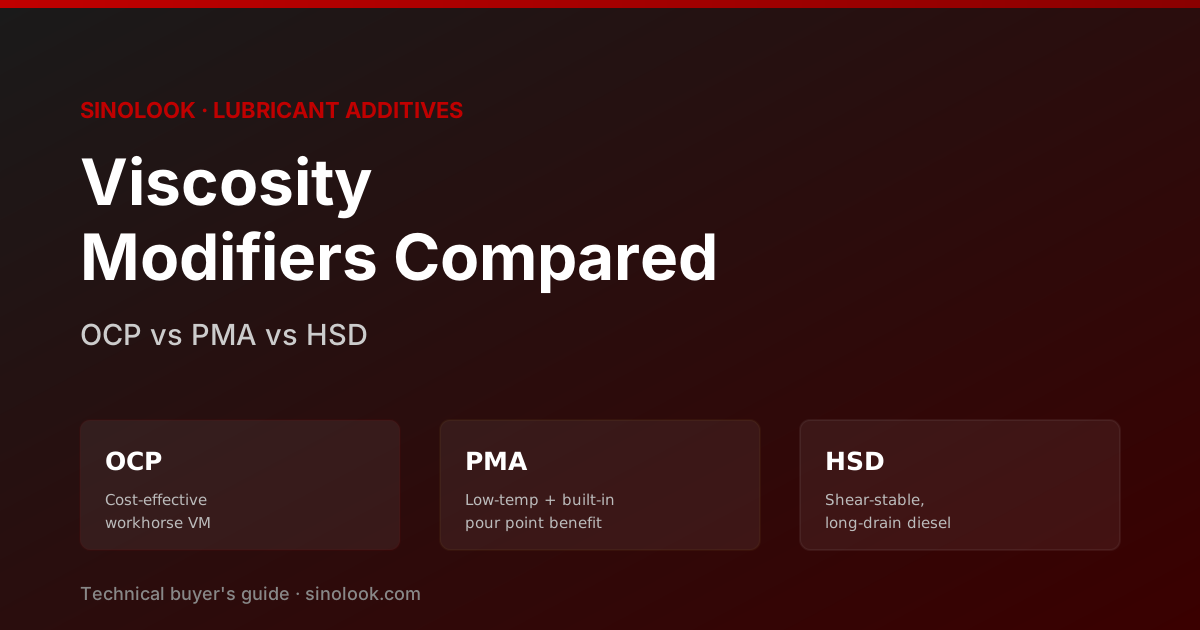
Viscosity Modifiers Compared: OCP vs PMA vs HSD
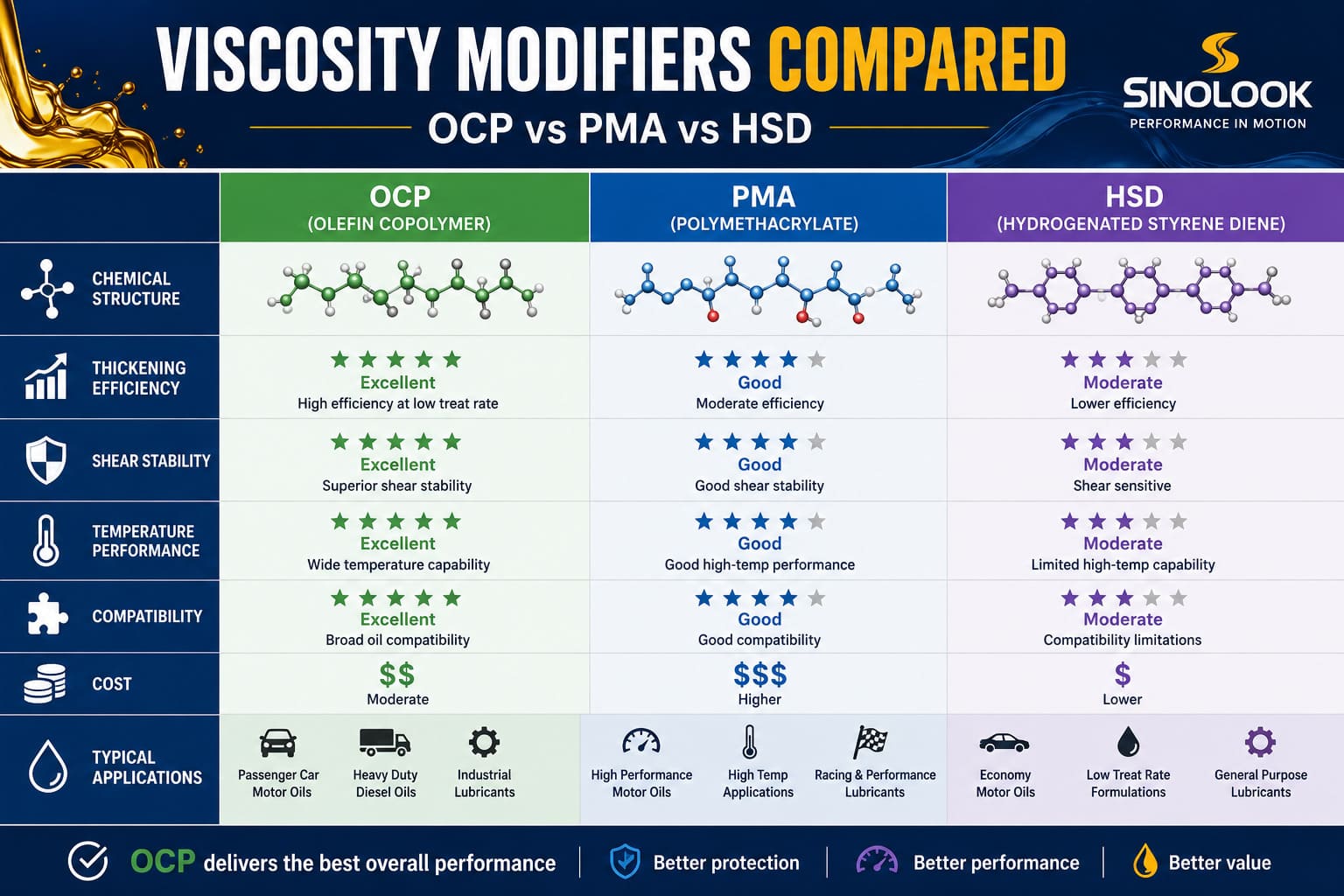
Viscosity modifiers turn a thin base oil into a multigrade oil — thickening more at high temperature than low, so the oil flows when cold and protects when hot. But the three main chemistries trade off cost, shear stability and low-temperature performance differently. Here is how to choose.
What a viscosity modifier does
A viscosity modifier (VM), also called a viscosity index improver, is a polymer that thickens oil more at high temperature than at low. This flattens the viscosity-temperature curve, letting a single oil behave like a thin oil when cold (for easy cold starts) and a thick oil when hot (for film strength). It is what makes a multigrade oil like 5W-30 possible.
The trade-offs between VM types come down to three things: thickening efficiency (how much viscosity per unit of polymer, which drives cost), shear stability (how well it resists permanent thinning in service), and low-temperature performance. The three main chemistries each optimize a different balance.
OCP, PMA and HSD
OCP — olefin copolymer
OCP (ethylene-propylene copolymer) is the cost-effective workhorse of engine oils, with excellent thickening efficiency and a range of shear-stability grades. It is the most widely used VM.
PMA — polymethacrylate
PMA offers excellent low-temperature performance and a built-in pour point depression bonus few other VMs provide. It is preferred for ATF, hydraulic oils and high-VI oils.
HSD — hydrogenated styrene-diene
HSD has very high shear stability (very low SSI), holding its viscosity grade through long, demanding service. It is ideal for long-drain heavy-duty diesel oils.
| Property | OCP | PMA | HSD |
|---|---|---|---|
| Cost efficiency | Best | Higher | Higher |
| Thickening efficiency | Excellent | Good | High |
| Shear stability | Range of grades | Good | Very high (low SSI) |
| Low-temp performance | Good | Excellent | Good |
| Pour point benefit | No | Yes (built-in) | No |
| Best for | Engine oils | ATF / hydraulic / high-VI | Long-drain diesel |
Key insight: there is no single best VM — OCP wins on cost for mainstream engine oils, PMA on low-temperature performance for ATF and hydraulic oils, and HSD on shear stability for long-drain diesel. Match the chemistry to what the oil must do, and to the drain interval it must survive.
Shear stability (SSI) explained
Shear Stability Index (SSI) measures how much a VM permanently loses viscosity under mechanical shear in service — a lower SSI means the polymer resists shearing and the oil stays in grade longer. Viscosity itself is measured by ASTM D445. SSI is the single most important durability property of a VM: a high-SSI polymer may shear down and drop the oil out of grade before the drain interval is up.
This is why HSD, with very low SSI, is favoured for long-drain diesel oils, while OCP is available across a range of SSI grades to match cost against durability. Choosing SSI is really choosing how long the oil must hold its grade.
How to choose (by application)
Passenger car and general engine oils
OCP is the cost-effective standard, with SSI chosen to match the drain interval. See engine oil additives.
Long-drain heavy-duty diesel
HSD's shear stability keeps the oil in grade through extended, high-shear service. See diesel engine oil additives.
ATF, hydraulic and high-VI oils
PMA's low-temperature performance and built-in pour point depression make it the choice. See hydraulic oil additives.
Choosing a viscosity modifier?
Sinolook supplies OCP, PMA and HSD viscosity modifiers in a range of shear-stability grades to over 60 countries. Tell us your viscosity target and drain interval and our technical team will help you choose.
Request technical support & a quoteFrequently asked questions
What is the difference between OCP, PMA and HSD viscosity modifiers?
OCP (olefin copolymer) is the cost-effective workhorse with excellent thickening efficiency for engine oils. PMA (polymethacrylate) offers excellent low-temperature performance and built-in pour point depression, preferred for ATF and hydraulic oils. HSD (hydrogenated styrene-diene) has very high shear stability for long-drain diesel oils. The best choice depends on cost, low-temperature needs and shear durability.
What is shear stability (SSI) in a viscosity modifier?
Shear Stability Index (SSI) measures the permanent viscosity a polymer loses under mechanical shear in service. A lower SSI means better shear durability and longer in-grade life. It is the most important durability property of a VM — a high-SSI polymer may shear down and drop the oil out of grade before the drain interval ends. HSD has very low SSI; OCP comes in a range of grades.
Which viscosity modifier is best for diesel engine oils?
Long-drain heavy-duty diesel oils benefit most from HSD (hydrogenated styrene-diene), whose very high shear stability holds the viscosity grade through extended, high-shear service. OCP is also used where cost matters and the drain interval is less demanding, with SSI grade chosen accordingly.
Does PMA really depress pour point too?
Yes. A distinctive advantage of polymethacrylate (PMA) viscosity modifiers is that they depress the pour point in addition to modifying viscosity — a dual benefit few other VMs provide. This can reduce or supplement the separate pour point depressant needed, which is one reason PMA is favoured for ATF, hydraulic and high-VI oils.
Can Sinolook supply viscosity modifiers in different SSI grades?
Yes. Sinolook supplies OCP, PMA and HSD viscosity modifiers across a range of shear-stability (SSI) grades to over 60 countries, with TDS, MSDS and batch COA. Our technical team can help you select the right VM type and SSI grade for your viscosity target and drain interval. Contact sales@sinolook.com.