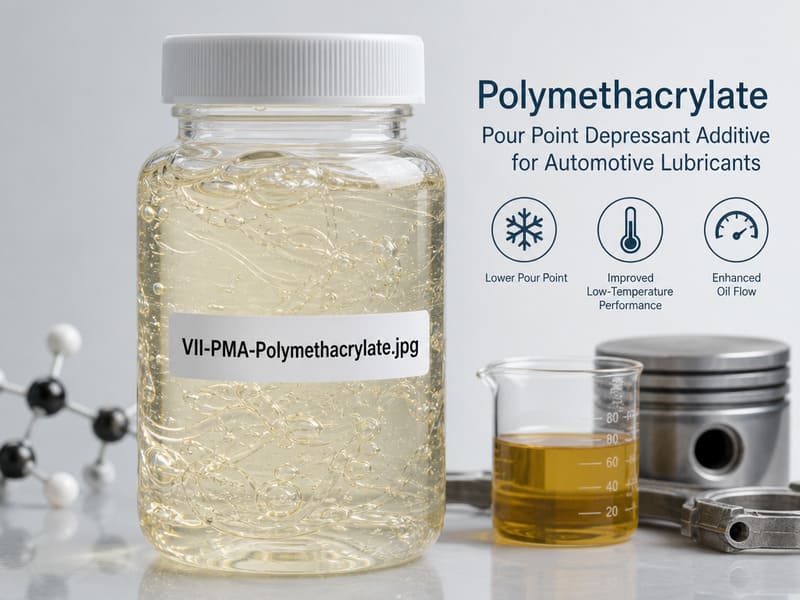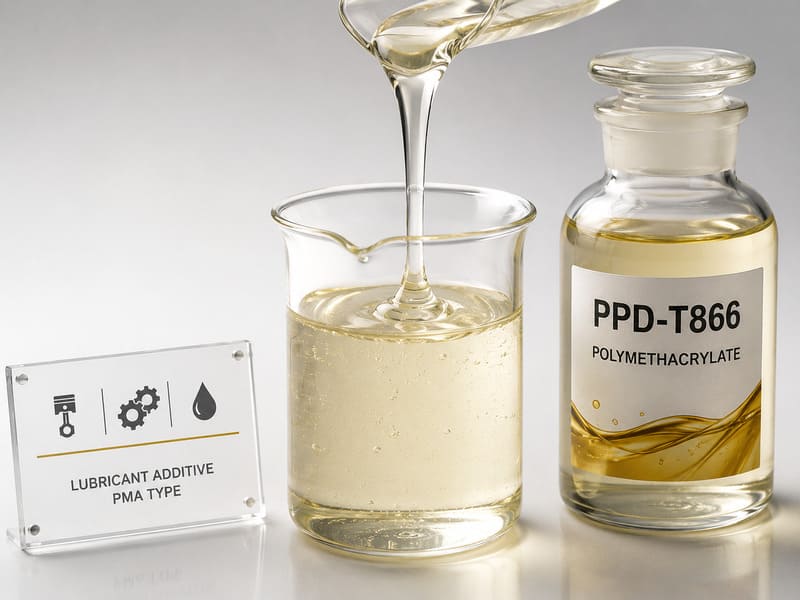
T866 Polymethacrylate PPD
PMA type · Group I/II/III · Per TDS
The versatile workhorse PPD. Effective across Group I, II and III base oils, with bonus viscosity index improvement. The most widely specified PMA-type pour point depressant.
View detailsPMA-type (T866, T866A) and EVA-type (T809) pour point depressants that modify wax crystallization for low-temperature flow. Three chemistries covering Group I, II, III and high-wax base oils — for engine oils, hydraulic, gear oils and diesel.
Every mineral base oil contains dissolved paraffin wax. As temperature drops, that wax crystallizes — and without a pour point depressant, the crystals interlock into a rigid network that gels the entire oil, stopping it from flowing.
A pour point depressant (PPD), also called a cold flow improver, prevents this. PPD molecules co-crystallize with the wax as it forms, keeping the crystals small and isolated so they cannot build a continuous gel network — leaving the oil free to flow at much lower temperatures. PPDs are highly active, typically lowering the pour point 10–30°C at treat rates of just 0.05–1.0%. Sinolook supplies both PMA-type (T866, T866A — versatile across Group I/II/III) and EVA-type (T809 — best for high-wax stocks), so you can match the PPD to your exact base oil.
A PPD does not dissolve wax or stop it appearing. Instead it changes the shape of the wax crystals as they form — turning large interlocking plates that gel the oil into small isolated crystals that let the oil keep flowing.
Because the PPD must co-crystallize with the specific wax in your base oil, response is base-oil-specific — always confirm with a pour point response curve in the actual stock. PMA-type PPDs additionally provide some viscosity index improvement — see viscosity index improvers →.
A small dose of pour point depressant transforms a base oil's cold-flow behaviour. The chart below shows a typical pour point response — actual reduction depends on the base oil wax profile and PPD type.
Note the diminishing return — most of the benefit comes by 0.3%, and beyond the optimum, extra PPD gives little further reduction (and can occasionally raise the pour point). This is why a pour point response curve in your actual base oil is essential.
PMA-type T866 and T866A for versatile Group I/II/III performance, plus EVA-type T809 for high-wax stocks — click any product for full TDS and bulk-supply quotation.
PMA type · Group I/II/III · Per TDS
The versatile workhorse PPD. Effective across Group I, II and III base oils, with bonus viscosity index improvement. The most widely specified PMA-type pour point depressant.
View detailsPMA type · wider base range · Per TDS
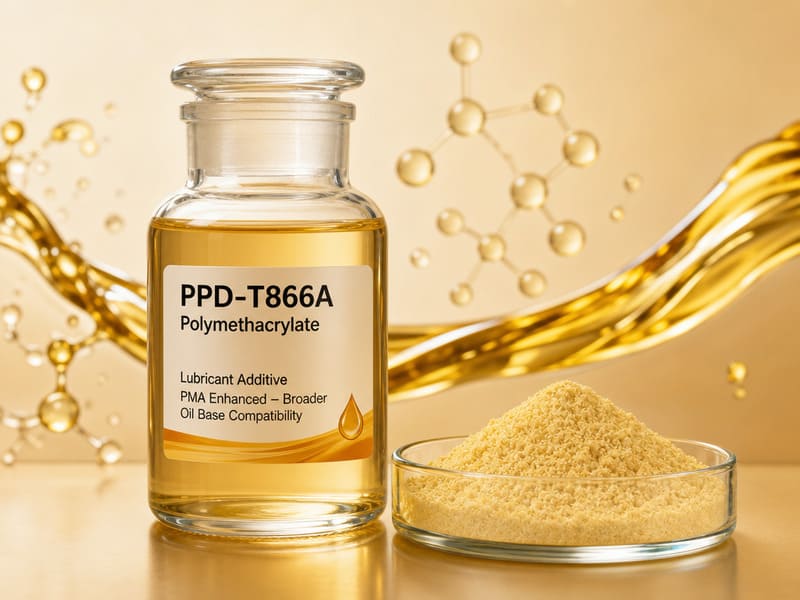
An improved PMA-type PPD with broader base-oil compatibility and optimized side-chain distribution — for formulators needing reliable response across mixed or varying base stocks.
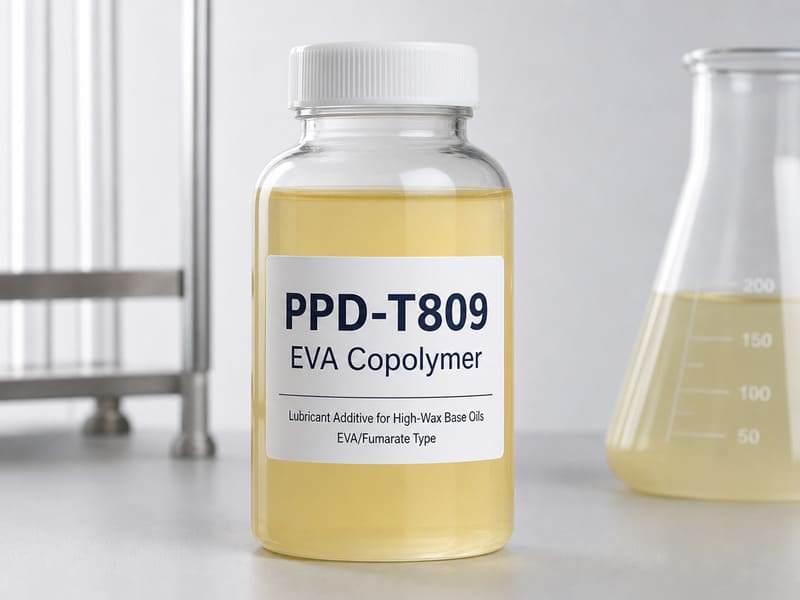
View detailsEVA / fumarate type · high-wax · Per TDS
Ethylene-vinyl acetate type PPD, particularly effective in highly paraffinic, high-wax base oils. Often the most cost-effective choice for Group I and high-wax stocks.
View detailsQuick comparison across all three Sinolook pour point depressants. Click any row to open the full TDS.
| Product | Type | Best Base Oil | Typical Treat Rate | Key Strength | TDS |
|---|---|---|---|---|---|
| T866 ★ | Polymethacrylate (PMA) | Group I / II / III | 0.1–0.5% | Versatile + bonus VI improvement | View → |
| T866A | Polymethacrylate (PMA) | Mixed / varying stocks | 0.1–0.5% | Wider base-oil compatibility | View → |
| T809 | EVA / fumarate ester | Group I, high-wax | 0.05–1.0% | Best for high-wax · cost-effective | View → |
Treat rates indicative. PPD response is base-oil-specific — always confirm with a pour point response curve in your actual base oil.
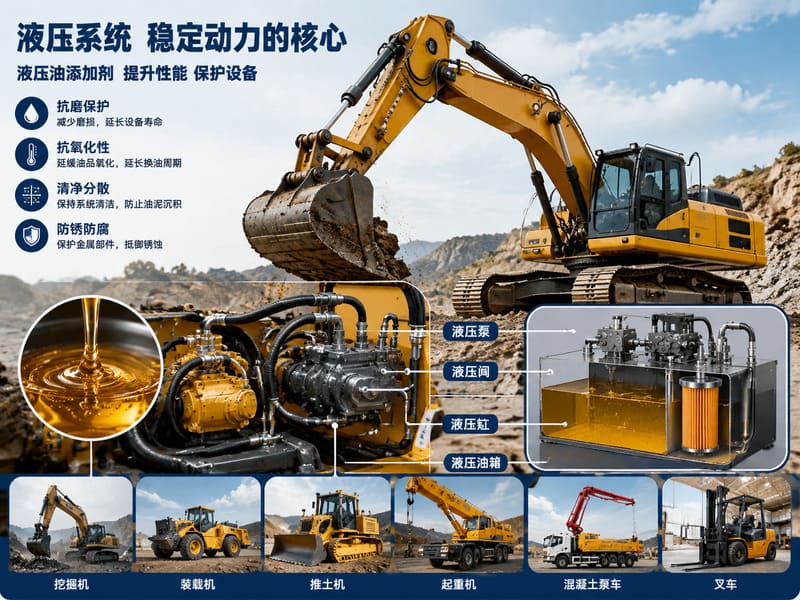
Any lubricant that operates in cold climates or starts up cold needs a pour point depressant — from winter engine oils to outdoor hydraulic systems and cold-store gear drives.
PPD performance depends entirely on matching the additive to the base oil's wax profile. Sinolook carries both PMA and EVA chemistries so you can select — or test — the best response for your exact stock.
T866 / T866A (PMA) for Group I/II/III versatility plus T809 (EVA) for high-wax stocks — select the right chemistry for your base oil without switching suppliers.
Tell us your base oil type and target pour point, and we'll recommend the best-matched chemistry and a starting treat-rate range for your pour point response testing.
Our PMA-type PPDs deliver pour point depression plus viscosity index improvement — see our viscosity index improvers for the VII-focused PMA grades.
Start with a 200L drum for formulation qualification, scale to IBC tote, flexitank or ISO tank for commercial supply across 60+ countries.
Cold-weather multigrade oils combine pour point depressants (for the gel point) with viscosity modifiers (for the viscosity-temperature curve). PMA chemistry bridges both — Sinolook supplies the complete cold-flow toolkit:

PMA, OCP and HSD viscosity modifiers. PMA bridges VII and PPD — the natural partner for multigrade cold-flow formulations.

7 PIBSI grades for sludge and soot control — part of the complete engine oil additive package alongside PPD and VII.
Tell us your base oil type (Group I/II/III or high-wax), target pour point and volume — we'll recommend the right PPD chemistry and respond within 24 hours with TDS and a delivered quotation.
Request a Quote