How to Choose an Ashless Dispersant: PIBSI Mono vs Bis vs Poly
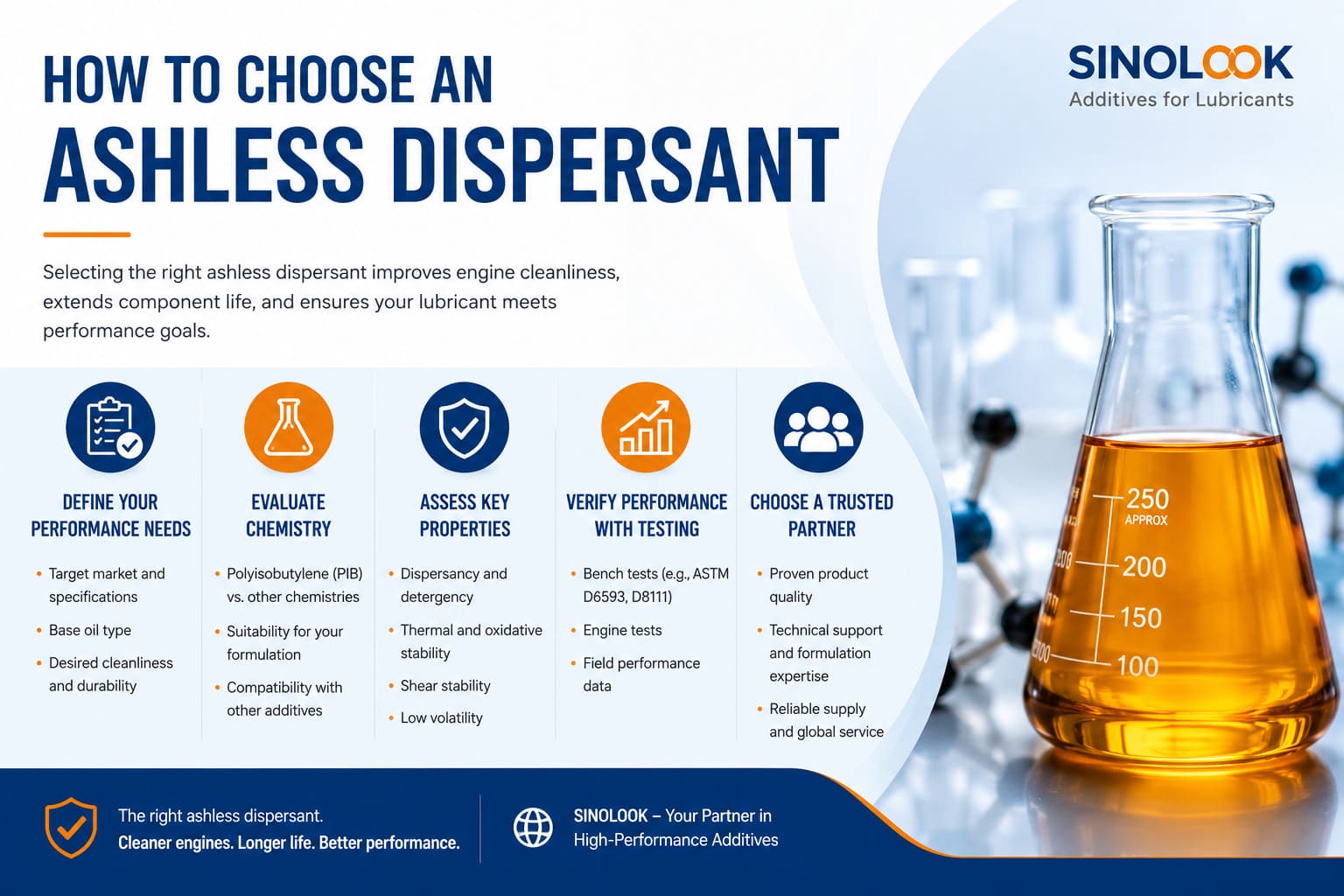
If detergents keep hot metal clean, dispersants keep the cold end clean — suspending sludge, soot and oxidation products so they cannot agglomerate into deposits. Nearly all are PIBSI succinimides, but they come as mono, bis or poly types. Choosing the right one depends mostly on how much soot you need to control.
What a dispersant does
A dispersant is the additive that keeps insoluble contaminants — soot, sludge, oxidation by-products — suspended as fine particles in the oil. Without it, these particles clump together, dropping out as sludge and deposits or thickening the oil. Dispersants are typically the largest additive component by mass in an engine oil, because suspending a heavy soot load takes a lot of dispersant.
The standard chemistry is PIBSI — polyisobutylene succinimide. A polyisobutylene (PIB) tail keeps the molecule oil-soluble; a polyamine head grabs onto contaminants. Being ashless (metal-free), dispersants add no sulphated ash, which matters for modern low-SAPS engine oils. The key variable is how many PIB chains attach to each polyamine head — that is what "mono", "bis" and "poly" mean.
Mono, bis and poly PIBSI
Mono-succinimide
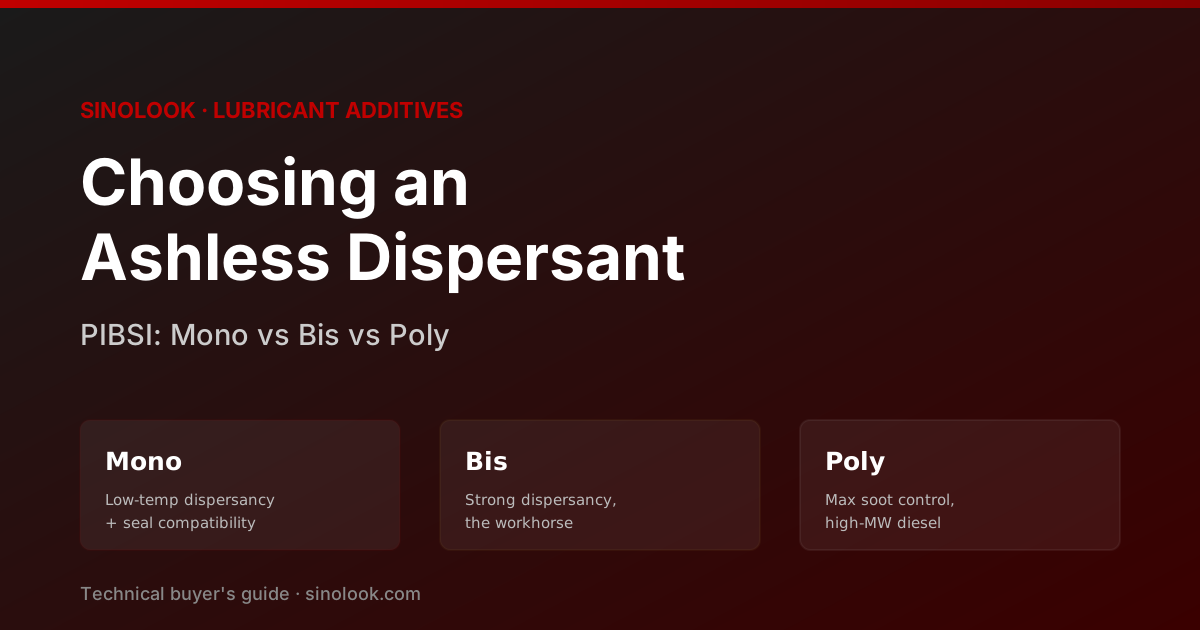
Mono PIBSI has one PIB chain per polyamine head. This structure tends to give good low-temperature dispersancy and seal compatibility, making it valuable where those properties matter more than raw dispersancy.
Bis-succinimide
Bis PIBSI has two PIB chains, giving stronger dispersancy and better thermal stability. It is the versatile workhorse dispersant of modern passenger car and diesel oils.
Poly-succinimide
Poly PIBSI uses high-molecular-weight structures with multiple couplings for maximum dispersancy. It is the premier choice for heavy-duty diesel oils, where exhaust gas recirculation (EGR) generates heavy soot that must be kept finely dispersed.
| Property | Mono | Bis | Poly |
|---|---|---|---|
| PIB chains | One | Two | Multiple (high-MW) |
| Dispersancy | Moderate | Strong | Maximum |
| Low-temp performance | Good | Good | Moderate |
| Seal compatibility | Good | Moderate | Moderate |
| Soot handling | Light | Medium–heavy | Heaviest |
| Typical use | PCMO, seal-sensitive | Workhorse PCMO/diesel | Heavy-duty diesel |
Key insight: the deciding factor is usually soot load. Light-duty passenger car oils lean on mono and bis types; heavy-duty diesel oils with EGR need the maximum soot-carrying capacity of high-MW poly-succinimide to prevent soot-induced viscosity increase.
How to choose (by application)
Passenger car engine oils
PCMO has a lighter soot load, so bis-succinimide as the workhorse, sometimes with mono for low-temperature sludge and seal balance, covers most needs. See engine oil additives.
Heavy-duty diesel engine oils
Diesel soot is the dominant challenge. High-MW poly-succinimide provides the soot-carrying capacity to prevent the viscosity increase that fails diesel oils. See diesel engine oil additives.
Borated and modified grades
Beyond the mono/bis/poly choice, dispersants can be borated or boron-phosphated to add anti-wear character, improve oxidative stability and — importantly — improve elastomer seal compatibility. If your formulation is seal-sensitive or you want multifunctional performance, see borated PIBSI and the related borated bis grades. For the fundamentals of additive systems, the American Petroleum Institute publishes the engine oil categories these dispersants are formulated to meet.
Need help selecting a dispersant?
Sinolook supplies the full PIBSI range — mono, bis, poly, borated and boron-phosphated — to over 60 countries. Tell us your soot load and seal requirements and our technical team will help you choose.
Request technical support & a quoteFrequently asked questions
What is the difference between mono, bis and poly succinimide dispersants?
They differ in how many polyisobutylene (PIB) chains attach to the polyamine head. Mono has one chain (good low-temperature dispersancy and seal compatibility), bis has two (stronger dispersancy and thermal stability — the workhorse), and poly has multiple high-molecular-weight couplings (maximum dispersancy for the heaviest soot loads). The right choice depends mainly on soot load.
Which dispersant is best for diesel engine oils?
Heavy-duty diesel oils, especially those with exhaust gas recirculation (EGR), generate heavy soot and benefit most from high-molecular-weight poly-succinimide, which has the greatest soot-carrying capacity. This prevents the soot-induced viscosity increase that can push the oil out of grade. Bis-succinimide is also used, often in combination.
What does borating a dispersant do?
Borating a succinimide dispersant introduces boron into the structure, adding anti-wear character, improving thermal and oxidative stability, and improving elastomer seal compatibility by reducing unfavourable interaction between dispersant nitrogen and seals. Borated and boron-phosphated grades are chosen for multifunctional performance and seal-sensitive formulations.
Why are dispersants the largest additive in engine oil?
Dispersants must suspend the entire soot and sludge load an engine produces, which requires significant treat rates — often several percent of the finished oil, especially in diesel oils. This makes them typically the largest additive component by mass. The exact level depends on the application and the dispersant's nitrogen content and structure.
Can Sinolook supply borated and high-MW dispersants?
Yes. Sinolook supplies the complete ashless dispersant range — mono, bis and poly PIBSI, plus borated, borated bis and boron-phosphated grades — to over 60 countries, with TDS, MSDS and batch COA. Our technical team can help you select the right dispersant for your soot load and seal requirements. Contact sales@sinolook.com.