Low-Viscosity Dispersant
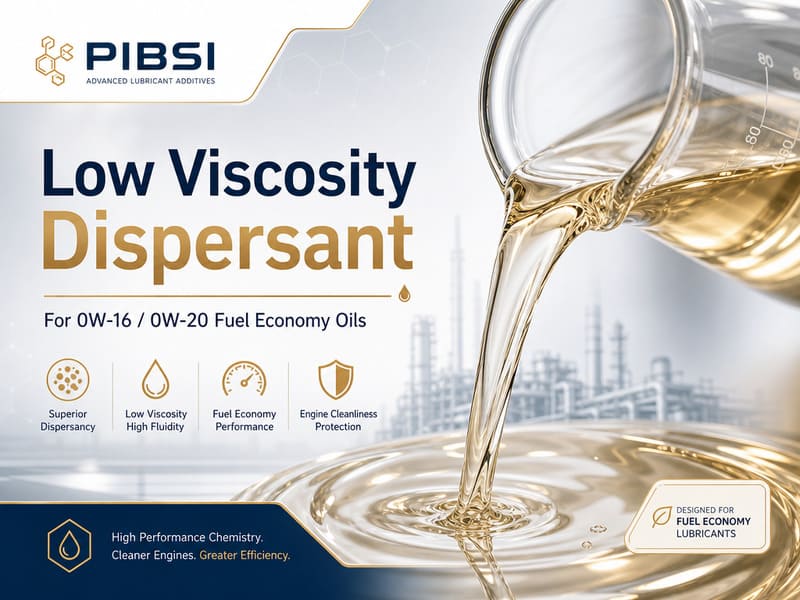
Low-viscosity dispersant — a succinimide dispersant designed for low kinematic viscosity, supporting fuel-economy and low-viscosity engine oils without sacrificing sludge and soot control.
The dispersant for modern low-viscosity, fuel-economy oils
As engine oils move to lower viscosity grades for fuel economy, dispersants must contribute less to viscosity while still controlling sludge and soot — the role of the low-viscosity dispersant.
A low-viscosity dispersant is a succinimide dispersant engineered to deliver effective sludge and soot dispersancy with a lower viscosity contribution. Modern fuel-economy engine oils use ever-lower viscosity grades (such as 0W and 5W oils), and because dispersants are a major component, a high-viscosity dispersant would push the oil's viscosity up. The low-viscosity grade lets formulators maintain cleanliness while hitting low-viscosity, fuel-economy targets. It is part of the ashless dispersant family and supports modern engine oil formulation.
Low-Viscosity Dispersant — typical properties
Representative typical values for low-viscosity dispersant. Indicative only — exact values vary by grade and are confirmed on the TDS and batch COA.
| Property | Typical Value | Method / Note |
|---|---|---|
| Appearance | Amber viscous liquid | Visual |
| Total Base Number (TBN) | ~15–40 mg KOH/g | ASTM D2896 · grade-dependent |
| Nitrogen content | ~1–2 wt% | Polyamine head |
| Kinematic viscosity (100°C) | ~80–250 mm²/s | ASTM D445 · lower than standard |
| Flash point (COC) | > ~170 °C | ASTM D92 |
| Density (15°C) | ~0.9–0.95 g/cm³ | Typical |
| Viscosity contribution | Reduced | Fuel-economy design |
Typical values for guidance only — not a specification. Request the TDS for the specific grade you need; the COA reports actual measured values for your batch.
Where low-viscosity dispersant is used
Fuel-Economy Engine Oils
Maintains dispersancy while supporting low-viscosity fuel-economy targets. See engine oil additives.
Low-Viscosity Grades
Suits 0W and 5W oils where dispersant viscosity contribution must be minimized.
Modern PCMO
Balances cleanliness with the low-viscosity, low-friction trend.
Detergent-Dispersant Systems
Provides dispersancy without pushing up finished-oil viscosity.
Why formulators choose low-viscosity dispersant
Low viscosity contribution
Delivers dispersancy with reduced impact on finished-oil viscosity — key for fuel economy.
Maintains cleanliness
Effective sludge and soot control despite the lower viscosity design.
Fuel-economy enabler
Lets formulators hit low-viscosity grades without sacrificing engine cleanliness.
From sample drum to ISO tank
Sinolook supplies low-viscosity dispersant at any scale, from formulation samples to commercial bulk, to over 60 countries.
Frequently asked questions
What is a low-viscosity dispersant used for?
Why do fuel-economy oils need low-viscosity dispersants?
Does a low-viscosity dispersant control sludge as well?
Which viscosity grades use low-viscosity dispersants?
Can Sinolook provide TDS, MSDS and COA?
Request low-viscosity dispersant from Sinolook
Tell us your target grade, application and volume — we'll send the TDS, a batch COA and a delivered quotation within 24 hours.
Request a Quote