ZDDP Explained: Primary vs Secondary, and the Low-SAPS Challenge
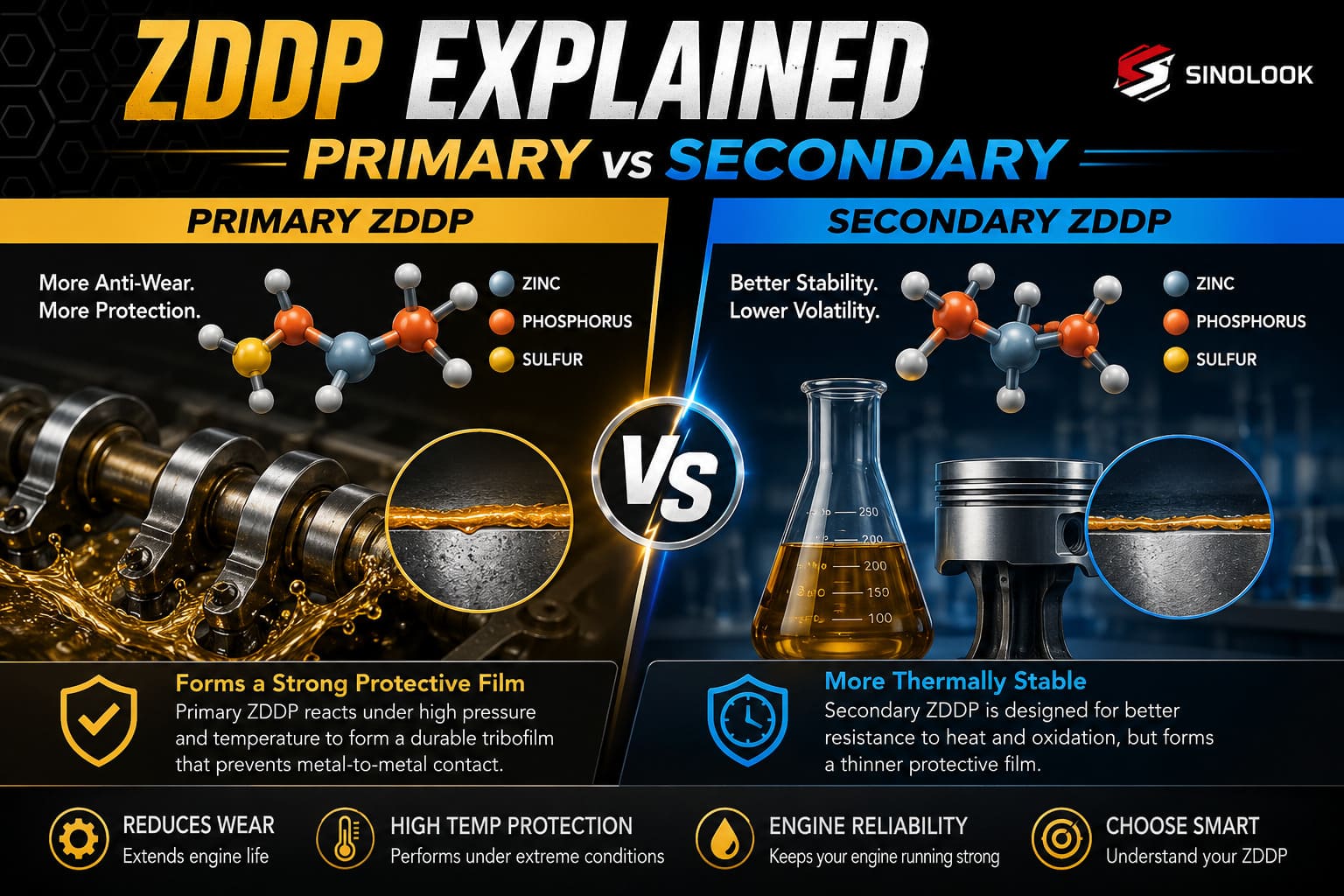
ZDDP is the single most important additive in lubrication — one molecule delivering anti-wear, antioxidant and anti-corrosion protection. But primary and secondary types behave differently, and modern low-SAPS rules are reshaping how much you can use. Here is what every formulator and buyer should understand.
What ZDDP does
ZDDP (zinc dialkyldithiophosphate) is the backbone anti-wear additive in engine and hydraulic oils, and it does three jobs at once. It forms a protective phosphate tribofilm at metal contacts under load (anti-wear); it decomposes peroxides that would otherwise degrade the oil (antioxidant); and it protects against corrosion. Few additives are so multifunctional, which is why ZDDP has been central to lubrication for decades.
The anti-wear film is sacrificial and self-healing: it forms, gets worn away, and reforms continuously, preventing direct metal-to-metal contact. This is what protects valvetrains, bearings and pumps under boundary lubrication. But ZDDP is made from alcohols, and whether those alcohols are primary or secondary changes how the additive behaves.
Primary vs secondary ZDDP
Primary ZDDP
Primary ZDDP (from primary alcohols) has better thermal stability and decomposes at higher temperatures. This makes it well suited to high-temperature service and applications needing thermal durability, such as industrial oils and certain engine oils. Premium primary C8 (octyl) ZDDP takes this further with excellent thermal stability for long-drain oils.
Secondary ZDDP
Secondary ZDDP decomposes at lower temperatures, which means it forms its anti-wear film faster — giving quicker protection, valuable at start-up and lower operating temperatures — but with less thermal durability. Many oils use a secondary/primary blend to capture both the fast film formation and the thermal stability.
| Property | Primary ZDDP | Secondary ZDDP |
|---|---|---|
| Thermal stability | Higher | Lower |
| Anti-wear film speed | Slower to activate | Faster |
| High-temp durability | Better | Less |
| Decomposition temp | Higher | Lower |
| Best for | High-temp, long-drain | Fast protection, start-up |
| Common solution | C8 premium grade | Blend with primary |
Key insight: primary and secondary are not strictly better or worse — they trade thermal durability against speed of anti-wear film formation. Many quality oils use a tuned secondary/primary blend to get both. The bigger story today is the low-SAPS constraint on how much ZDDP you can use at all.
The low-SAPS challenge
ZDDP contains zinc, phosphorus and sulphur — the very elements modern emission systems dislike. Phosphorus can poison catalytic converters over time, so modern low-SAPS (Sulphated Ash, Phosphorus, Sulphur) engine oils strictly limit it. The engine oil categories that codify these limits are published by the American Petroleum Institute.
This creates a genuine dilemma: ZDDP is the best anti-wear additive available, but you can use less of it than before. Formulators respond by using ZDDP more efficiently (optimized primary/secondary structures), and by supplementing it with ashless anti-wear additives that carry no metal or phosphorus.
Ashless alternatives
Where phosphorus must be minimized, ashless anti-wear additives step in. TPPT (triphenyl phosphorothionate) is the leading ashless anti-wear/EP additive for zinc-free hydraulic oils, turbine oils and gear oils. Ashless dialkyldithiocarbamate ester provides anti-wear and antioxidant performance with no zinc or phosphorus at all — ideal for the cleanest low-SAPS oils. These rarely replace ZDDP entirely, but they let formulators reduce phosphorus while maintaining protection. TBN and oxidation tests behind these decisions follow ASTM methods.
Optimizing a low-SAPS anti-wear system?
Sinolook supplies primary, C8, blend and hybrid ZDDP, plus ashless TPPT and dithiocarbamate ester alternatives, to over 60 countries. Our technical team can help you balance anti-wear performance against your phosphorus budget.
Request technical support & a quoteFrequently asked questions
What is the difference between primary and secondary ZDDP?
Primary ZDDP (from primary alcohols) has better thermal stability and decomposes at higher temperatures, suiting high-temperature and long-drain service. Secondary ZDDP decomposes at lower temperatures, forming its anti-wear film faster for quicker protection but with less thermal durability. Many oils use a secondary/primary blend to get both fast film formation and thermal stability.
Why is ZDDP limited in modern engine oils?
ZDDP contains phosphorus, which can poison catalytic converters and emission systems over time. Modern low-SAPS (Sulphated Ash, Phosphorus, Sulphur) engine oils therefore limit phosphorus, constraining how much ZDDP can be used. Formulators use ZDDP more efficiently and supplement it with ashless anti-wear additives to maintain protection within the limits.
What can replace ZDDP in low-SAPS oils?
Ashless anti-wear additives such as TPPT (triphenyl phosphorothionate) and ashless dialkyldithiocarbamate ester provide anti-wear and extreme-pressure protection with no metal, and in some cases no phosphorus. They rarely replace ZDDP entirely — its combination of anti-wear, antioxidant and anti-corrosion performance is hard to match — but they let formulators reduce phosphorus while maintaining protection.
How does ZDDP protect against wear?
ZDDP reacts at metal contact points under heat and pressure to form a protective phosphate-rich tribofilm. This sacrificial film carries the load and prevents direct metal-to-metal contact, dramatically reducing wear. The film continuously reforms as it is worn away, giving durable boundary-lubrication protection — which is why ZDDP is the backbone anti-wear additive.
Can Sinolook supply ZDDP and ashless alternatives?
Yes. Sinolook supplies primary, primary C8, secondary/primary blend and hybrid alkyl ZDDP, plus ashless anti-wear alternatives including TPPT and ashless dialkyldithiocarbamate ester, to over 60 countries with TDS, MSDS and batch COA. Our technical team can help balance anti-wear performance against low-SAPS limits. Contact sales@sinolook.com.