The difference between DOT 3 and DOT 4 brake fluid comes down to boiling point margin. Both are synthetic, glycol-ether based hydraulic fluids that meet US NHTSA safety standard FMVSS 116 and international standard ISO 4925. They use the same chemistry, the same rubber seal compatibility, and the same metal-corrosion limits. The difference is that DOT 4 must meet higher minimum boiling points — which translates into better resistance to brake fade under heavy braking.
This guide explains exactly what changes between the two grades, when you can safely mix them, when you can upgrade, when you absolutely cannot downgrade, and how to read the typical batch values that brake fluid manufacturers publish.

DOT 3 vs DOT 4: side-by-side specifications
The clearest way to compare DOT 3 vs DOT 4 brake fluid is to look at the regulatory minimum specifications side by side, alongside Sinolook's actual production batch values:
| Property | DOT 3 (Class 3) | DOT 4 (Class 4) |
|---|---|---|
| Chemistry | Glycol-ether based | Glycol-ether based |
| Dry ERBP — minimum | ≥ 205 °C | ≥ 230 °C |
| Dry ERBP — Sinolook typical | 222 °C | 250 °C |
| Wet ERBP — minimum | ≥ 140 °C | ≥ 155 °C |
| Wet ERBP — Sinolook typical | 151 °C | 160 °C |
| Viscosity at −40 °C — maximum | ≤ 1,500 mm²/s | ≤ 1,500 mm²/s |
| Viscosity at −40 °C — Sinolook typical | 1,395 mm²/s | 1,300 mm²/s |
| pH range | 7.0 – 11.5 | 7.0 – 11.5 |
| Compatible with DOT 3 / DOT 4 / DOT 5.1 | Yes | Yes |
| Compatible with DOT 5 (silicone) | No | No |
The numerical takeaway: DOT 4 has approximately 25 °C higher dry boiling point and 15 °C higher wet boiling point than DOT 3 at the regulatory minimum. In practice, well-made commercial brake fluids exceed these minimums by 10-20 °C — Sinolook's typical batch values shown above illustrate the range.
DOT 3 and DOT 4 are the same chemistry family with different performance floors. They are fully compatible with each other but not with DOT 5 silicone. If your vehicle manual specifies DOT 4, the brake system was designed assuming DOT 4 boiling points — using DOT 3 reduces your safety margin.
The same chemistry, different boiling point margins
Both DOT 3 and DOT 4 brake fluids are made from polyalkylene glycol ethers and borate esters. The key difference is the proportion and grade of borate ester used in the formulation — more borate ester gives a higher dry boiling point, which is what DOT 4 requires above DOT 3.
This shared chemistry has two important consequences:
- Identical compatibility profile. Both DOT 3 and DOT 4 are compatible with SBR (styrene-butadiene rubber) and EPDM (ethylene-propylene-diene monomer) brake seals, plus all common brake-system metals — tinned iron, steel, cast iron, aluminium, brass, copper and zinc — within the limits defined by SAE J1703.
- Identical hygroscopy behavior. Both grades absorb atmospheric moisture from sealed brake systems over time, which is why both have a "wet boiling point" specification roughly 60-80 °C below the dry boiling point.
The third consequence is what makes DOT 3 and DOT 4 freely mixable in any ratio without seal damage or chemistry breakdown — they are, at a molecular level, the same family of glycol-ether brake fluid with different additive ratios.
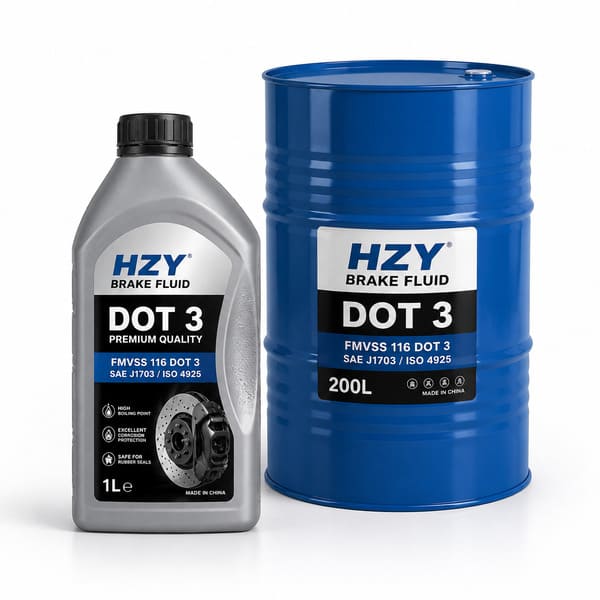
Synthetic glycol-ether DOT 3 brake fluid — 222 °C dry ERBP, AMECA #230611. For older cars, motorcycles and hydraulic clutch systems. View product details →
Which one does your vehicle need?
The vehicle manufacturer specifies the required brake fluid grade in two places:
- The brake fluid reservoir cap on the master cylinder, typically with text reading "DOT 3", "DOT 4", "DOT 3 / DOT 4", or "DOT 4 LV". This is the most authoritative source.
- The owner's manual, usually in the section on fluid capacities and specifications.
As a rough rule of thumb that you should always verify against the actual specification on the cap:
- Most vehicles built before 2006: typically specify DOT 3
- Most vehicles built 2006 and later: typically specify DOT 4 or DOT 4 LV
- Most motorcycles: typically specify DOT 3, DOT 4 or DOT 4 / DOT 5.1
- Modern EVs and hybrids: typically specify DOT 4 LV, HZY6 or DOT 5.1
The 2006 cutoff date is approximate — it reflects when stricter regulations on Anti-lock Braking System (ABS) and Electronic Stability Program (ESP) performance pushed most manufacturers to specify higher-boiling-point fluids. Regional differences apply: some European manufacturers specified DOT 4 from the early 1990s, while some North American light trucks continued specifying DOT 3 well into the 2010s.
Can you mix DOT 3 and DOT 4 brake fluid? Compatibility rules
Yes — DOT 3 and DOT 4 are fully compatible and freely mixable in any ratio. This is one of the few absolute statements you can make about brake fluid compatibility:
| Mixing scenario | Safe? | Notes |
|---|---|---|
| Top up DOT 3 system with DOT 4 | Yes | Effectively a partial upgrade — no system flush required |
| Top up DOT 4 system with DOT 3 | Only emergency / temporary | Reduces overall boiling point margin. Flush and refill with DOT 4 at next service. |
| Mix DOT 3 / DOT 4 with DOT 4 LV or DOT 5.1 | Yes | All glycol-ether grades are inter-compatible |
| Mix any DOT 3 / 4 / 4 LV / 5.1 with DOT 5 silicone | NEVER | Chemistry is incompatible — will damage seals and cause brake failure |
The last row deserves special emphasis. DOT 5.1 is glycol-ether based, while DOT 5 (without the .1) is silicone-based and chemically incompatible with every other DOT grade. The naming convention is genuinely confusing — DOT 5.1 should logically be a more advanced version of DOT 5, but it is actually a more advanced version of DOT 4.
Upgrading from DOT 3 to DOT 4 — what changes
Upgrading from DOT 3 to DOT 4 is the most common brake fluid change you can make on an older vehicle, and it is generally safe and beneficial. Here is what to expect:
What stays the same
- Pedal feel — the viscosity at normal operating temperatures is essentially identical
- Brake system component lifespan — same seal and metal compatibility
- Service interval — both grades need to be replaced every approximately 2 years
- Bleeding procedure — identical mechanically
What improves
- Resistance to brake fade — the higher dry boiling point means the fluid is less likely to vapor-lock during sustained heavy braking, such as mountain descents or repeated stops in city traffic
- Wet boiling point margin over service life — DOT 4 starts at a higher wet ERBP and degrades slower in absolute terms
- Compatibility with future upgrades — if you later switch to DOT 4 LV (low-viscosity), DOT 5.1 or HZY6, those are all backward-compatible with existing DOT 4
Procedure: You can either top up your existing DOT 3 with DOT 4 (which will partially convert the system over multiple top-ups), or do a complete brake fluid flush and refill, which gives an immediate full upgrade. Either approach is mechanically safe.
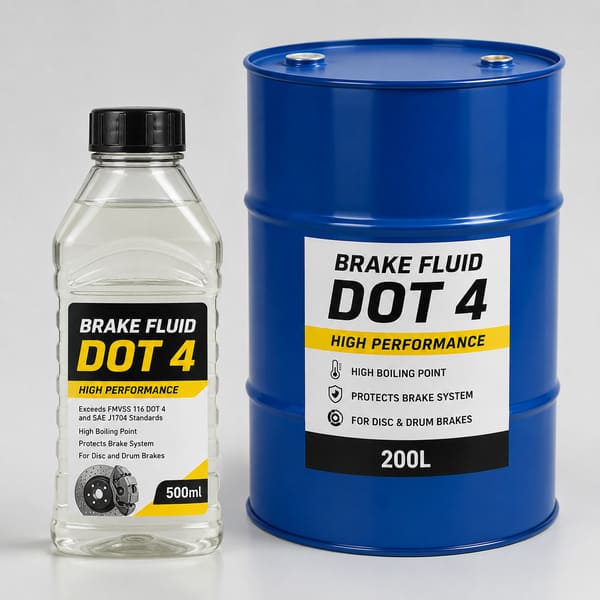
Synthetic glycol-ether DOT 4 brake fluid — 250 °C dry ERBP, AMECA #221045. The universal choice for modern passenger cars and light trucks. View product details →
Never downgrade from DOT 4 to DOT 3 — why it's unsafe
The opposite operation — putting DOT 3 into a system that originally specified DOT 4 — is technically possible (the fluids are compatible), but it is never recommended and may not be a legally compliant repair in some jurisdictions.
The reason: modern vehicles with ABS and ESP have brake systems engineered assuming the higher boiling points of DOT 4. Two specific failure modes appear if you downgrade:
- Brake fade under sustained heavy use. A DOT 3 system in a vehicle designed for DOT 4 reaches the vapor-lock threshold at lower brake-pad temperatures, which can produce a "spongy pedal" or complete loss of brake assist on a long descent.
- ABS / ESP modulator damage potential. Modern ABS valves cycle at high frequency. Under fade conditions, the increased vapor in the line can damage modulator solenoids.
The US National Highway Traffic Safety Administration provides authoritative reference material on brake fluid specifications in its FMVSS 116 regulation, which specifies the test procedures and minimum performance levels for each grade.
Reading boiling points and certifications
When evaluating any brake fluid manufacturer's product specifications, three numbers matter most:
Dry equilibrium reflux boiling point (Dry ERBP)
This is the boiling point of the brake fluid as it leaves the factory in a sealed container. It must exceed the minimum specified by the DOT grade — 205 °C for DOT 3, 230 °C for DOT 4. Good manufacturers exceed the minimum by 15-25 °C.
Wet equilibrium reflux boiling point (Wet ERBP)
This is the boiling point after the fluid has been deliberately humidified to 3.7% water content — meant to simulate the fluid after several years in service. Minimum 140 °C for DOT 3, 155 °C for DOT 4.
Independent certification
Brake fluid that bears a US "DOT 3" or "DOT 4" mark on its label has been registered with the Automotive Manufacturers Equipment Compliance Agency (AMECA), which maintains the public registry of compliant brake fluids under FMVSS 116. Each registered product receives a notification number that can be verified in the AMECA database. For example, Sinolook's DOT 3 carries AMECA notification #230611, and Sinolook DOT 4 carries #221045. Independent batch testing for Sinolook products is performed at ABIC Testing Laboratories, Inc. in Fairfield, New Jersey.
Service interval and replacement
Both DOT 3 and DOT 4 brake fluid degrade through the same mechanism: gradual moisture absorption from the atmosphere. Even in a sealed brake system, moisture diffuses through reservoir caps and rubber hoses over time, raising the water content and lowering the wet boiling point.
Most vehicle manufacturers recommend a brake fluid change every 2 years or 40,000 km / 24,000 miles, whichever comes first — applied to both DOT 3 and DOT 4. In specific operating conditions, more frequent service is warranted:
- Humid tropical climates — moisture absorption is faster, consider annual change
- Mountain driving or sustained heavy braking — thermal cycling stresses the additive package
- Track-day use — change before every event for performance vehicles
- Vehicles stored unused for extended periods — moisture still enters slowly
Workshops use moisture test strips (or refractometers) to measure water content in brake fluid. The general rule: replace at or above 3% water content, regardless of calendar time.
Frequently asked questions
Can I mix DOT 3 and DOT 4 brake fluid?
Yes. DOT 3 and DOT 4 brake fluids are both glycol-ether based and fully compatible. You can safely top up DOT 3 with DOT 4 (an upgrade), or top up DOT 4 with DOT 4. Never downgrade from DOT 4 to DOT 3 in a system that specifies DOT 4. The fluids must never be mixed with DOT 5 silicone brake fluid (note: DOT 5.1 is glycol-ether based — see our DOT 5.1 page).
Is DOT 4 better than DOT 3?
DOT 4 has higher dry boiling point (typically 250 °C vs 215 °C for Sinolook batches) and higher wet boiling point (160 °C vs 151 °C), making it more resistant to brake fade under heavy braking. However "better" depends on the application — if the vehicle manufacturer specifies DOT 3, DOT 3 is the correct fluid and switching to DOT 4 only provides extra thermal margin, not better function.
Can I use DOT 4 in a car that specifies DOT 3?
Yes. DOT 4 is a direct upgrade from DOT 3 — fully compatible chemistry, higher boiling points, same seal and metal compatibility. No system flush is required when switching. Many older vehicles benefit from the extra thermal margin, especially in mountain driving or warm climates.
Can I use DOT 3 in a car that specifies DOT 4?
No. Never downgrade brake fluid. If the vehicle manufacturer specifies DOT 4, the brake system was designed assuming DOT 4 boiling points. Using DOT 3 reduces your safety margin against brake fade and could be considered a non-compliant repair. Always use the specified grade or higher.
What is the main difference between DOT 3 and DOT 4 brake fluid?
Both DOT 3 and DOT 4 are synthetic glycol-ether based hydraulic brake fluids, but they meet different minimum boiling-point specifications under FMVSS 116 and ISO 4925. DOT 3 must have a dry boiling point of at least 205 °C and a wet boiling point of at least 140 °C. DOT 4 requires at least 230 °C dry and 155 °C wet. Sinolook's actual production values typically exceed these minimums by 15-20 °C.
Related Sinolook brake fluid products
If you need to source DOT 3 or DOT 4 brake fluid for bulk distribution, OEM private-label or automotive workshop supply, Sinolook manufactures the complete glycol-ether range:
- Sinolook DOT 3 Brake Fluid — 222 °C dry ERBP, AMECA #230611, for older vehicles and clutch systems
- Sinolook DOT 4 Brake Fluid — 250 °C dry ERBP, AMECA #221045, the universal modern grade
- Sinolook DOT 4+ Brake Fluid — 260 °C dry ERBP, premium DOT 4 for heavier thermal duty
- Sinolook DOT 4 LV (DOT 4+ PLUS) — low-viscosity DOT 4 for modern ABS / ESP / EHB systems
- Sinolook DOT 5.1 Brake Fluid — highest standard glycol-ether grade for sportbikes and performance vehicles
For the complete product range and direct comparison of all seven Sinolook brake fluid grades, see the brake fluid product portfolio.