Brake fluid boiling point is the single most important specification in any brake fluid. It determines how hard you can brake — and for how long — before the fluid vaporizes and the pedal goes soft. Every DOT grade is defined first and foremost by two boiling point numbers: a "dry" value for fresh fluid and a "wet" value for fluid that has absorbed moisture in service. Understanding the gap between these two numbers explains why brake fluid needs regular replacement even when it looks perfectly fine.
This guide explains what this specification actually measures, why there are two values, how it falls over time, and how the physics of boiling produces the dangerous condition known as vapor lock or brake fade.
What is brake fluid boiling point?
Brake fluid transmits the force from your foot on the pedal to the brake pads at each wheel. It works because liquids are incompressible — when you push fluid in one place, it moves an equal amount somewhere else, transmitting force through the hydraulic line.
But under heavy braking, the friction between pad and disc generates intense heat. That heat conducts back through the caliper into the brake fluid sitting right behind the piston. If the fluid gets hot enough to boil, it turns from liquid into vapor — and vapor, unlike liquid, is compressible. The moment vapor forms in the brake lines, pressing the pedal compresses the gas bubble instead of moving the brake pads. The result is a soft, sinking pedal and a sudden loss of braking force.
The boiling point of brake fluid is the temperature at which this happens. A higher value means the fluid can absorb more heat before vaporizing — which is exactly why brake fluid grades are defined by their boiling points.
ERBP: how boiling point is measured
Brake fluid boiling point is measured by a standardized laboratory method called the Equilibrium Reflux Boiling Point, abbreviated ERBP. The test is defined identically in the US standard FMVSS 116 and the international standard ISO 4925.
In the test, a measured sample of brake fluid is heated in a flask fitted with a reflux condenser. As the fluid approaches its boiling point, vapor rises, condenses, and drips back into the flask. When the boiling reaches a stable, steady rate — equilibrium — the temperature is recorded. That temperature is the ERBP.
The word "equilibrium" matters: it ensures the result is reproducible between laboratories and not affected by how quickly the sample was heated. This is why every reputable brake fluid manufacturer reports boiling point as "ERBP" rather than just "boiling point" — it signals the value was obtained by the standardized method. To see how independent verification works in practice, Sinolook fluids are tested at ABIC Testing Laboratories, Inc. in the United States.
Dry vs wet boiling point
Every brake fluid has two ERBP values, and the difference between them is the key to understanding brake fluid maintenance.
Dry ERBP — fresh fluid
The dry boiling point is measured on fresh fluid straight from a sealed container, with effectively zero water content. This is the "best case" number and the larger of the two. It is the figure most prominently advertised on brake fluid labels.
Wet ERBP — fluid in service
The wet boiling point is measured after the fluid sample has been deliberately humidified to 3.7% water by volume — a level chosen to represent roughly two years of typical in-service moisture absorption. This is the "worst case" number, and it is arguably the more important of the two, because it represents the condition your fluid will actually be in before its scheduled replacement.
The dry boiling point tells you how good the fluid is when new. The wet boiling point tells you how safe it will still be after two years in your car. When comparing brake fluids, always compare wet ERBP — it is the number that reflects real-world safety margin.
Brake fluid boiling point chart by DOT grade
The complete reference of minimum requirements and Sinolook's typical production values across all grades:
| Grade | Dry ERBP min. | Wet ERBP min. | Sinolook dry typ. | Sinolook wet typ. |
|---|---|---|---|---|
| DOT 3 | 205 °C | 140 °C | 222 °C | 151 °C |
| DOT 4 | 230 °C | 155 °C | 250 °C | 160 °C |
| DOT 4+ | 230 °C | 155 °C | 260 °C | 165 °C |
| DOT 4 LV | 230 °C | 155 °C | 265 °C | 170 °C |
| DOT 5.1 | 260 °C | 180 °C | 267 °C | 185 °C |
| HZY6 / Class 6 | 260 °C | 180 °C | 267 °C | 187 °C |
| Class 7 | 260 °C | 180 °C | 270 °C | 190 °C |
Note how every grade exceeds its regulatory minimum — that headroom is the mark of a well-formulated fluid. For the full specification of each grade, see the brake fluid product portfolio or the complete guide to brake fluid types.
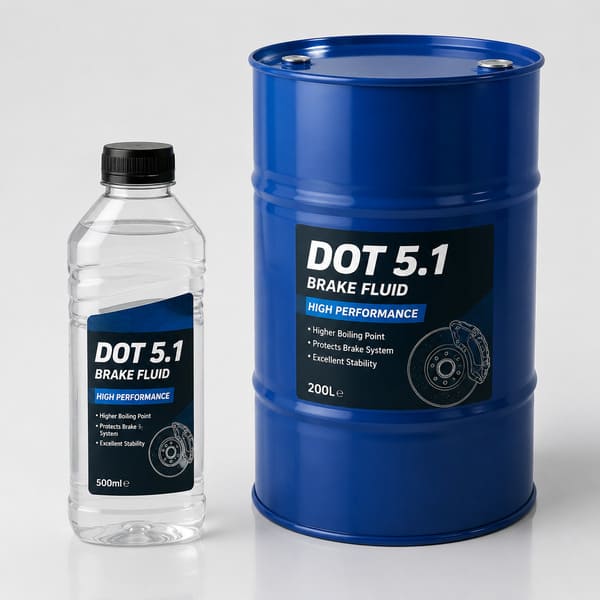
When boiling point margin matters most — 267 °C dry, 185 °C wet ERBP. For sportbikes, performance vehicles and demanding commercial fleets. View product details →
How moisture lowers the boiling point
Glycol-ether brake fluid is hygroscopic — it actively attracts and absorbs water molecules from the atmosphere. Even in a sealed brake system, moisture slowly enters through the reservoir cap vent, through microscopic pores in rubber brake hoses, and during any service that opens the system.
The relationship between absorbed moisture and boiling point is not linear. The first 2-3% of water content causes a dramatic drop, after which the decline becomes more gradual:
This curve explains the standard 2-year replacement interval. Most of the boiling point loss happens within the first 18-24 months as the fluid approaches 3% water content. Beyond that point, the fluid no longer has a safe margin against vapor lock under hard braking.
Vapor lock and brake fade explained
"Vapor lock" and "brake fade" describe the dangerous condition that results when brake fluid exceeds its boiling point. The mechanism, step by step:
- Heat builds up. Hard or sustained braking — a long mountain descent, repeated emergency stops, or track driving — generates intense friction heat at the brake pads and discs.
- Heat reaches the fluid. That heat conducts through the caliper into the brake fluid directly behind the piston.
- The fluid boils. If the fluid temperature exceeds its current (wet) boiling point, it vaporizes, forming compressible gas bubbles in the lines.
- The pedal goes soft. When you press the pedal, the force now compresses the vapor bubbles instead of transmitting to the pads. The pedal sinks toward the floor with little braking effect.
- Braking is lost. In severe cases the brakes become almost completely ineffective until the fluid cools and the vapor re-condenses.
Vapor lock from boiled brake fluid is a genuine cause of brake failure, particularly on long descents and in performance driving. It is also entirely preventable: use a fluid with an adequate boiling point for your application, and replace it before its wet boiling point falls too far.
The reason a higher-boiling-point fluid resists fade is simple: it can absorb more heat before reaching the vaporization temperature. This is why performance and racing applications favor grades like DOT 5.1 and Class 7, whose wet boiling points of 185 °C and 190 °C give a much larger safety margin than the 151 °C of DOT 3.
Why a higher boiling point is safer
The practical value of boiling point margin depends on how hard the brakes work:
- Everyday city and highway driving rarely pushes brake temperatures high enough to challenge even DOT 3. For these vehicles, any in-spec fluid maintained on schedule is safe.
- Mountain driving, towing, and heavy vehicles generate sustained heat that benefits from the higher margin of DOT 4 or DOT 4+.
- Performance road vehicles and sportbikes can reach brake temperatures where DOT 5.1's higher boiling point provides meaningful additional safety.
- Track and racing use demands the highest available margin — the domain of Class 7 and dedicated racing fluids.
In every case, the wet boiling point is the number that matters, because that is the condition the fluid will be in after real-world service. A fluid with a high dry boiling point but a mediocre wet boiling point offers a false sense of security.
How to maintain your boiling point margin
Three practices keep your brake fluid's boiling point in the safe zone:
- Replace on schedule. Follow the manufacturer's recommended interval — typically every 2 years — or sooner in humid climates or hard-use conditions. See our guide on how to change brake fluid for the full procedure.
- Use fresh, sealed fluid. Because brake fluid absorbs moisture the moment its container is opened, always fill from a freshly opened, sealed bottle — never a part-used one that has been sitting open.
- Choose the right grade. Match the fluid grade to your driving. For most vehicles the manufacturer-specified grade is correct; for performance or heavy-duty use, a higher grade adds margin. Our DOT 3 vs DOT 4 comparison explains the trade-offs.
Sinolook manufactures the full glycol-ether brake fluid range with documented dry and wet ERBP values on every batch Certificate of Analysis. For bulk supply, OEM, or private-label packaging, see the brake fluid product portfolio.
Frequently asked questions
What is the boiling point of brake fluid?
Brake fluid boiling point depends on the grade and its moisture content. Fresh DOT 3 has a dry boiling point of at least 205 °C, DOT 4 at least 230 °C, and DOT 5.1 at least 260 °C. These are "dry" values for new fluid. As the fluid absorbs moisture in service, the boiling point falls to the "wet" value — for example, DOT 4 must retain at least 155 °C wet boiling point. Premium fluids exceed these minimums; Sinolook DOT 4 typically measures 250 °C dry and 160 °C wet.
What is the difference between dry and wet boiling point?
The dry boiling point (dry ERBP) is the boiling point of fresh brake fluid straight from a sealed container with zero water content. The wet boiling point (wet ERBP) is the boiling point after the fluid has absorbed 3.7% water by volume, simulating roughly two years of service. Because brake fluid is hygroscopic, the wet boiling point is the more important real-world figure — it represents the worst-case condition the fluid will face before it should be replaced.
What is ERBP in brake fluid?
ERBP stands for Equilibrium Reflux Boiling Point. It is the standardized laboratory test method used under FMVSS 116 and ISO 4925 to measure the boiling point of brake fluid. A sample is heated in controlled apparatus until it boils at a steady reflux rate, and the temperature at that equilibrium point is recorded. ERBP is measured both dry (fresh fluid) and wet (after humidification to 3.7% water content).
Why does the boiling point matter?
If brake fluid boils, it produces vapor bubbles in the brake lines. Unlike liquid, vapor is compressible — so when you press the brake pedal, the pedal compresses the vapor instead of transmitting force to the brake pads. This is called vapor lock or brake fade, and it produces a soft or non-responsive pedal and dramatically increased stopping distance. A higher boiling point provides more safety margin against this failure.
How much does the boiling point drop with moisture?
Brake fluid boiling point drops sharply with the first 2-3% of absorbed moisture, then more gradually. For typical DOT 4, the boiling point can fall from around 250 °C dry to below 160 °C once the fluid reaches 3% water content — a drop of roughly 90 °C. Most of this decline happens within the first 18-24 months of service, which is why the standard replacement interval is 2 years.
Brake fluid with documented boiling point margin
Sinolook manufactures the complete glycol-ether brake fluid range at our IATF 16949:2016 certified plant in Nan'an, Fujian, China — independently tested at ABIC Testing Laboratories, Inc. in the United States, meeting SAE J1703, FMVSS 116 and ISO 4925, with dry and wet ERBP documented on every batch:
- Sinolook DOT 3 — 222 °C dry / 151 °C wet
- Sinolook DOT 4 — 250 °C dry / 160 °C wet
- Sinolook DOT 5.1 — 267 °C dry / 185 °C wet
- Sinolook HZY6 — 267 °C dry / 187 °C wet
- Sinolook Class 7 — 270 °C dry / 190 °C wet
Compliant fluids are verifiable in the AMECA database — Sinolook DOT 4 carries notification #221045. For the full range and specifications, see the brake fluid product portfolio.