The single most damaging mistake in brake-system maintenance is mixing DOT 5 brake fluid with DOT 5.1 brake fluid. The two grades sit next to each other in the numbering system, sound almost identical, and are often shelved side-by-side in workshops — yet they are chemically opposite. DOT 5 is silicone-based and hydrophobic. DOT 5.1 is glycol-ether based and hygroscopic. They cannot share a brake system, and the consequences of mixing them include seal failure, gel formation in brake lines, and complete loss of braking function.
This guide walks through exactly why these two grades exist, what each one is made of, where they should and should not be used, and what to do if a cross-contamination has already occurred. By the end, you should never confuse the two again.
The 60-second summary
If you read nothing else in this article, read this section:
DOT 5 is silicone. DOT 5.1 is glycol-ether. They are chemically incompatible and must never be mixed. DOT 5.1 is fully compatible with DOT 3, DOT 4, DOT 4+ and DOT 4 LV. DOT 5 is compatible only with itself.
- DOT 5 — silicone-based, hydrophobic, paint-safe, purple-dyed, found in older Harley-Davidson motorcycles and military vehicles
- DOT 5.1 — glycol-ether based, hygroscopic, fully compatible with DOT 3 / DOT 4, amber-clear, used in modern performance vehicles, sportbikes, and as an upgrade from DOT 3 / DOT 4
The boiling points and viscosity specifications happen to be similar — both have a minimum dry boiling point of 260 °C and a minimum wet boiling point of 180 °C under FMVSS 116. That coincidence does not make them interchangeable. They are completely different products that share only a regulatory performance floor.
Two completely different chemistries
The fundamental difference between DOT 5 and DOT 5.1 is the chemistry of the base fluid itself. Everything else — compatibility behavior, hygroscopy, paint safety, ABS suitability — follows from this single distinction. The US National Highway Traffic Safety Administration formally defines both grades under FMVSS 116, but the regulation specifies different test procedures for petroleum-based fluids (DOT 5 silicone) and non-petroleum-based fluids (DOT 3, 4, 5.1) — reflecting the chemistry difference at the regulatory level.
DOT 5: silicone (polydimethylsiloxane)
DOT 5 is made from polydimethylsiloxane (PDMS), a synthetic polymer in the silicone family. The repeating unit in the polymer chain is a silicon-oxygen-silicon backbone with methyl groups attached. Key properties that result from this chemistry:
- Hydrophobic — the silicone backbone does not bond with water molecules. Water that enters the brake system through reservoir caps or rubber hoses does not mix with the fluid but separates and pools at the lowest points.
- Paint-safe — silicone does not chemically attack automotive paint. A spilled drop of DOT 5 does not damage the fender finish the way glycol-ether fluid does.
- Higher compressibility — silicone is more compressible than glycol-ether at high pressures, which can produce a "spongy" pedal feel under hard braking.
- Air entrainment — silicone has a higher tendency to entrain air bubbles during the bleeding process and during ABS pump cycling, which is why DOT 5 is generally not recommended for vehicles with anti-lock braking.
DOT 5.1: glycol-ether (polyalkylene glycol ether)
DOT 5.1 is made from polyalkylene glycol ethers and borate esters — the same chemistry family as DOT 3, DOT 4, DOT 4+ and DOT 4 LV. The performance difference between the grades comes from the specific glycol-ether species selected and the borate-ester ratio in the additive package. Key properties:
- Hygroscopic — glycol-ether actively absorbs atmospheric moisture, mixing the water uniformly into the fluid. Over time this lowers the boiling point, which is why brake fluid needs to be replaced every 2 years even in a sealed system.
- Paint-damaging — glycol-ether dissolves automotive paint on contact. Any spill must be washed off immediately.
- Lower compressibility — gives a firmer pedal feel under heavy braking.
- ABS-compatible — modern glycol-ether formulations such as DOT 4 LV and DOT 5.1 are specifically engineered for high-frequency ABS valve cycling and electro-hydraulic brake-by-wire systems.
Why the naming is so confusing
The naming convention is a historical artifact, not the result of any logical design choice. The order of events:
- 1972 — FMVSS 116 introduced and defined DOT 3 and DOT 4 (both glycol-ether based), with chemistry harmonized to SAE J1703.
- Late 1970s — Silicone brake fluid developed for the US military, which needed a brake fluid that could be stored for years without degradation and would not damage paintwork. Added to FMVSS 116 as DOT 5.
- 1980s-1990s — Adoption of ABS in passenger vehicles created demand for a high-performance glycol-ether fluid above DOT 4, since silicone DOT 5 was unsuitable for ABS. The glycol-ether industry developed an upgraded formulation that exceeded DOT 4 boiling points.
- Mid-1990s — That upgraded glycol-ether fluid was designated DOT 5.1. The "5.1" designation indicated the higher performance tier above DOT 5, while the ".1" suffix was meant to distinguish the glycol chemistry from the silicone chemistry of plain DOT 5.
In retrospect, this naming was a marketing disaster. A logically sound naming would have been "DOT 6" or "DOT 4S" or "DOT 4+ Plus" — anything that would not create the impression that DOT 5.1 is a minor revision of DOT 5. Modern industry standards reflect this: ISO 4925 now classifies these grades as Class 5-1 (the glycol fluid), Class 6 (HZY6), and Class 7 (the top tier) — skipping the "Class 5" designation altogether to avoid confusion with silicone.
When discussing brake fluid in a professional context, refer to the chemistry family rather than just the DOT number. "Glycol DOT 5.1" or "silicone DOT 5" makes the chemistry unambiguous and prevents misunderstandings during sourcing or service.
DOT 5 vs DOT 5.1: side-by-side comparison
The complete comparison across every property that matters for selection, application, and compatibility:
| Property | DOT 5 (Silicone) | DOT 5.1 (Glycol-Ether) |
|---|---|---|
| Chemistry family | Silicone (PDMS) | Glycol-ether + borate ester |
| Color | Purple (industry convention) | Amber to clear |
| Hygroscopic | No — hydrophobic, water pools separately | Yes — absorbs atmospheric moisture |
| Damages paint | No — paint-safe | Yes — wash off spills immediately |
| Dry ERBP (FMVSS 116 minimum) | ≥ 260 °C | ≥ 260 °C |
| Wet ERBP (FMVSS 116 minimum) | ≥ 180 °C | ≥ 180 °C |
| Compressibility | Higher (more "spongy" feel under hard braking) | Lower (firmer pedal) |
| ABS / ESP compatibility | Generally not recommended | Yes — standard for modern ABS / ESP |
| Mixable with DOT 3 / 4 / 4 LV | NO — incompatible | Yes |
| Air entrainment during bleeding | Higher — harder to bleed completely | Lower — standard bleeding procedures |
| Typical applications | Older Harley-Davidson, military, ceremonial vehicles | Sportbikes, performance road vehicles, commercial fleets |
| ISO 4925 designation | Not classified (FMVSS 116 only) | Class 5-1 |
| Sinolook product line | Not manufactured (available on consultation) | Sinolook DOT 5.1 → |
Where each one is actually used
The applications for the two fluids barely overlap.
DOT 5 silicone — niche applications only
Commercial demand for silicone DOT 5 is relatively narrow today. Its main users include:
- Older Harley-Davidson motorcycles — most pre-2007 Harley-Davidson models were factory-filled with DOT 5 silicone, primarily because the brake reservoir is positioned where a paint-damaging glycol fluid would be a service concern. Newer Harley-Davidson models have largely switched to glycol-ether fluids.
- US military vehicles — DOT 5 silicone was specified for military vehicles needing long-term storage capability without fluid degradation. The Humvee, M-series trucks, and many tactical vehicles use silicone fluid.
- Show cars and museum vehicles — restored classic cars where preventing paint damage from accidental brake fluid contact is more important than peak ABS performance.
- Cold-climate emergency vehicles — some applications where the fluid's lack of hygroscopy is considered more important than ABS compatibility.
DOT 5.1 glycol-ether — broad commercial use
DOT 5.1 is the standard high-performance brake fluid for modern vehicles where DOT 4 is marginal. Common applications:
- Sportbikes — high-performance street and track motorcycles where aggressive braking generates extreme thermal loads on the brake fluid. The most popular upgrade fluid for sportbike riders.
- Performance road vehicles — modified or high-performance cars facing heavier thermal duty than standard DOT 4 was designed for.
- Track-day cars — though dedicated racing brake fluids may go further still (see Sinolook Class 7 for the top-tier racing grade).
- Heavy commercial fleets — city buses, delivery trucks, and other commercial vehicles operating mountainous routes or stop-and-go duty cycles.
- Aftermarket upgrade fill — a direct fill-and-forget upgrade for vehicles originally specified for DOT 3 or DOT 4.
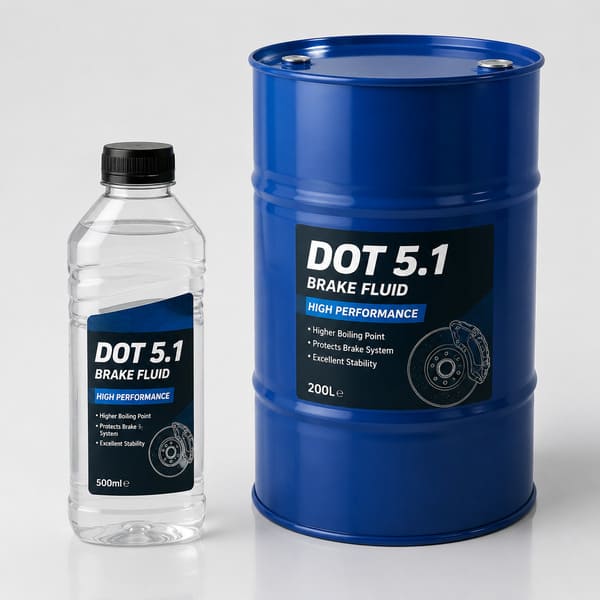
High-performance glycol-ether DOT 5.1 — 267 °C dry ERBP, 185 °C wet ERBP. Fully compatible with DOT 3 and DOT 4. For sportbikes, performance vehicles, and commercial fleets. View product details →
Why mixing them destroys the brake system
If silicone DOT 5 is mixed with any glycol-ether brake fluid — DOT 3, DOT 4, DOT 4 LV, DOT 5.1, HZY6 or Class 7 — the consequences cascade through the brake system over hours to days:
Phase 1: Phase separation (minutes to hours)
The two fluids do not blend. The silicone fluid, being less dense and chemically dissimilar, separates and forms a distinct layer. In a brake reservoir at rest, you can often see a visible interface between the two liquids.
Phase 2: Gel formation (hours to days)
The borate esters in glycol-ether brake fluid react with the silicone PDMS at the molecular interface. A viscous gel forms — neither fluid nor solid, but resembling a thick jelly. The gel preferentially accumulates at low points in the brake system: in caliper bores, at the inner walls of brake lines, and around piston seals.
Phase 3: Seal degradation (days to weeks)
The SBR and EPDM seals in the brake system, engineered for one chemistry family, begin to react inconsistently with the mixed fluid. Some seals swell, some shrink, some develop microcracks. The previously smooth piston-bore interface becomes irregular.
Phase 4: Brake system failure (weeks)
The combination of gel-restricted lines, swollen seals, and changing piston travel produces a brake pedal that progressively loses firmness. In severe cases, a brake circuit may fail entirely — a calamitous outcome that is fully preventable by never mixing the two chemistries.
Do not drive the vehicle. The entire brake system — reservoir, master cylinder, lines, calipers, and seals — must be flushed and rebuilt. New brake fluid alone is not sufficient; the gel residue must be physically removed and rubber seals replaced. See the next section for the full remediation procedure.
What to do if cross-contamination has occurred
If you discover that silicone DOT 5 has been added to a glycol-ether system (or vice versa), the brake system must be fully decontaminated. The standard procedure:
- Stop driving the vehicle immediately. Have it transported to the workshop rather than driven.
- Drain the entire brake system. Open all bleeders and pump out every drop of fluid. Disconnect lines at the master cylinder and caliper to ensure full drainage.
- Replace all rubber components. Master cylinder seals, caliper piston seals, brake hoses, and reservoir gaskets must be replaced — they have been compromised by the cross-contamination.
- Flush the metal lines. Use the original fluid type (after identifying which one the system was originally designed for) to flush the lines until fluid emerges clear and free of any gel particles.
- Refill with the correct fluid grade. Verify against the reservoir cap specification and the vehicle's service manual.
- Bleed the system thoroughly. Multiple bleeding cycles may be required to remove all entrained air.
- Road-test before returning to service. Verify pedal feel, braking distance, and ABS function over a structured test sequence.
The cost of this procedure is typically 5-10 times the cost of the original cross-contaminated fluid. Prevention is dramatically cheaper than remediation.
How to identify which one you have
If you have a brake fluid sample without clear labeling, several practical tests can distinguish silicone DOT 5 from glycol-ether DOT 5.1:
Visual inspection
DOT 5 silicone is typically dyed purple (industry convention). Glycol-ether brake fluids — including DOT 5.1 — are typically clear to amber. This is not a regulatory requirement under FMVSS 116, but it is the conventional industry practice.
Water mixing test
Place a small drop of the fluid in a clear glass with water. Silicone DOT 5 forms distinct droplets that do not blend with the water (hydrophobic). Glycol-ether DOT 5.1 mixes uniformly into the water immediately (hygroscopic).
Paint contact test
On a hidden, unimportant painted surface — never an automotive paintwork — apply a small drop and wait one minute. Glycol-ether fluid will visibly soften or discolor the paint; silicone will leave no mark.
Professional moisture testing
Workshop-grade moisture test strips (or electronic moisture meters) read the water content of the fluid. Silicone DOT 5 will register zero or near-zero moisture content regardless of age. Glycol-ether brake fluid will register some moisture even in fresh, sealed product.
Verify regulatory registration
Brake fluid sold in the United States with a "DOT 3", "DOT 4", "DOT 5" or "DOT 5.1" designation must be registered with the Automotive Manufacturers Equipment Compliance Agency (AMECA), which maintains the public registry of compliant brake fluids under FMVSS 116. Sinolook glycol-ether brake fluids carry AMECA notification numbers — for example, Sinolook DOT 4 is #221045. If a product cannot be verified in the AMECA database, the chemistry and grade claim should be treated with skepticism.
Which one should you choose?
For 99% of vehicles on the road today, the answer is clear:
Choose DOT 5.1 if you have a modern vehicle
Any modern passenger car, motorcycle, or commercial vehicle built with ABS, ESP, ESC, or any form of electronic brake control should use a glycol-ether brake fluid — DOT 3, DOT 4, DOT 4 LV, or DOT 5.1, depending on what the manufacturer specifies. DOT 5.1 specifically is the top of the standard glycol family with the highest boiling points (267 / 185 °C in Sinolook batches) while remaining fully compatible with DOT 3 and DOT 4 below it.
Choose DOT 5 only if your vehicle was specifically designed for it
The two main categories: pre-2007 Harley-Davidson motorcycles whose service manual specifies DOT 5, and US military vehicles whose technical orders specify silicone fluid. For any other application, DOT 5 is not the right choice.
The default recommendation
If you are unsure, default to following the brake fluid reservoir cap specification on the master cylinder. That label was placed by the vehicle manufacturer with full knowledge of the brake system design — and following it is always the safe choice.
Frequently asked questions
What is the difference between DOT 5 and DOT 5.1 brake fluid?
Despite the similar names, DOT 5 and DOT 5.1 are two completely different types of brake fluid. DOT 5 is silicone-based (polydimethylsiloxane), hydrophobic, and chemically incompatible with all other DOT grades. DOT 5.1 is glycol-ether based, hygroscopic, and fully compatible with DOT 3, DOT 4, and DOT 4 LV. They must never be mixed.
Can you mix DOT 5 and DOT 5.1 brake fluid?
No — never. The two chemistries are incompatible. Mixing produces gel formation in the brake lines, seal swelling and degradation, and progressive brake system failure. If cross-contamination has occurred, the entire brake system must be flushed and rebuilt with new seals.
Is DOT 5.1 better than DOT 5?
They serve different applications, so they are not directly comparable. DOT 5 silicone is paint-safe and hydrophobic — preferred for show vehicles, older Harley-Davidson motorcycles, and certain military applications. DOT 5.1 glycol-ether has higher performance for ABS systems, better cold-temperature flow, and is the standard upgrade path from DOT 3 or DOT 4. For most modern vehicles, DOT 5.1 is the better choice.
Why is DOT 5.1 not just called DOT 5?
Historical accident. DOT 5 silicone was introduced first under FMVSS 116 to meet military and motorcycle requirements. Later, a higher-performance glycol-ether grade was developed that exceeded DOT 4 boiling points — it was designated DOT 5.1 to indicate the higher performance tier while keeping the glycol chemistry distinct from silicone DOT 5. The naming has caused confusion for decades, but the industry standards are now well established. ISO 4925:2020 uses the clearer "Class 5-1" designation.
How can I tell if my brake fluid is DOT 5 or DOT 5.1?
Check the bottle label and the vehicle's brake fluid reservoir cap — those are the authoritative sources. As secondary checks: DOT 5 silicone is typically dyed purple; glycol-ether fluids are clear to amber. A drop of DOT 5 in water does not mix; DOT 5.1 mixes immediately. Professional moisture-content testing strips also give an immediate reading — silicone shows zero, glycol-ether shows some moisture even when fresh.
Sourcing brake fluid for your operation
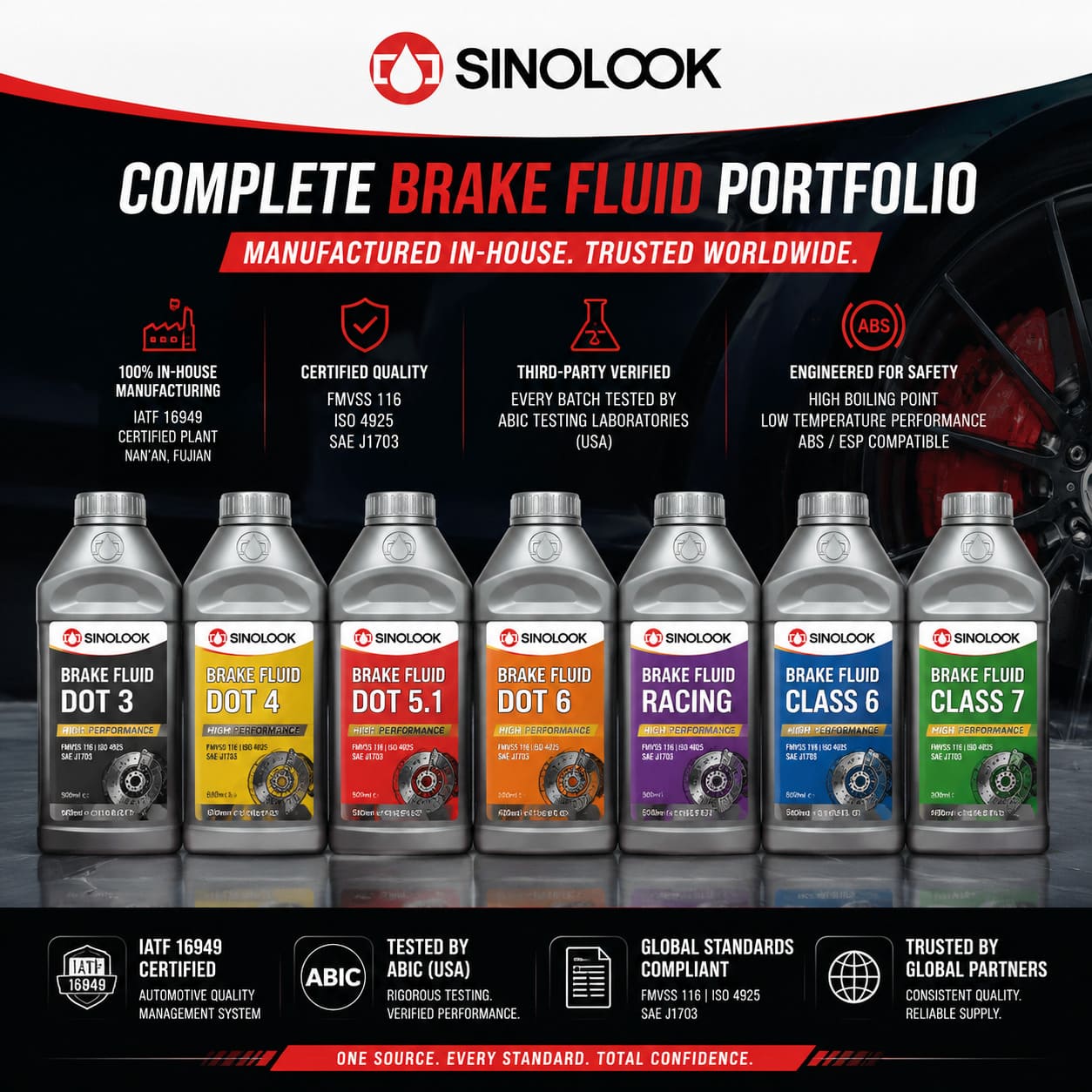
Sinolook manufactures the complete glycol-ether brake fluid family at our IATF 16949:2016 certified plant in Nan'an, Fujian, China — independently tested at ABIC Testing Laboratories, Inc. in the United States. For bulk supply, OEM private label, or aftermarket distribution, all grades are available in retail bottles, drums, IBC totes, flexitank or ISO tank:
- Sinolook DOT 5.1 Brake Fluid — 267 °C dry ERBP, ISO 4925 Class 5-1, FMVSS 116 certified
- Sinolook DOT 4 LV (DOT 4+ PLUS) — low-viscosity DOT 4 for modern ABS / ESP systems
- Sinolook DOT 4 Brake Fluid — the universal modern grade, AMECA #221045
- Sinolook HZY6 / Class 6 — premium grade for EVs and hybrids
- Sinolook Class 7 (HZY6+) — patented flagship for motorsport and OEM programs
For the full side-by-side specification of all seven grades, see the brake fluid product portfolio, or read our complete guide to brake fluid types.
Sinolook does not manufacture silicone DOT 5 in standard production — please contact our sales team for special silicone fluid requirements.