Brake fluid for electric cars is one of the most misunderstood topics in EV ownership. A common assumption is that because EVs use regenerative braking, they barely need brake fluid at all. The reality is the opposite: electric vehicles and hybrids place new, specific demands on their brake fluid — they need it to be low-viscosity for fast brake-by-wire response, high-boiling-point for safety margin, and replaced on schedule despite lighter friction-brake use. The grades that fit best are the modern low-viscosity ones: DOT 4 LV, DOT 5.1, and ISO 4925 Class 6 (HZY6).
This guide explains why electrified vehicles have different brake fluid requirements, how regenerative braking and brake-by-wire change the picture, and which grade suits your EV or hybrid.
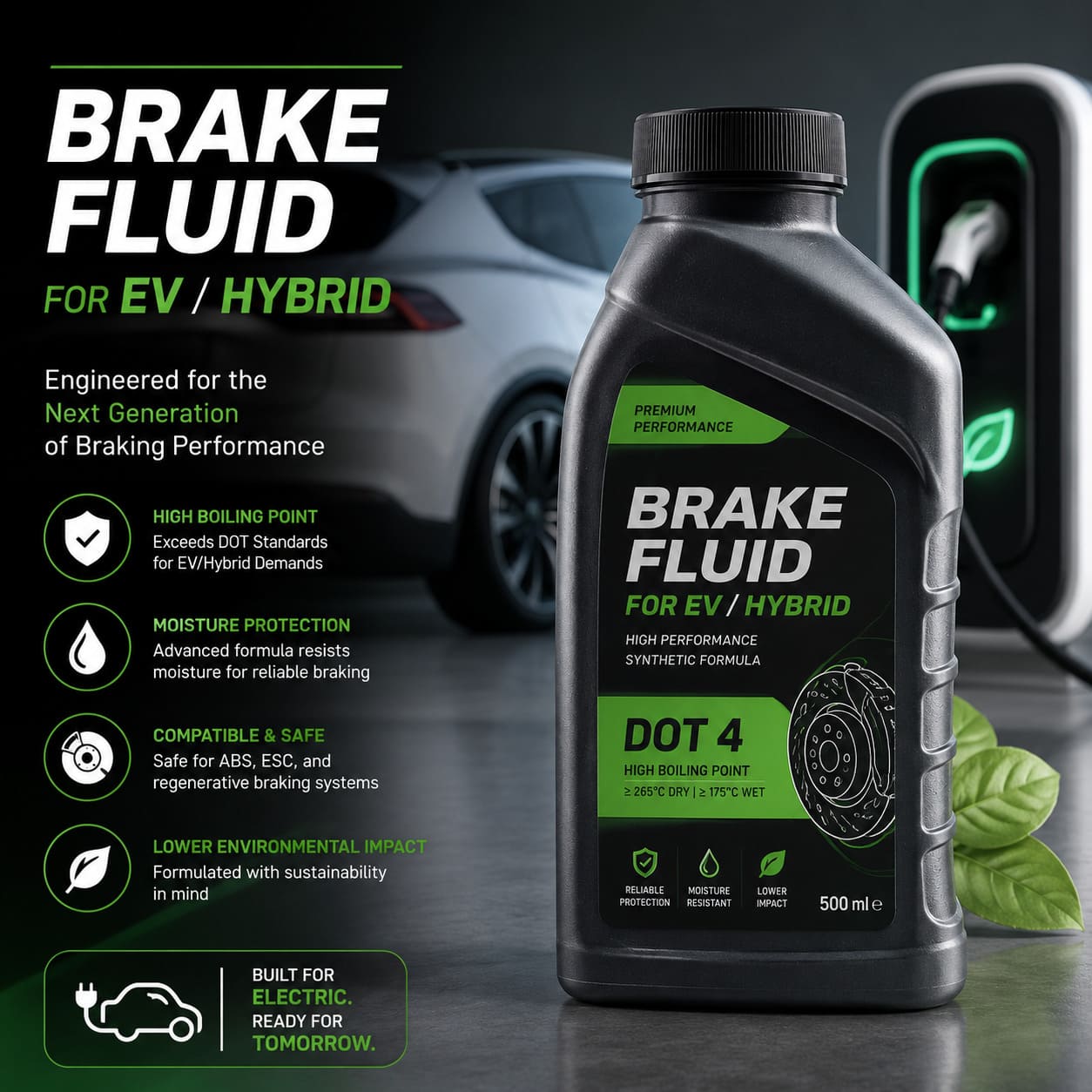
Do electric cars even use brake fluid?
Yes — every electric car and hybrid on the road uses brake fluid. Despite regenerative braking, EVs still have a complete conventional hydraulic friction brake system: master cylinder, brake lines, calipers, pads and discs, all operated by brake fluid.
Regenerative braking — where the electric motor acts as a generator to slow the vehicle and recharge the battery — handles much of the routine deceleration. But the friction brakes, and the fluid that operates them, remain essential for:
- Hard stops — emergency or heavy braking exceeds what regen alone can deliver
- Low-speed braking — regen weakens at very low speeds, so friction brakes take over to bring the car to a complete stop
- Battery-full conditions — when the battery is fully charged, regen braking is limited and friction braking compensates
- Stability and ABS events — emergency stability control and anti-lock function always work through the hydraulic system
So brake fluid for electric cars is just as safety-critical as in any other vehicle — it simply works alongside a sophisticated electronic braking system.
Why EV brake fluid requirements are different
The difference is in how the brake fluid is used. Conventional cars apply brake fluid pressure directly from the pedal through the master cylinder. EVs and hybrids interpose an electronic layer:
- Brake-by-wire. Many EVs decouple the brake pedal from the hydraulics. A sensor reads pedal pressure, a computer decides how much braking comes from regen and how much from friction, and an electro-hydraulic actuator applies the friction brakes electronically.
- Regen-friction blending. The system constantly blends regenerative and friction braking, switching between them seamlessly. This requires the hydraulic actuator to modulate pressure rapidly and precisely.
- High-frequency valve cycling. The electro-hydraulic valves cycle far more often than a conventional ABS, pumping small volumes of fluid through narrow passages many times per second.
All three of these put a premium on one fluid property above all: low viscosity.
Why low viscosity matters for EVs
Viscosity is the brake fluid's resistance to flow. The lower the viscosity — especially at cold temperatures — the faster the fluid can move through the narrow passages and valves of a brake-by-wire system. For an EV constantly blending regen and friction braking through high-frequency valves, low viscosity translates directly into faster, more precise, more responsive braking.
The contrast is clearest at −40 °C, where all brake fluids thicken:
| Grade | Viscosity at −40 °C | EV / hybrid suitability |
|---|---|---|
| DOT 4 (standard) | ~1,300 mm²/s | Adequate where specified, but not ideal for brake-by-wire |
| DOT 4 LV | ~1,000 mm²/s | Good — common modern EV / hybrid specification |
| DOT 5.1 | ~813 mm²/s | Very good — low viscosity + high boiling point |
| HZY6 / Class 6 | ~689 mm²/s | Excellent — purpose-built for EV / brake-by-wire |
| Class 7 | ~680 mm²/s | Highest tier — premium EV and performance EV |
Lower numbers are better for EV applications. HZY6 and Class 7, at under 700 mm²/s, flow roughly twice as easily at −40 °C as standard DOT 4 — which is exactly why they are increasingly specified for electric and hybrid vehicles. To understand viscosity's companion property, see our guide on brake fluid boiling point.
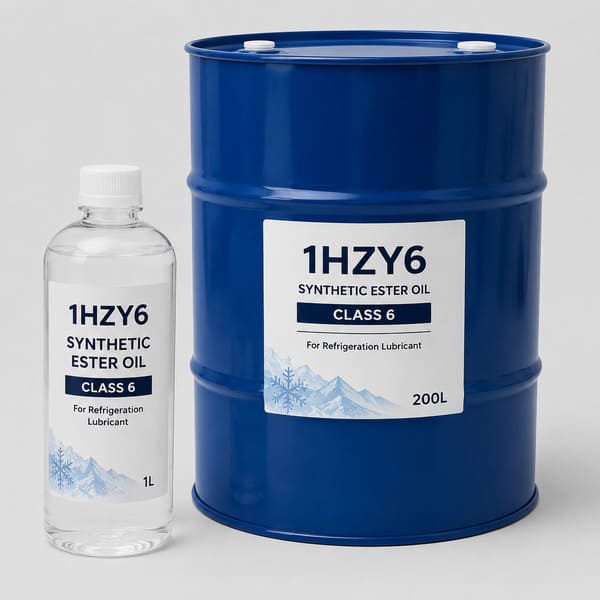
Purpose-built for EVs and hybrids — 689 mm²/s at −40 °C with DOT 5.1-class boiling points (267 °C / 187 °C). For regenerative braking and brake-by-wire systems. View product details →
Regenerative braking and fluid life
A reasonable question: if regenerative braking means the friction brakes are used much less, does the brake fluid last longer?
The answer is nuanced. Lighter friction-brake use does reduce thermal stress on the fluid — there are fewer hard, heat-generating brake applications. But brake fluid degrades primarily through moisture absorption, not heat, and that process continues regardless of how often the brakes are used. A glycol-ether fluid sealed in an EV's brake system still absorbs atmospheric moisture over time, lowering its boiling point on the same timeline as any other vehicle.
Because EV friction brakes are used so lightly, some owners and even service schedules neglect the brake fluid entirely. But moisture-laden fluid still corrodes internal components — and an EV that rarely exercises its friction brakes can suffer caliper and ABS corrosion if the fluid is never refreshed. EV brake fluid still needs changing on schedule.
Which grades suit EVs and hybrids
The right brake fluid for electric cars depends entirely on what the vehicle manufacturer specifies — but the modern EV trend is clear, toward low-viscosity high-performance fluids:
- DOT 4 LV — the most common modern EV / hybrid factory specification. Low viscosity for brake-by-wire, fully compatible with DOT 4.
- DOT 5.1 — even lower viscosity plus higher boiling point. A strong choice for performance EVs.
- HZY6 (Class 6) — purpose-built for electrification, combining the lowest practical viscosity with DOT 5.1-class boiling points.
- Class 7 — the highest tier, for premium and high-performance EVs and brake-by-wire systems demanding the fastest possible response.
All of these are glycol-ether based and mutually compatible, so upgrading within the range is straightforward — see can you mix brake fluids. The one fluid to avoid entirely in an EV is silicone DOT 5, which is incompatible with ABS and brake-by-wire systems.
The brake fluid reservoir cap and owner's manual specify the exact grade your EV requires. You can always use a higher compatible grade (for example HZY6 in place of DOT 4 LV) but never a lower-viscosity-class grade than specified for a brake-by-wire system.
HZY6 and Class 7 — built for electrification
The arrival of mass-market EVs is precisely why ISO 4925 added Class 6 and Class 7 to the standard. These grades did not exist in the original DOT system because they solve a problem that only became urgent with electrification: how to combine a high boiling point (for safety margin) with very low viscosity (for brake-by-wire response).
HZY6 (Class 6) achieves around 689 mm²/s at −40 °C — far below standard DOT 4 — while retaining a 267 °C dry boiling point comparable to DOT 5.1. Class 7 goes further still, with the lowest viscosity and highest boiling point in the range. For a Chinese EV manufacturer or a global OEM specifying brake fluid for an electrified platform, these are the grades that meet the requirement. For the full technical comparison, see our guide to brake fluid types.
How often to change EV brake fluid
EV and hybrid brake fluid follows the same general replacement schedule as conventional vehicles, because moisture absorption — not brake use — is the main driver of degradation:
| Condition | Recommended interval |
|---|---|
| Standard EV / hybrid use | Every 2 years (per manufacturer schedule) |
| Humid / tropical climate | Annually |
| Performance EV / track use | Before demanding events |
| Measured water content ≥ 3% | Replace immediately |
The procedure for changing EV brake fluid is the same as any vehicle, with one important caveat: many EVs require a diagnostic scan tool to fully bleed the brake-by-wire actuator and ABS modulator. For the general procedure see how to change brake fluid, but for most EVs the work is best done by a qualified technician with the correct equipment.
Frequently asked questions
Do electric cars use brake fluid?
Yes. Electric cars have conventional hydraulic friction brakes alongside regenerative braking, and those hydraulic brakes use brake fluid just like any other vehicle. Although regenerative braking reduces how often the friction brakes engage, the brake fluid is still essential for hard stops, low-speed braking, and emergency braking. EVs typically specify DOT 4, DOT 4 LV, DOT 5.1 or a Class 6 (HZY6) fluid.
What brake fluid do electric cars use?
Most electric vehicles specify a low-viscosity glycol-ether brake fluid — commonly DOT 4 LV, DOT 5.1, or an ISO 4925 Class 6 (HZY6) fluid. The low viscosity is important because EVs use brake-by-wire and high-frequency ABS modulation that require fast fluid response. Always check the reservoir cap or owner's manual for the exact grade your EV requires.
Why do EVs need low-viscosity brake fluid?
Electric vehicles and hybrids use brake-by-wire systems and blend regenerative braking with friction braking through high-frequency electro-hydraulic valves. These valves pump small volumes of fluid rapidly through narrow passages, so a low-viscosity fluid responds faster and more precisely — especially in cold weather. This is why grades like DOT 4 LV, DOT 5.1 and HZY6, with viscosity well below standard DOT 4, are preferred.
Does regenerative braking affect brake fluid life?
Regenerative braking reduces how often the friction brakes are used, which can reduce thermal stress on the brake fluid. However, the fluid still absorbs atmospheric moisture over time regardless of use, so it still needs replacement on the manufacturer's schedule — typically every 2 years. Some EVs that rarely use friction braking can even accumulate corrosion if the fluid is never refreshed.
Can I use regular DOT 4 in my electric car?
Only if the manufacturer specifies DOT 4. Many EVs specify a low-viscosity grade such as DOT 4 LV or Class 6 (HZY6) because their brake-by-wire systems need faster fluid response. Using standard DOT 4 where a low-viscosity grade is specified may impair ABS and regen-braking performance in cold conditions. Always follow the reservoir cap specification — and you can always use a higher compatible grade.
Brake fluid built for the electric era
Sinolook manufactures the complete low-viscosity brake fluid range at our IATF 16949:2016 certified plant in Nan'an, Fujian, China — independently tested at ABIC Testing Laboratories, Inc. in the United States, meeting ISO 4925 and FMVSS 116. For EV and hybrid OEM, aftermarket, or distribution supply:
- Sinolook DOT 4 LV — low-viscosity for modern EV / hybrid ABS / ESP
- Sinolook DOT 5.1 — low viscosity plus high boiling point
- Sinolook HZY6 / Class 6 — purpose-built for electrification
- Sinolook Class 7 — the patented flagship for premium EVs
Compliant fluids are verifiable in the AMECA database. For the full range and specifications, see the brake fluid product portfolio.