Can you mix brake fluids? The short answer: yes, you can mix any glycol-ether grades — but you must never mix glycol-ether fluid with silicone DOT 5. All the common grades (DOT 3, DOT 4, DOT 4+, DOT 4 LV, DOT 5.1, HZY6 and Class 7) belong to the same glycol-ether chemistry family and combine freely. The single exception is silicone DOT 5, which is chemically incompatible with everything else. Mixing across that line is the most damaging — and most preventable — error in brake maintenance.
This guide gives you the complete compatibility matrix, explains exactly which combinations are safe, what happens when incompatible fluids meet, and what to do if a mix-up has already occurred.
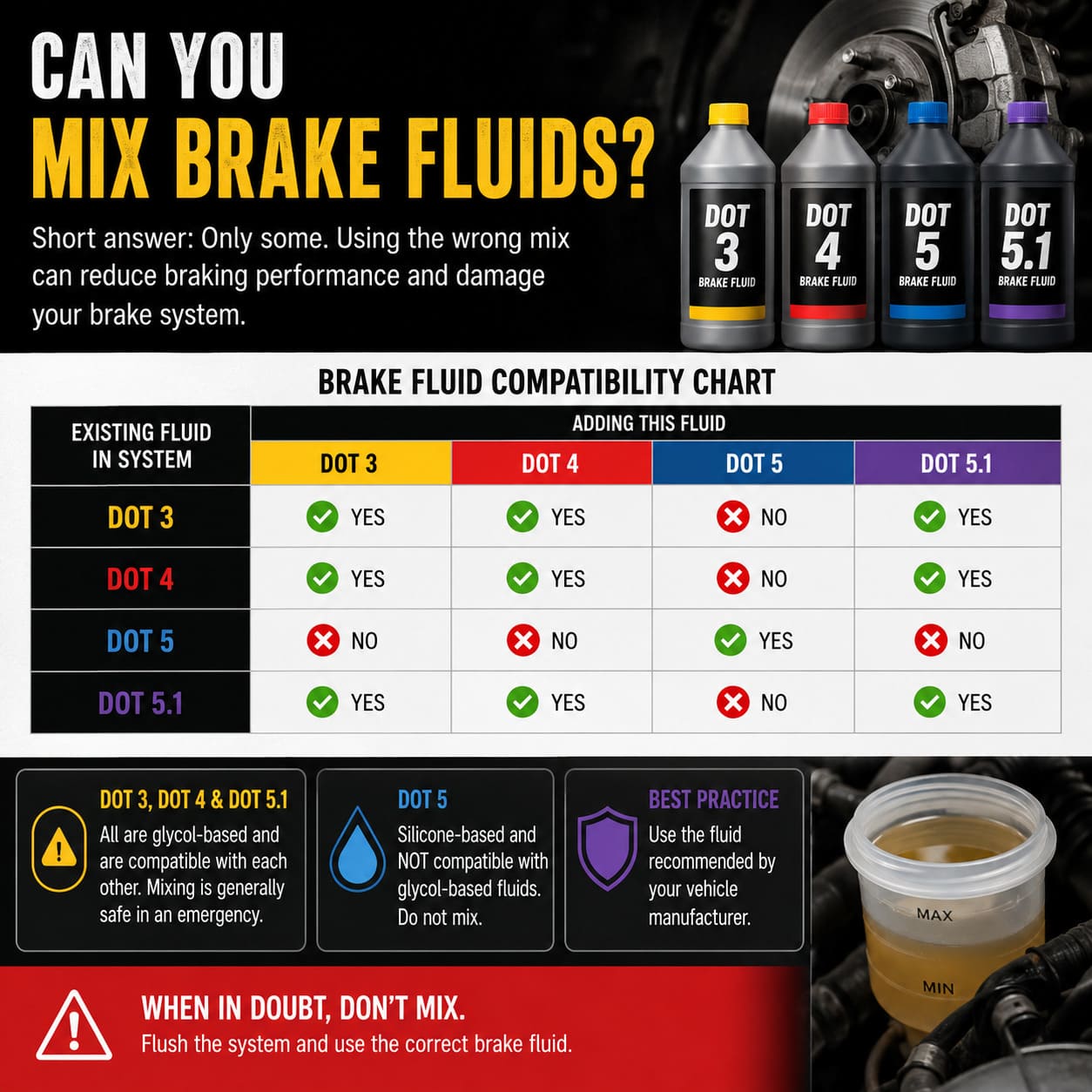
The quick answer
Brake fluids fall into two chemistry families, and the mixing rule follows directly from that split:
- Glycol-ether family (DOT 3, DOT 4, DOT 4+, DOT 4 LV, DOT 5.1, HZY6, Class 7) — all mutually compatible, mix in any ratio.
- Silicone family (DOT 5 only) — compatible only with itself, never with any glycol-ether fluid.
Glycol mixes with glycol. Silicone stays alone. Every DOT grade except DOT 5 is glycol-ether based and inter-compatible. Silicone DOT 5 must never be combined with any other grade. If you remember only one thing about brake fluid mixing, remember this.
The complete mixing compatibility matrix
This matrix shows every combination at a glance. Green means safe to mix; red means never mix; amber means compatible but not recommended long-term.
| Mix ↓ with → | DOT 3 | DOT 4 | DOT 4+ / LV | DOT 5.1 | HZY6 / Class 7 | DOT 5 (silicone) |
|---|---|---|---|---|---|---|
| DOT 3 | ✓ | ✓ | ✓ | ✓ | ✓ | ✗ |
| DOT 4 | ✓ | ✓ | ✓ | ✓ | ✓ | ✗ |
| DOT 4+ / LV | ✓ | ✓ | ✓ | ✓ | ✓ | ✗ |
| DOT 5.1 | ✓ | ✓ | ✓ | ✓ | ✓ | ✗ |
| HZY6 / Class 7 | ✓ | ✓ | ✓ | ✓ | ✓ | ✗ |
| DOT 5 (silicone) | ✗ | ✗ | ✗ | ✗ | ✗ | ✓ |
The pattern is simple: the entire grid is green except the DOT 5 row and column, which are red against everything but themselves. For a deeper look at the grades themselves, see our complete guide to brake fluid types.
Why glycol-ether grades mix freely
DOT 3, DOT 4, DOT 4+, DOT 4 LV, DOT 5.1, HZY6 and Class 7 are all synthesized from the same base chemistry — polyalkylene glycol ethers and borate esters. The difference between grades comes from the specific glycol-ether species and the additive ratios, which determine the boiling point and viscosity. But at the molecular level they are the same family, so combining them produces no adverse reaction.
When you mix two glycol-ether grades, the resulting blend simply has properties somewhere between the two. For example, topping up a DOT 4 system with DOT 5.1 raises the blend's boiling point slightly; topping up DOT 5.1 with DOT 4 lowers it slightly. The seals, metals and brake components see no chemistry they were not designed for.
This is also why these grades all share identical compatibility with the rubber seal materials (SBR and EPDM) used in brake systems, as verified under ISO 4925 and SAE J1703.
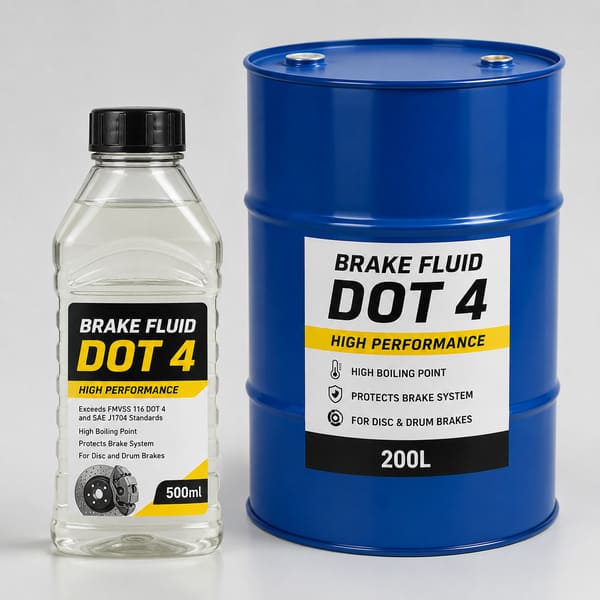
Compatible with all glycol-ether grades — 250 °C dry ERBP, FMVSS 116 certified. The universal modern grade for cars and light trucks. View product details →
Can you mix DOT 3 and DOT 4?
Yes — DOT 3 and DOT 4 mix freely. This is the most common real-world mixing question, because many older vehicles specify DOT 3 and owners often have DOT 4 on hand (or vice versa). The practical guidance:
- Topping up DOT 3 with DOT 4: Perfectly safe, and effectively a small upgrade — the blend has a slightly higher boiling point than pure DOT 3.
- Topping up DOT 4 with DOT 3: Safe in an emergency, but lowers the overall boiling point margin. Flush and refill with DOT 4 at the next service.
For the full comparison of these two grades, see our dedicated DOT 3 vs DOT 4 brake fluid guide.
Can you mix DOT 4 and DOT 5.1?
Yes — and this is where the naming trips people up. DOT 5.1 is glycol-ether based, so it mixes freely with DOT 4 and every other glycol grade. Topping up DOT 4 with DOT 5.1 actually raises the system's boiling point, since DOT 5.1 has a higher specification.
DOT 5.1 (glycol) mixes with DOT 4. DOT 5 (silicone) does NOT. The single ".1" makes all the difference — DOT 5.1 is glycol-ether, DOT 5 is silicone. They are chemically opposite. Read our full DOT 5 vs DOT 5.1 guide if there is any doubt.
Why you can never mix in silicone DOT 5
Silicone DOT 5 is made from polydimethylsiloxane — a completely different chemistry from the glycol-ether family. When silicone DOT 5 contacts any glycol-ether fluid, four things happen in sequence:
- Phase separation. The two fluids do not blend; the silicone forms a separate layer.
- Gel formation. The borate esters in glycol fluid react with the silicone at the interface, forming a viscous gel that accumulates in brake lines and caliper bores.
- Seal degradation. Rubber seals engineered for one chemistry react inconsistently with the mixed fluid — some swell, some shrink.
- Brake failure. Gel-restricted lines and compromised seals progressively reduce braking performance until a circuit fails.
This is why silicone DOT 5 is confined to specific applications — older Harley-Davidson motorcycles, military vehicles, and show cars — where the whole system is designed around it and no glycol fluid is ever introduced.
The upgrade rule: higher is fine, lower is not
Within the compatible glycol-ether family, there is a simple directional rule for mixing and topping up:
| Action | Safe? | Effect |
|---|---|---|
| Add a higher grade to a lower-grade system | ✓ Recommended | Raises boiling point — a safe upgrade |
| Add a lower grade to a higher-grade system | △ Emergency only | Lowers boiling point margin — flush at next service |
| Use a grade below the manufacturer's spec | ✗ Never | Reduces safety margin below design intent |
The takeaway: you can always go up the chain (DOT 3 → DOT 4 → DOT 5.1 → Class 7) safely. You should avoid going down it, and you must never go below what your vehicle's reservoir cap specifies. To understand the boiling-point consequences, see our guide on brake fluid boiling point.
What to do if you've mixed incompatible fluids
If glycol-ether fluid and silicone DOT 5 have been combined in the same system, the brake system must be fully decontaminated — new fluid alone is not enough. The standard remediation:
- Stop driving the vehicle immediately and have it transported rather than driven.
- Drain the entire system — open all bleeders and disconnect lines to ensure complete drainage.
- Replace all rubber components — master cylinder seals, caliper seals, brake hoses and reservoir gaskets.
- Flush the metal lines with the correct fluid type until they run clear and free of gel.
- Refill, bleed thoroughly, and road-test before returning the vehicle to service.
If, on the other hand, you simply topped up one glycol-ether grade with another (for example DOT 3 with DOT 4), no remediation is needed — the fluids are compatible. For the routine flush procedure, see how to change brake fluid.
Frequently asked questions
Can you mix brake fluids?
It depends on the chemistry. All glycol-ether brake fluids — DOT 3, DOT 4, DOT 4+, DOT 4 LV, DOT 5.1, HZY6 and Class 7 — are fully compatible and can be mixed in any ratio. Silicone DOT 5 must never be mixed with any glycol-ether fluid.
Can you mix DOT 3 and DOT 4 brake fluid?
Yes. DOT 3 and DOT 4 are both glycol-ether based and fully compatible. You can top up DOT 3 with DOT 4 (an upgrade) or mix them in any ratio. Avoid topping up a DOT 4 system with DOT 3 long-term, as it lowers the overall boiling point margin.
Can you mix DOT 4 and DOT 5.1 brake fluid?
Yes. Both DOT 4 and DOT 5.1 are glycol-ether based and fully compatible. Mixing them is safe and topping up DOT 4 with DOT 5.1 effectively upgrades the boiling point of the system. Note that DOT 5.1 is glycol-based — it is NOT the same as silicone DOT 5, which is incompatible.
What happens if you mix DOT 5 and DOT 5.1?
Mixing silicone DOT 5 with glycol-ether DOT 5.1 causes the two chemistries to separate and react, forming a gel in the brake lines, swelling rubber seals, and progressively degrading brake performance until the system fails. Despite the similar names, DOT 5 and DOT 5.1 are chemically opposite and must never be combined.
Do you have to flush old brake fluid before adding new?
For compatible glycol-ether grades, you do not need a full flush just to top up or upgrade — they mix freely. However, a complete flush every 2 years is still recommended to remove moisture-laden old fluid. A full flush is mandatory when switching between incompatible chemistries (glycol to silicone or vice versa).
Sourcing compatible brake fluid
Sinolook manufactures the complete glycol-ether brake fluid family at our IATF 16949:2016 certified plant in Nan'an, Fujian, China — independently tested at ABIC Testing Laboratories, Inc. in the United States. Every grade is mutually compatible, so distributors and workshops can stock the range with confidence:
- Sinolook DOT 3 — for older vehicles, motorcycles and clutch systems
- Sinolook DOT 4 — the universal modern grade
- Sinolook DOT 4 LV — low-viscosity for modern ABS / ESP systems
- Sinolook DOT 5.1 — highest standard glycol grade for performance use
- Sinolook Class 7 — patented flagship for motorsport and OEM programs
Compliant fluids are verifiable in the AMECA database — Sinolook DOT 4 carries notification #221045. For the full range, see the brake fluid product portfolio.