Every brake fluid grade you have ever seen — DOT 3, DOT 4, DOT 5.1, HZY6, Class 7 — is defined by a brake fluid standard. There are four that matter: the US FMVSS 116, the international ISO 4925, the industry reference SAE J1703, and China's national standard GB 12981. They use largely the same laboratory tests, but each names the grades differently and a few define higher tiers the others don't. For anyone sourcing brake fluid for a global market, understanding how these standards map to one another is essential.
This guide breaks down each of the four brake fluid standards, explains exactly what they measure, and provides a cross-reference table so you can translate a grade from one standard to another.
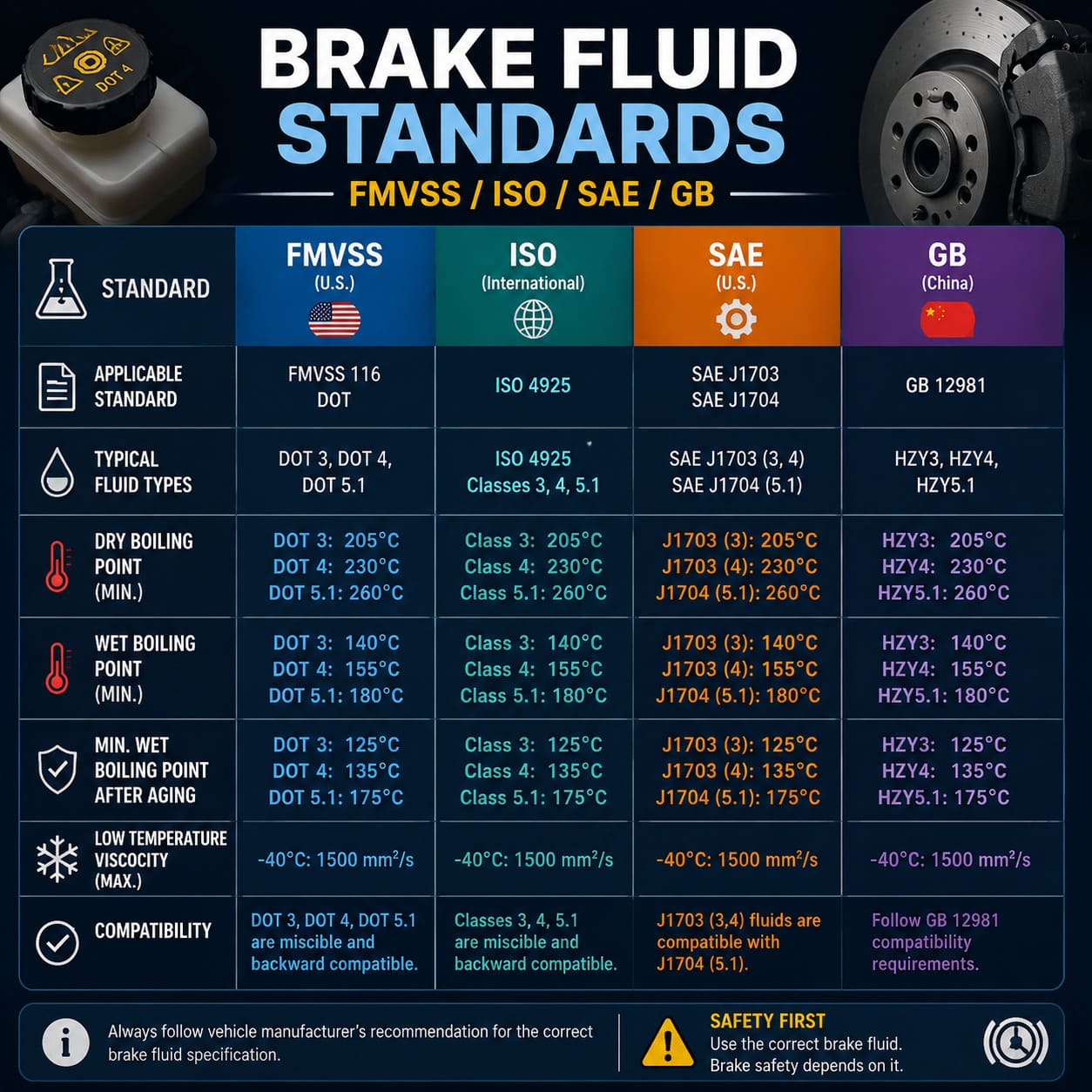
The four major brake fluid standards
At a glance, here is who publishes each standard and which region it primarily governs:
Published by the US Department of Transportation / NHTSA. The source of the DOT 3, DOT 4, DOT 5 and DOT 5.1 grade names. Legally mandatory for brake fluid sold in the USA.
The global reference standard. Defines Classes 3, 4, 5-1, 6 and 7 — including higher-performance tiers that FMVSS 116 does not formally specify.
An industry standard overlapping closely with DOT 4 requirements. Frequently cited alongside FMVSS 116 on product labels and OEM specifications.
China's national brake fluid standard. Uses the HZY designation (HZY3, HZY4, HZY5, HZY6) closely aligned with ISO 4925 classes.
FMVSS 116 — the US standard (DOT grades)
FMVSS 116 is US Federal Motor Vehicle Safety Standard No. 116, published in 49 CFR §571.116. It is the origin of the familiar "DOT" grade names that appear on brake fluid bottles worldwide.
FMVSS 116 defines four grades by chemistry and minimum performance:
- DOT 3 — glycol-ether, dry ERBP ≥ 205 °C, wet ERBP ≥ 140 °C
- DOT 4 — glycol-ether, dry ERBP ≥ 230 °C, wet ERBP ≥ 155 °C
- DOT 5 — silicone-based, dry ERBP ≥ 260 °C, wet ERBP ≥ 180 °C
- DOT 5.1 — glycol-ether, dry ERBP ≥ 260 °C, wet ERBP ≥ 180 °C
Note that FMVSS 116 specifies separate test procedures for non-petroleum-based fluids (DOT 3, 4, 5.1) and petroleum/silicone-based fluids (DOT 5). Brake fluid sold in the US must be registered with the Automotive Manufacturers Equipment Compliance Agency (AMECA), which maintains the public registry of compliant fluids. For example, Sinolook DOT 4 carries AMECA notification #221045.
ISO 4925 — the international standard
ISO 4925:2020 is the international standard for non-petroleum-based brake fluid. It uses essentially the same test methods as FMVSS 116, but extends the range with higher-performance classes that the US standard does not formally include:
- Class 3 — equivalent to DOT 3
- Class 4 — equivalent to DOT 4
- Class 5-1 — equivalent to DOT 5.1
- Class 6 — high boiling point + low viscosity (no FMVSS equivalent)
- Class 7 — the highest tier, highest boiling point + lowest viscosity
Classes 6 and 7 are increasingly important for modern vehicles. They combine DOT 5.1-level boiling points with much lower low-temperature viscosity, which is exactly what electric vehicles, hybrids and advanced ABS systems require. Sinolook's HZY6 (Class 6) and Class 7 grades are built to these classes.
SAE J1703 — the industry reference
SAE J1703 is published by the Society of Automotive Engineers. It is an industry reference standard for glycol-ether brake fluid that overlaps closely with the DOT 4 requirements of FMVSS 116. It is frequently cited alongside FMVSS 116 on product labels and in OEM specifications, providing an additional layer of industry validation. A companion standard, SAE J1704, corresponds more closely to higher-performance fluids.
GB 12981 — China's national standard (HZY)
GB 12981 is the Guobiao (national standard) for motor vehicle brake fluid in China. It uses the HZY designation, which maps directly onto the ISO 4925 classes:
- HZY3 — corresponds to ISO Class 3 / DOT 3
- HZY4 — corresponds to ISO Class 4 / DOT 4
- HZY5 — corresponds to ISO Class 5-1 / DOT 5.1
- HZY6 — corresponds to ISO Class 6
GB 12981 is closely aligned with ISO 4925 in both test methods and performance requirements. For manufacturers based in China supplying the global market — like Sinolook — testing to GB 12981 alongside FMVSS 116 and ISO 4925 is standard practice.
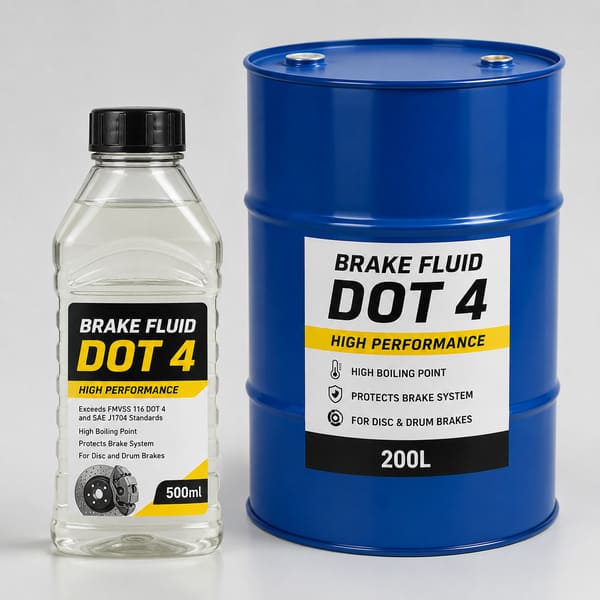
Certified to FMVSS 116, ISO 4925 Class 4, SAE J1703 and GB 12981 HZY4 — AMECA #221045. Independently tested at ABIC Laboratories, USA. View product details →
Cross-reference: how the standards map
This is the table B2B buyers reach for most often — translating a grade across all four standards:
| FMVSS 116 (US) | ISO 4925 | GB 12981 (China) | Dry ERBP min. | Wet ERBP min. | Sinolook product |
|---|---|---|---|---|---|
| DOT 3 | Class 3 | HZY3 | 205 °C | 140 °C | DOT 3 |
| DOT 4 | Class 4 | HZY4 | 230 °C | 155 °C | DOT 4 |
| DOT 4 (LV) | Class 4 / 6 | HZY4 | 230 °C | 155 °C | DOT 4 LV |
| DOT 5.1 | Class 5-1 | HZY5 | 260 °C | 180 °C | DOT 5.1 |
| — (no DOT) | Class 6 | HZY6 | 260 °C | 180 °C | HZY6 |
| — (no DOT) | Class 7 | — | 260 °C | 180 °C | Class 7 |
| DOT 5 | — (silicone) | — | 260 °C | 180 °C | Silicone — not standard production |
A grade on one row is broadly equivalent across all four standards. For example, a fluid labelled DOT 5.1 = ISO Class 5-1 = GB HZY5 describes the same performance tier. Classes 6 and 7 exist only in ISO and GB — there is no DOT equivalent, which is why these grades are often labelled by their ISO class.
What the standards actually test
All four standards measure brake fluid against the same core set of properties. The test methods are nearly identical across FMVSS 116, ISO 4925 and GB 12981:
- Equilibrium Reflux Boiling Point (dry ERBP) — boiling point of fresh fluid. See our guide on brake fluid boiling point.
- Wet ERBP — boiling point after humidification to 3.7% water content.
- Kinematic viscosity — measured at −40 °C and 100 °C to ensure flow at temperature extremes.
- pH value — must fall within a defined range (typically 7.0–11.5).
- Corrosion resistance — exposure of standard metal strips (tinned iron, steel, aluminium, cast iron, brass, copper, zinc) with mass-change limits.
- Rubber compatibility — SBR and EPDM seal swelling and hardness change within limits.
- Fluidity and appearance at low temperature, oxidation resistance, and stroking properties.
Because the tests are harmonized, a fluid that passes ISO 4925 Class 4 will, in practice, also meet DOT 4 — which is why quality manufacturers test once and certify to multiple standards.
Why multi-standard certification matters
For international B2B buyers — distributors, lubricant blenders, OEM brake-system suppliers — multi-standard certification is a practical sourcing requirement, not a marketing nicety:
- Global resale. A fluid certified to FMVSS 116, ISO 4925 and GB 12981 can be sold across North America, Europe, Asia and China without re-testing.
- OEM acceptance. Vehicle manufacturers specify brake fluid by standard; multi-standard compliance widens the range of OEM programs a fluid can serve.
- Customs and import. Different regions require different certifications for import clearance. Multi-standard documentation simplifies the paperwork.
- Independent verification. Reputable manufacturers back their certifications with independent third-party test reports — Sinolook fluids are tested at ABIC Testing Laboratories, Inc. in the United States.
When evaluating a brake fluid supplier, ask for the full certification set — FMVSS 116 (with AMECA number), ISO 4925, SAE J1703 and GB 12981 — plus a recent independent test report. Sinolook provides all of these per shipment. See the brake fluid product portfolio.
Frequently asked questions
What are the main brake fluid standards?
There are four major standards. FMVSS 116 is the US Federal Motor Vehicle Safety Standard that defines the DOT grades (DOT 3, DOT 4, DOT 5, DOT 5.1). ISO 4925 is the international standard that defines Classes 3, 4, 5-1, 6 and 7. SAE J1703 is an industry reference standard overlapping with DOT 4. GB 12981 is China's national standard, using the HZY designation. All four define brake fluid by boiling point, viscosity, corrosion and rubber compatibility.
What is FMVSS 116?
FMVSS 116 is US Federal Motor Vehicle Safety Standard No. 116, published in 49 CFR 571.116. It defines the minimum performance requirements for brake fluid sold in the United States and is the source of the familiar DOT 3, DOT 4, DOT 5 and DOT 5.1 grade designations. It specifies test methods and minimum values for dry and wet boiling point, viscosity, corrosion resistance and rubber compatibility.
What is the difference between FMVSS 116 and ISO 4925?
FMVSS 116 (US) and ISO 4925 (international) use essentially the same test methods, but ISO 4925 defines additional higher-performance classes — Class 5-1, Class 6 and Class 7 — that FMVSS 116 does not formally include. A fluid certified to ISO 4925 Class 5-1 is broadly equivalent to a DOT 5.1 fluid under FMVSS 116. Most quality manufacturers test to both standards.
What is GB 12981 brake fluid standard?
GB 12981 is China's national standard for motor vehicle brake fluid. It uses the HZY designation — HZY3, HZY4, HZY5, HZY6 — which correspond closely to ISO 4925 Class 3, 4, 5-1 and 6 respectively. GB 12981 is closely aligned with ISO 4925 test methods and performance requirements.
Does brake fluid need to meet multiple standards?
Quality brake fluid is typically certified to multiple standards so it can be sold globally. A premium product often carries FMVSS 116, ISO 4925, SAE J1703 and GB 12981 compliance simultaneously. For international B2B buyers, multi-standard certification is important because it confirms the fluid can be sold and used across different regulatory regions.
Brake fluid certified to all four standards
Sinolook manufactures the complete glycol-ether brake fluid range at our IATF 16949:2016 certified plant in Nan'an, Fujian, China — every grade certified to FMVSS 116, ISO 4925, SAE J1703 and GB 12981, and independently tested at ABIC Testing Laboratories, Inc. in the United States:
- Sinolook DOT 3 — Class 3 / HZY3, AMECA #230611
- Sinolook DOT 4 — Class 4 / HZY4, AMECA #221045
- Sinolook DOT 4 LV — low-viscosity Class 4 / HZY4
- Sinolook DOT 5.1 — Class 5-1 / HZY5
- Sinolook HZY6 — ISO Class 6 / GB HZY6
- Sinolook Class 7 — ISO Class 7, patented formulation
For the complete range and full certification documentation, see the brake fluid product portfolio or our guide to brake fluid types.