There are seven commercial types of brake fluid in use today, divided into two chemistry families that should never be mixed. The glycol-ether family covers six of the seven grades — DOT 3, DOT 4, DOT 4+, DOT 4 LV, DOT 5.1, HZY6 and Class 7 — and accounts for the brake fluid in virtually every passenger car, light truck, motorcycle and electric vehicle on the road. The silicone family contains a single outlier — DOT 5 — used primarily in older Harley-Davidson motorcycles and certain military vehicles.
This guide walks through each type of brake fluid in commercial use, explains where the grades came from, what their specifications mean in practice, and which one you need for your specific application.
The two chemistry families: glycol-ether vs silicone
Before discussing individual grades, it helps to understand the two underlying chemistries — because mixing across the two families is the single most damaging mistake in brake-system maintenance.
Glycol-ether brake fluid
Glycol-ether brake fluids are synthesized from polyalkylene glycol ethers, borate esters, corrosion inhibitors and antioxidants. They are hygroscopic — they absorb atmospheric moisture over time, which gradually lowers their boiling point. This is the chemistry behind every DOT 3, DOT 4, DOT 4+, DOT 4 LV, DOT 5.1, HZY6 and Class 7 brake fluid on the market.
Glycol-ether fluids are also compatible with conventional rubber seal materials — styrene-butadiene rubber (SBR) and ethylene-propylene-diene monomer (EPDM) — which are the standard seal materials in modern hydraulic brake systems. Compatibility testing per ISO 4925 §6.10 verifies that the fluid does not excessively soften, harden or swell either seal material.
Silicone brake fluid
Silicone brake fluid (chemically polydimethylsiloxane, or PDMS) was developed as an alternative for vehicles requiring brake fluid that does not damage paintwork on contact and does not absorb atmospheric moisture. It is hydrophobic — water entering the system does not mix with the fluid but pools separately, which can lead to localized corrosion.
Silicone is the chemistry behind DOT 5 only. It is chemically incompatible with glycol-ether fluids: mixing the two causes seal swelling, gel formation in the brake lines, and eventual brake system failure. Silicone DOT 5 is also generally not recommended for vehicles with anti-lock braking systems (ABS) because air bubbles can become entrained in the higher-viscosity silicone fluid.
Never mix glycol-ether brake fluid (DOT 3, 4, 4+, 4 LV, 5.1, HZY6, Class 7) with silicone brake fluid (DOT 5). The two chemistries are incompatible. Despite the similar numbering, DOT 5 (silicone) and DOT 5.1 (glycol) are not interchangeable.
DOT and ISO classification systems
Brake fluid is classified by two parallel standards that the industry generally treats as equivalent:
FMVSS 116 (US "DOT" classification)
The US Department of Transportation publishes Federal Motor Vehicle Safety Standard No. 116, which defines the minimum performance requirements for brake fluid sold in the United States. The full regulation is in 49 CFR §571.116. The "DOT" classifications (DOT 3, DOT 4, DOT 5, DOT 5.1) come from this standard.
ISO 4925 (international classification)
The International Organization for Standardization publishes ISO 4925:2020, which defines the same test methods as FMVSS 116 but adds higher-performance grades — Class 5-1, Class 6 and Class 7 — that the US standard does not formally define. China's brake fluid standard GB 12981 uses the HZY designation (HZY3 = Class 3, HZY4 = Class 4, etc.) and is closely aligned with ISO 4925.
SAE J1703
The Society of Automotive Engineers publishes SAE J1703, which serves as an industry reference standard. It overlaps significantly with the requirements of DOT 4 and is often cited alongside FMVSS 116 on brake fluid product labels.
AMECA notification
In the United States, brake fluid that bears a "DOT 3" or "DOT 4" mark on its label must be registered with the Automotive Manufacturers Equipment Compliance Agency (AMECA), which maintains the public registry of compliant brake fluids under FMVSS 116. Each registered product receives an AMECA notification number — for example, Sinolook DOT 3 carries #230611, and Sinolook DOT 4 carries #221045.
All seven types of brake fluid at a glance
Here is the complete summary of every commercial brake fluid grade, ordered from lowest to highest performance specification:
| Type | Chemistry | Dry ERBP min. | Wet ERBP min. | Visc. @ −40°C max. | Best for |
|---|---|---|---|---|---|
| DOT 3 | Glycol-ether | 205 °C | 140 °C | 1,500 mm²/s | Older cars, motorcycles, clutch systems |
| DOT 4 | Glycol-ether | 230 °C | 155 °C | 1,500 mm²/s | Modern cars, light trucks |
| DOT 4+ | Glycol-ether | ≥ 260 °C | ≥ 165 °C | 1,500 mm²/s | Heavy-duty & warm-climate use |
| DOT 4 LV | Glycol-ether | ≥ 230 °C | ≥ 155 °C | ≤ 750 mm²/s | Modern ABS / ESP / EHB systems |
| DOT 5 | Silicone | 260 °C | 180 °C | 900 mm²/s | Older Harley-Davidson, military |
| DOT 5.1 | Glycol-ether | 260 °C | 180 °C | 900 mm²/s | Performance vehicles, sportbikes |
| HZY6 / Class 6 | Glycol-ether | 260 °C | 180 °C | 750 mm²/s | EVs, hybrids, brake-by-wire |
| Class 7 | Glycol-ether | ≥ 260 °C | ≥ 180 °C | ≤ 680 mm²/s | Racing, premium OEM, autonomous-ready |
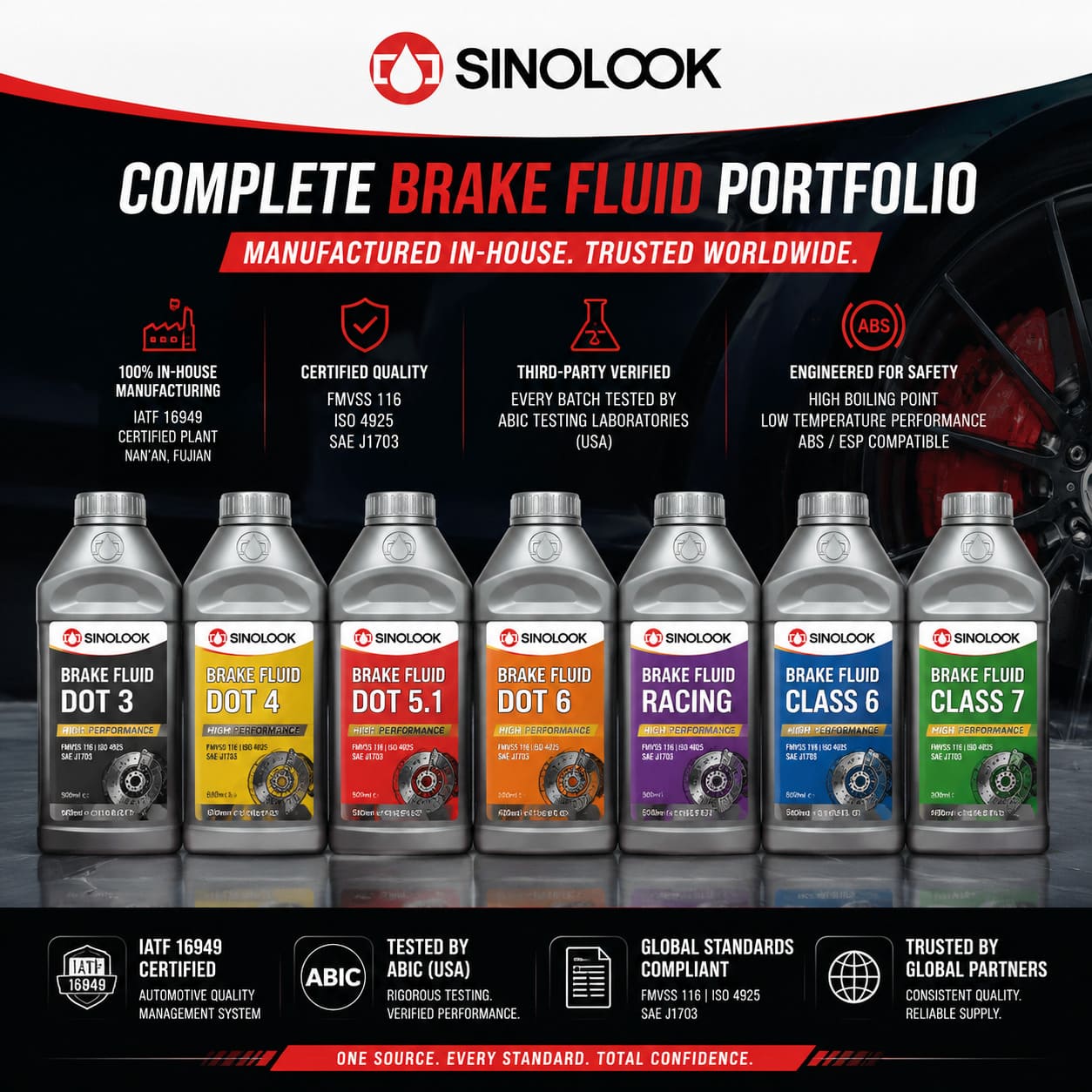
The numbers shown are the regulatory minimums. Well-made commercial brake fluids — including Sinolook's — exceed the standard minimums by 10-25 °C on boiling points and have headroom of 10-40% on viscosity. For a complete side-by-side of the Sinolook portfolio, see our brake fluid product range.
Brake fluid selection decision tree
The selection process for the right type of brake fluid is straightforward once you know the rules:
DOT 3 — the global default
DOT 3 Brake Fluid
DOT 3 is the foundational glycol-ether brake fluid. It has been the global default specification for hydraulic brake systems since FMVSS 116 was first enacted in 1972, and it remains the most widely used grade by volume worldwide. Most passenger cars built before 2006, virtually all commuter motorcycles and scooters, and most hydraulic clutch systems specify DOT 3.
Despite its position at the bottom of the performance hierarchy, DOT 3 is not "low quality" — it is engineered to meet a defined performance floor, and well-made DOT 3 exceeds the minimum by significant margins. Sinolook DOT 3 carries AMECA notification #230611 and typical batch values of 222 °C dry / 151 °C wet — comfortably above the FMVSS 116 minimum.
Sinolook DOT 3 product detailsDOT 4 — the modern standard
DOT 4 Brake Fluid
DOT 4 became the default specification for new passenger cars around 2006, when stricter regulations on ABS and ESP performance pushed manufacturers toward higher boiling-point fluids. It uses the same glycol-ether chemistry as DOT 3 but with a higher borate-ester ratio in the formulation, yielding ~25 °C higher dry boiling point.
DOT 4 is fully backward compatible with DOT 3 — you can mix the two in any ratio, top up either with either, or upgrade an entire system from DOT 3 to DOT 4 without flushing. The reverse, however, is unsafe: never downgrade a DOT 4 system to DOT 3. For a deep dive on the comparison, see our DOT 3 vs DOT 4 brake fluid guide.
Sinolook DOT 4 product details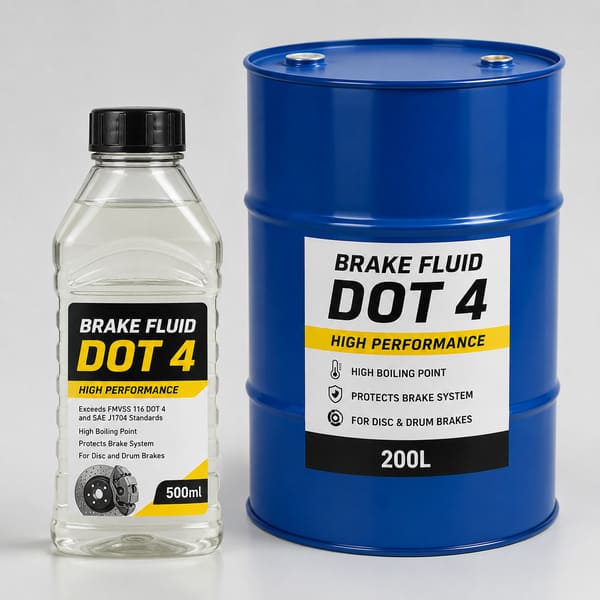
The universal modern brake fluid — 250 °C dry ERBP, AMECA #221045, FMVSS 116 certified. For passenger cars, light trucks and motorcycles. View product details →
DOT 4+ — the upgrade path
DOT 4+ Brake Fluid
DOT 4+ is a premium DOT 4 formulation that exceeds the ISO 4925 Class 4 minimum boiling points by significant margins — typically 260 °C dry / 165 °C wet versus the minimum 230 / 155. It sits between standard DOT 4 and DOT 5.1, addressing applications where DOT 4 may be marginal but DOT 5.1 is overkill: warm-climate operation, mountain driving, towing duty, or moderately performance-oriented driving.
DOT 4+ uses the same glycol-ether chemistry as DOT 3 and DOT 4, so it is fully compatible with both. A direct upgrade fill is safe, with no operational difference except higher thermal margin.
Sinolook DOT 4+ product detailsDOT 4 LV (DOT 4+ PLUS) — for ABS / ESP
DOT 4 LV (Low Viscosity)
DOT 4 LV (Low Viscosity), also marketed as DOT 4+ PLUS, is the modern evolution of DOT 4 — same chemistry, dramatically lower kinematic viscosity at low temperatures. The 1,000 mm²/s viscosity at −40 °C is about 33% lower than standard DOT 4 (1,300 mm²/s), enabling faster ABS modulator and ESP valve response. Most European and Asian OEMs since 2010 specify DOT 4 LV for vehicles with electronic stability control.
This is the grade where the "low viscosity revolution" started. Brake systems with ABS, ESP, ESC, VSC, or Electronic Hydraulic Brake (EHB) actuators all benefit from lower-viscosity hydraulic fluid because the valves cycle at high frequency and pump small volumes of fluid through narrow orifices.
Sinolook DOT 4 LV product detailsDOT 5 — silicone, the outlier
DOT 5 Brake Fluid (Silicone)
DOT 5 is the single silicone-based brake fluid in commercial use. It is hydrophobic (does not absorb water), does not damage automotive paintwork, and was originally developed for US military vehicles requiring long-term storage without fluid degradation. Today, its main application is the older Harley-Davidson motorcycle range, plus certain ceremonial and museum vehicles.
DOT 5 is chemically incompatible with all glycol-ether brake fluids and generally not recommended for vehicles with anti-lock braking systems, because the higher-viscosity silicone fluid can entrain air bubbles that ABS pumps struggle to clear. Sinolook does not manufacture DOT 5 silicone fluid in standard production — please consult sales for special requirements.
DOT 5.1 — the highest glycol grade
DOT 5.1 Brake Fluid
Despite the similar name, DOT 5.1 is fundamentally different from DOT 5 — it is glycol-ether based and fully compatible with DOT 3 and DOT 4. DOT 5.1 sits at the top of the standard glycol family with the highest dry and wet boiling points (267 °C / 185 °C in Sinolook batches). It is the preferred choice for sportbikes, performance road vehicles, demanding commercial fleets, and aftermarket upgrades.
The DOT 5 / DOT 5.1 naming confusion is the single most common source of brake fluid mixing errors. If you have any doubt, see our dedicated DOT 5 vs DOT 5.1 guide.
Sinolook DOT 5.1 product detailsHZY6 — premium for EVs & hybrids
HZY6 / ISO 4925 Class 6 Brake Fluid
HZY6 — corresponding to ISO 4925:2020 Class 6 — combines the high-temperature performance of DOT 5.1 with the low-viscosity benefits of DOT 4 LV. At Sinolook's typical 689 mm²/s at −40 °C, it is among the lowest-viscosity glycol-ether brake fluids in commercial production. The combination of high boiling points and low viscosity makes it the modern OEM specification for electric vehicles, hybrids and vehicles with brake-by-wire systems.
HZY6 is increasingly specified by Chinese EV and hybrid manufacturers, and by global OEMs for vehicles equipped with advanced driver assistance systems (ADAS) and electro-hydraulic brake-by-wire architectures.
Sinolook HZY6 product detailsClass 7 — the top tier
Class 7 Brake Fluid (HZY6+)
Class 7 is the highest tier in ISO 4925:2020 — the most demanding brake fluid specification currently published. Sinolook's Class 7 is a patented formulation that exceeds every commercial racing brake fluid specification with a 270 °C dry ERBP, 190 °C wet ERBP, and ultra-low 680 mm²/s viscosity at −40 °C. It also features a uniquely low friction coefficient of 0.03 (versus 0.12 for conventional brake fluid), reducing caliper noise and improving emergency-stop response time by approximately 30%.
Target applications: motorsport and track-day vehicles, premium electric vehicles, hypercars and supercars, and autonomous-ready ADAS systems requiring millisecond-precise hydraulic actuation.
Sinolook Class 7 product detailsCompatibility rules across grades
The compatibility matrix below summarizes the entire family. The single critical line is between silicone (DOT 5) and everything else — those two columns/rows should never be combined.
| Mixing | DOT 3 | DOT 4 | DOT 4+ / LV | DOT 5 | DOT 5.1 | HZY6 / Class 7 |
|---|---|---|---|---|---|---|
| DOT 3 | ✓ | ✓ | ✓ | ✗ NEVER | ✓ | ✓ |
| DOT 4 | ✓ | ✓ | ✓ | ✗ NEVER | ✓ | ✓ |
| DOT 4+ / LV | ✓ | ✓ | ✓ | ✗ NEVER | ✓ | ✓ |
| DOT 5 | ✗ NEVER | ✗ NEVER | ✗ NEVER | ✓ Silicone only | ✗ NEVER | ✗ NEVER |
| DOT 5.1 | ✓ | ✓ | ✓ | ✗ NEVER | ✓ | ✓ |
| HZY6 / Class 7 | ✓ | ✓ | ✓ | ✗ NEVER | ✓ | ✓ |
The general rules:
- Within the glycol-ether family (everything except DOT 5): all grades mix freely in any ratio without seal damage or chemistry breakdown.
- Upgrading is always safe. DOT 3 → DOT 4 → DOT 4+ → DOT 4 LV → DOT 5.1 → HZY6 → Class 7 — any leftward-to-rightward move on this chain is a safe upgrade. No system flush required.
- Downgrading is never safe. Going from a higher grade to a lower grade in a system designed for the higher grade reduces your safety margin against brake fade.
- DOT 5 silicone is chemically separate. Never mix DOT 5 with any glycol-ether fluid. The mixing will produce gel formation, seal swelling, and progressive brake system failure.
Frequently asked questions
How many types of brake fluid are there?
There are two main chemistry families of brake fluid — glycol-ether based and silicone based — divided into seven commercial grades. The glycol-ether family includes DOT 3, DOT 4, DOT 4+, DOT 4 LV, DOT 5.1, HZY6 (ISO Class 6) and Class 7. The silicone family contains only one grade: DOT 5. The two families are chemically incompatible and must never be mixed.
What are the most common types of brake fluid?
DOT 3 and DOT 4 are by far the most widely used brake fluid grades worldwide. DOT 3 is found in most older vehicles built before 2006 and in most commuter motorcycles. DOT 4 is the standard for modern passenger cars with ABS and ESP. Together they account for over 90% of brake fluid in service.
What is the difference between DOT brake fluid types?
The DOT grades differ in their minimum dry and wet boiling points and their low-temperature viscosity. DOT 3 has the lowest performance floor (dry 205 °C, wet 140 °C minimum). DOT 4 adds 25 °C dry / 15 °C wet. DOT 4+, DOT 4 LV, DOT 5.1, HZY6 and Class 7 progressively raise boiling points or lower viscosity. All glycol-ether grades use the same chemistry family with different additive packages.
Which type of brake fluid is best?
The best brake fluid is the grade specified by the vehicle manufacturer. Using a higher grade than specified — for example DOT 4 in a DOT 3 system — generally provides extra thermal margin without disadvantages. Using a lower grade than specified is unsafe and may be a non-compliant repair. For performance vehicles, sportbikes or EV / hybrid applications, premium grades like DOT 5.1 or Class 7 may offer measurable benefits.
Are DOT 5 and DOT 5.1 the same type of brake fluid?
No. Despite the similar names they are two completely different types of brake fluid. DOT 5 is silicone-based (polydimethylsiloxane) and used primarily in older Harley-Davidson motorcycles and certain military vehicles. DOT 5.1 is glycol-ether based and fully compatible with DOT 3 and DOT 4. The two must never be mixed — combining them will damage seals and cause brake failure.
The complete Sinolook brake fluid range
Sinolook manufactures the full glycol-ether brake fluid family at our IATF 16949:2016 certified plant in Nan'an, Fujian, China — independently tested at ABIC Testing Laboratories, Inc. in the United States. For bulk supply, OEM private label, or distribution partnerships, all seven grades are available in retail bottles, drums, IBC totes, flexitank or ISO tank:
- Sinolook DOT 3 Brake Fluid — entry-grade synthetic, AMECA #230611
- Sinolook DOT 4 Brake Fluid — the universal modern grade, AMECA #221045
- Sinolook DOT 4+ Brake Fluid — premium DOT 4 for heavier thermal duty
- Sinolook DOT 4 LV (DOT 4+ PLUS) — low-viscosity for modern ABS / ESP
- Sinolook DOT 5.1 Brake Fluid — highest standard glycol grade
- Sinolook HZY6 / Class 6 — premium grade for EVs and hybrids
- Sinolook Class 7 (HZY6+) — patented flagship for motorsport and OEM programs
For the side-by-side specification comparison of all seven grades, see the brake fluid product portfolio.