A motorcycle's brake fluid is the same chemistry as a car's — but choosing the right grade matters more on a bike. With only two wheels and far less mass to dissipate heat, a motorcycle's brakes work hard, and the brake fluid behind the caliper can reach high temperatures fast during aggressive riding. Most modern motorcycles use DOT 4, sportbikes often step up to DOT 5.1, and a handful of older Harley-Davidsons use silicone DOT 5 that must never be mixed with the rest.
This guide explains which brake fluid grade your bike needs, why the grade matters more on two wheels, the all-important Harley-Davidson exception, and how often to change it.
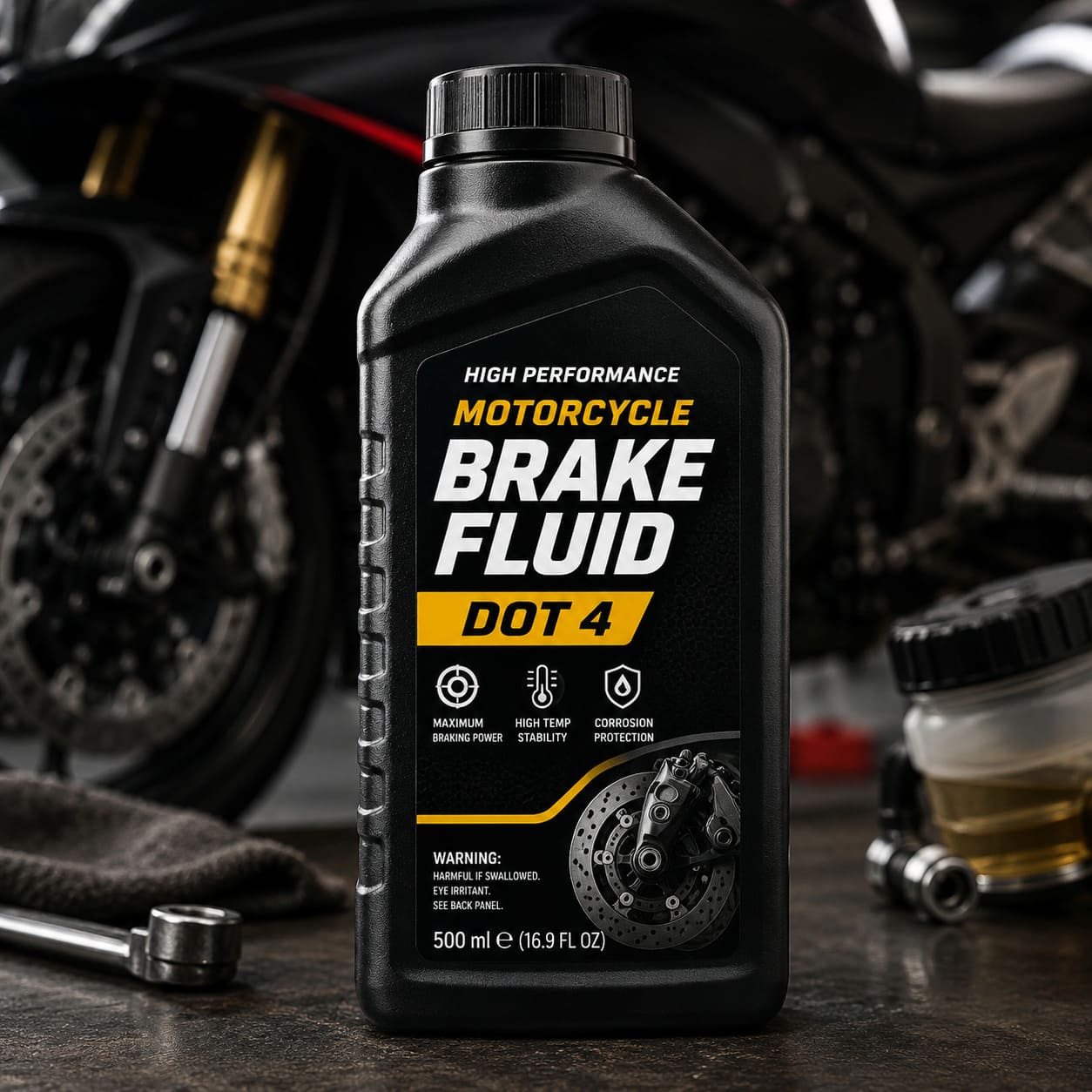
Quick answer: which grade for which bike
For most riders, the answer comes down to three categories:
| Motorcycle type | Typical grade | Notes |
|---|---|---|
| Commuter / standard motorcycles | DOT 4 | The most common factory specification |
| Sportbikes / performance bikes | DOT 5.1 | Higher boiling point resists fade under hard braking |
| Older / smaller motorcycles & scooters | DOT 3 | Older spec; DOT 4 is a safe upgrade |
| Pre-2007 Harley-Davidson (many models) | DOT 5 (silicone) | Special chemistry — never mix with glycol fluids |
This table is a general guide. The authoritative source is the brake fluid reservoir cap on your motorcycle and the owner's manual. Always use the grade your manufacturer specifies — or a higher glycol-ether grade — never a lower one.
Is motorcycle brake fluid different from car brake fluid?
No — brake fluid is not vehicle-specific. A bottle of DOT 4 is the same product whether it goes into a car, a truck, or a motorcycle. The DOT grades, the chemistry, and the standards (FMVSS 116, ISO 4925, SAE J1703) are identical across all applications.
What differs is how hard the brake fluid works. A motorcycle has unique demands:
- Smaller fluid reservoir. Less fluid volume means the fluid heats up and absorbs moisture faster relative to a car.
- Exposed location. Motorcycle master cylinders are often mounted on the handlebars, fully exposed to weather and temperature swings, accelerating moisture absorption.
- High brake loads. A sportbike's front brake does the majority of the stopping work, generating intense heat in a compact caliper.
- Direct feel. A rider feels brake-lever firmness directly — fluid that has boiled or absorbed moisture produces a spongy lever that is immediately noticeable.
So while the fluid is the same, the consequences of using old or under-specified fluid show up faster and more noticeably on a motorcycle.
The grades used on motorcycles
Three glycol-ether grades cover almost all motorcycles, plus the silicone exception:
DOT 4 — the motorcycle standard
DOT 4 is the most common factory fill for modern motorcycles. With a dry boiling point around 250 °C, it handles the braking demands of commuter bikes, tourers, and most road riding comfortably. It is fully compatible with DOT 3 and DOT 5.1.
DOT 5.1 — the performance upgrade
DOT 5.1 is the go-to upgrade for sportbikes and performance riding. Its higher boiling point (267 °C dry / 185 °C wet in Sinolook batches) gives more margin against brake fade during repeated hard braking. Because it is glycol-based, it mixes freely with DOT 4 — making it a simple, safe upgrade.
DOT 3 — older and smaller bikes
DOT 3 appears on some older motorcycles, scooters, and small-displacement bikes. It works fine where specified, and upgrading to DOT 4 is always safe if you want more thermal margin.
DOT 5 — silicone, the exception
DOT 5 silicone is used on certain motorcycles — most notably many older Harley-Davidson models. It is chemically different from all the above and must be kept completely separate. More on this below.
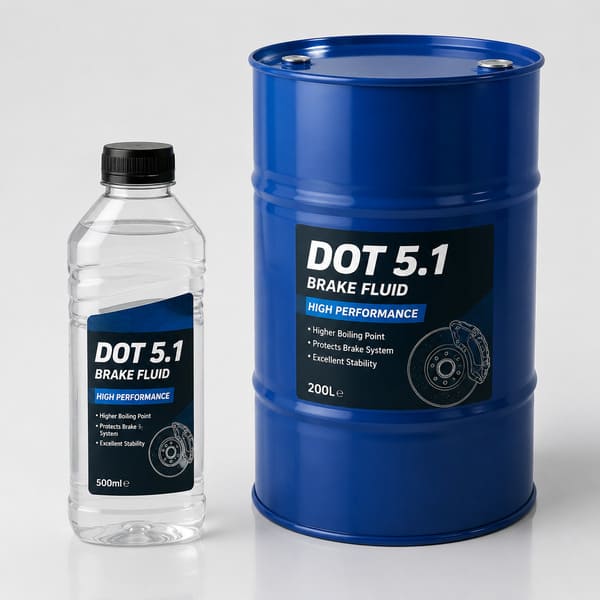
The popular upgrade for performance motorcycles — 267 °C dry, 185 °C wet ERBP. Glycol-based, fully compatible with DOT 4. View product details →
Why sportbikes use DOT 5.1
Sportbikes generate exceptional brake heat for their size. A litre-class sportbike can decelerate harder than most cars, and almost all of that braking force goes through a pair of compact front calipers. Under repeated hard braking — canyon riding, track days, aggressive street riding — the brake fluid behind those calipers can climb toward its boiling point.
This is exactly the scenario where a higher boiling point pays off. DOT 5.1's elevated wet boiling point (185 °C versus 160 °C for DOT 4) means the fluid can absorb more heat before it vaporizes and the lever goes soft. For a rider braking hard into a corner, that extra margin is a genuine safety benefit. The mechanism behind this is explained in our guide on brake fluid boiling point.
Because DOT 5.1 is glycol-ether based, upgrading a DOT 4 bike to DOT 5.1 requires no special procedure — the two are fully compatible, so you can flush and refill normally. See how to change brake fluid for the procedure.
The Harley-Davidson DOT 5 exception
Here is the one place where motorcycle brake fluid gets genuinely tricky. Many Harley-Davidson motorcycles built before approximately 2005-2007 were factory-filled with silicone DOT 5 brake fluid — not the glycol-ether DOT 5.1 that sounds almost identical.
On a Harley that specifies DOT 5 silicone, you must use silicone DOT 5 — never glycol DOT 4 or DOT 5.1. Mixing silicone with glycol fluid causes gel formation, seal damage, and brake failure. Despite the similar names, DOT 5 and DOT 5.1 are chemically opposite. Read our full DOT 5 vs DOT 5.1 guide.
Why did Harley-Davidson use silicone? DOT 5 is hydrophobic (doesn't absorb water) and paint-safe — useful qualities for cruiser motorcycles where the brake reservoir sits near painted bodywork and the bike may be stored for long periods. Newer Harley-Davidson models have largely switched to glycol-ether DOT 4, so this exception applies mainly to older bikes.
The rule: check your specific model and year. If the reservoir cap or manual says DOT 5, use silicone DOT 5. If it says DOT 4, use glycol DOT 4. Never substitute one for the other.
Sinolook manufactures the full glycol-ether range — DOT 3, DOT 4, DOT 5.1 and above — but does not produce silicone DOT 5 in standard production. For DOT 5 silicone requirements, contact our team.
How to find your bike's specified grade
There are three reliable ways to confirm the correct brake fluid for your motorcycle:
- The reservoir cap. The front brake master cylinder reservoir — usually on the right handlebar — has a cap stamped with the specified grade, such as "DOT 4" or "DOT 5.1". This is the most authoritative source.
- The owner's manual. The maintenance section lists the brake fluid specification and capacity.
- The rear brake reservoir. Don't forget the rear brake has its own reservoir, usually specifying the same grade as the front.
If you are still unsure which grade applies, or want to understand the differences between grades, our complete guide to brake fluid types walks through all of them.
How often to change motorcycle brake fluid
Motorcycles generally need more frequent brake fluid changes than cars, because of the smaller, more exposed reservoirs that absorb moisture faster:
| Riding type | Recommended interval |
|---|---|
| Standard road riding | Every 1–2 years |
| Humid / tropical climate | Annually |
| Sport / aggressive riding | Annually |
| Track days | Before every event |
Signs your motorcycle brake fluid needs changing include a spongy or inconsistent brake lever, a longer lever throw before the brakes bite, or visibly dark, dirty fluid in the reservoir sight glass. The full replacement procedure is covered in how to change brake fluid.
If your brake lever feels spongy after bleeding, or you are unsure about any part of the process, have the work done by a qualified motorcycle technician. On a motorcycle, brake failure has no margin for error.
Frequently asked questions
What brake fluid do motorcycles use?
Most modern motorcycles use DOT 4 brake fluid, while high-performance sportbikes often specify DOT 5.1 for its higher boiling point. Some older Harley-Davidson models use silicone DOT 5, which is chemically different and must never be mixed with the others. Always check the brake fluid reservoir cap on your bike for the specified grade.
Can I use car brake fluid in my motorcycle?
Yes, brake fluid is not vehicle-specific — DOT 3, DOT 4 and DOT 5.1 glycol-ether fluids are the same products whether used in a car or a motorcycle. What matters is using the grade specified on your motorcycle's reservoir cap, and always using fresh fluid from a freshly sealed bottle. The one exception is silicone DOT 5, which is only for bikes specifically designed for it.
What brake fluid does a Harley-Davidson use?
It depends on the model year. Most Harley-Davidson motorcycles built before approximately 2005-2007 use silicone DOT 5 brake fluid. Newer models have largely switched to glycol-ether DOT 4. Always check your specific model's service manual or reservoir cap — using the wrong chemistry (mixing DOT 5 silicone with DOT 4 glycol) will damage the brake system.
How often should I change motorcycle brake fluid?
Most motorcycle manufacturers recommend changing brake fluid every 1 to 2 years, regardless of mileage. Motorcycles often need more frequent changes than cars because their brake reservoirs are smaller and more exposed to heat and humidity, accelerating moisture absorption. Track riders should change fluid before every event.
Is DOT 5.1 good for motorcycles?
Yes, DOT 5.1 is an excellent choice for high-performance motorcycles and sportbikes. Its higher dry and wet boiling points (267 °C / 185 °C in Sinolook batches) resist brake fade during aggressive braking better than DOT 3 or DOT 4. It is fully compatible with DOT 4, so it can be used as a direct upgrade. Note that DOT 5.1 is glycol-based — it is NOT the same as silicone DOT 5.
Brake fluid for every motorcycle application
Sinolook manufactures the complete glycol-ether brake fluid range at our IATF 16949:2016 certified plant in Nan'an, Fujian, China — independently tested at ABIC Testing Laboratories, Inc. in the United States, and meeting ISO 4925 and FMVSS 116. For motorcycle aftermarket, OEM, or distribution supply:
- Sinolook DOT 3 — for older and smaller motorcycles
- Sinolook DOT 4 — the motorcycle standard
- Sinolook DOT 4 LV — for bikes with cornering-ABS and traction control
- Sinolook DOT 5.1 — the sportbike and performance favorite
- Sinolook Class 7 — the patented flagship for racing applications
Compliant fluids are verifiable in the AMECA database — Sinolook DOT 4 carries notification #221045. For the full range, see the brake fluid product portfolio.